- Premium Content It takes our newsroom weeks - if not months - to investigate and produce stories for our premium content. You can’t find them anywhere else.
 Jofie Yordan · · 6 min read
Why Shopee and Lazada dominate local players – but not Tokopedia
When Shopee launched in 2015, the ecommerce landscape in Southeast Asia was very different.
Lazada was the regional ecommerce leader, but each country also had strong local players – Vietnam had Tiki and Sendo and Singapore had Qoo10.
When Shopee began to overtake its competitors in 2019, though, local firms began buckling under the weight of the ecommerce giant’s scale and resources. Lazada, a regional player like Shopee, was placed second in most countries, while local players often languished in third place or beyond.
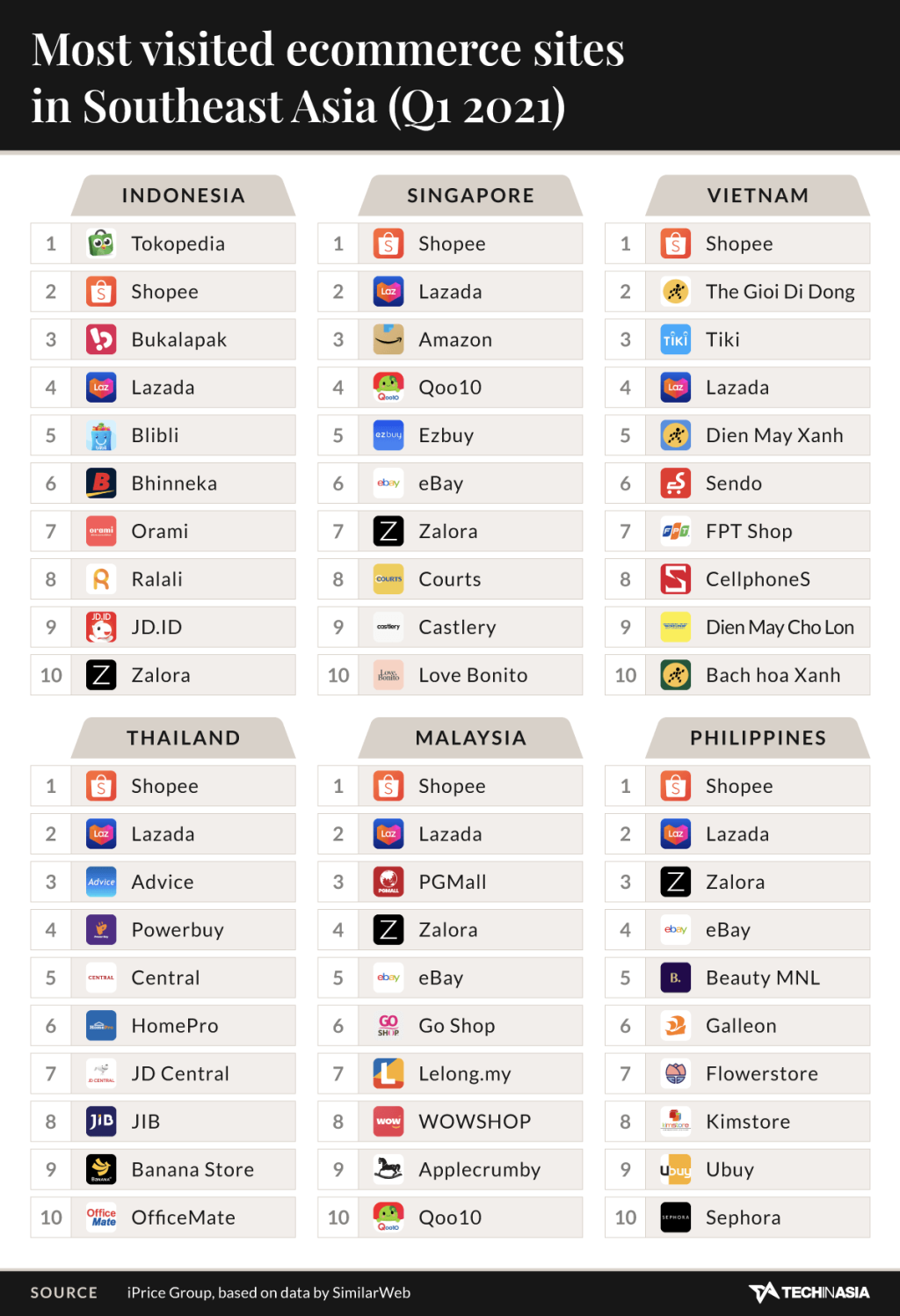
Most visited ecommerce sites in Southeast Asia / Image credit: Timmy Loen
But there is one exception: In Indonesia, homegrown unicorn Tokopedia appears to be neck and neck with Shopee as they vie for the top spot.
Based on Momentum Works’ latest report, Shopee was Indonesia’s market leader in 2020, but by a very narrow margin.
Without disclosing its methodology, Momentum Works estimated that Shopee held a 37% market share in the country, just a smidgen above Tokopedia’s 35% market share.
That said, Tokopedia remains very much in the running. It has kept Indonesia’s ecommerce battle interesting, especially with its merger with Gojek earlier this year and the joint entity’s plan for an IPO. Shopee, meanwhile, continues to broaden its scope with new services like payments, food delivery, and digital banking.
Neither of these firms can afford to rest on their laurels – with little separating the two, even small blunders can have an outsized impact. While other competitors like Bukalapak appear to be in the rearview mirror, the right strategy could make them a sudden threat.
After all, that’s exactly what Shopee did.
Enlist investors to win the war
Momentum Works’ Jianggan Li says there are several reasons why local players, which were often first-movers, have had a hard time going against regional players. One is the lack of patience: When infrastructure, consumer awareness, and supporting ecosystems are not ready, adoption for a service is often slow.
“The ensuing lack of growth might cause the management to make wrong judgments about the market potential, and investors could lose patience more quickly than they should,” Li explains. In the early days, he adds, some investors and operators who hail from traditional industries also underestimated ecommerce’s complexity.
For instance, several of Indonesia’s early ecommerce marketplaces were too focused on the business-to-consumer (B2C) model, where the marketplace buys goods wholesale and sells it to consumers. While the likes of Blibli and JD.id still use this model, their businesses are substantially smaller than Shopee or Tokopedia. Early B2C players are also less relevant now or – as in the case of Lippo Group’s MatahariMall – defunct.
The battle continues
Stay ahead in Asia’s tech landscape
This is premium content. Subscribe to read the full story.
Tokopedia has proven to be the exception to the norm. We find out why that’s the case.
We know this is not ideal. ⌛ Sign up in 20 seconds. Cancel anytime.
Our subscriber community includes professionals from these companies:





Stay updated on the go with our mobile app.
Get latest insights with smoother, more personalized experience through TIA mobile app.