Sumit Chakraberty · · 7 min read
Why on earth is a ride-hailing giant building an app store? Ola’s surprising way forward
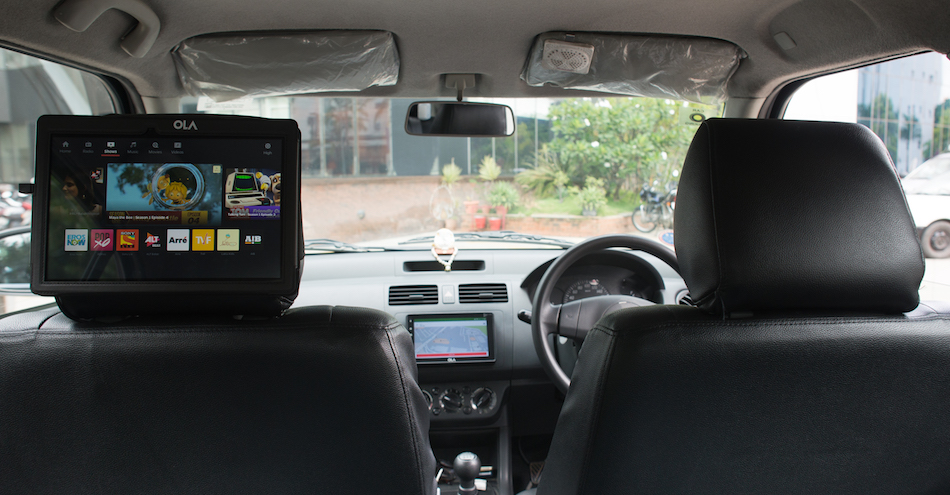
Photo credit: Ola.
Imagine getting into a cab in the morning where your Skype call and calendar are already set up in front of you. Or hailing a car at the end of a long day of work and your favorite music is playing. And the playlist depends on whether your destination is home or a bar.
The kinds of experiences you create with an app are different for a car.
These are some of the things Ola is implementing as part of a partnership with Microsoft it sealed earlier this month. The Ola Play touch console – usually fitted to the back of a front row seat, just like on a flight – lets a commuter play music and video, adjust the temperature, or use Microsoft’s Skype for Business and Office 365.
And because Ola knows it’s you, when you book the ride, all these apps and tools are already personalized when you enter the car. You could be watching a movie on Eros on your smart TV before the ride and just continue from where you left it.
But for India’s Uber rival, it’s not just about adding productivity tools to the infotainment and personalization features on Ola Play launched a year ago. It has more up its sleeve for riders and drivers as well as car makers.
Head of Ola Play Ankit Jain says Ola is building an app store, opening up the Ola Play platform for third parties to create interesting and useful experiences for riders and drivers. How about some Starbucks coffee delivered to the car on the way to a meeting? Or an app that acts as a personalized tour guide for a city you visit, recommending places to see, what to do, where to eat.
There’s even an app in the works for drivers to find the nearest public toilet – which Jain says is a pressing need they’ve identified. It also helps with the ongoing Swachh Bharat (Clean India) campaign if people don’t have to urinate on roadsides.
The Ola app store is not public yet, but partners are already developing apps for it.
But why do these apps have to be designed for Ola Play, I ask Jain. Why does Ola want a separate app store?
“I had the same debate with myself a year ago: why can’t we just pick up something that’s already built and put it in a car?” Jain smiles in response, before going on to explain why.
“Our app store is not for a mobile phone or tablet; it’s for a car, because the kinds of experiences you create are very different for a car,” he explains. “For example, if you’re building an app for a driver, you don’t want it to be very visual and distracting. It should have minimal elements and be voice-driven so that you’re not distracting someone from the core thing they’re doing, which is different from an app that you typically build for a phone where the whole intention is to engage you. Here the intention in some ways is not to engage you.”
The Ola app store is not public yet, but partners are already developing apps for it. “We’re open to having a conversation with anyone who is interested in building experiences on Ola Play,” says Jain. Current partners include Qualcomm for the hardware, and several others including Apple and Sony for music and other apps. But going forward, Ola is aiming for more apps specifically suited for in-vehicle use.
Future of mobility

Platform model
Security challenge





Stay updated on the go with our mobile app.
Get latest insights with smoother, more personalized experience through TIA mobile app.