Lokesh Choudhary · · 2 min read
Jio Financial Services’ stock price plummets on listing day
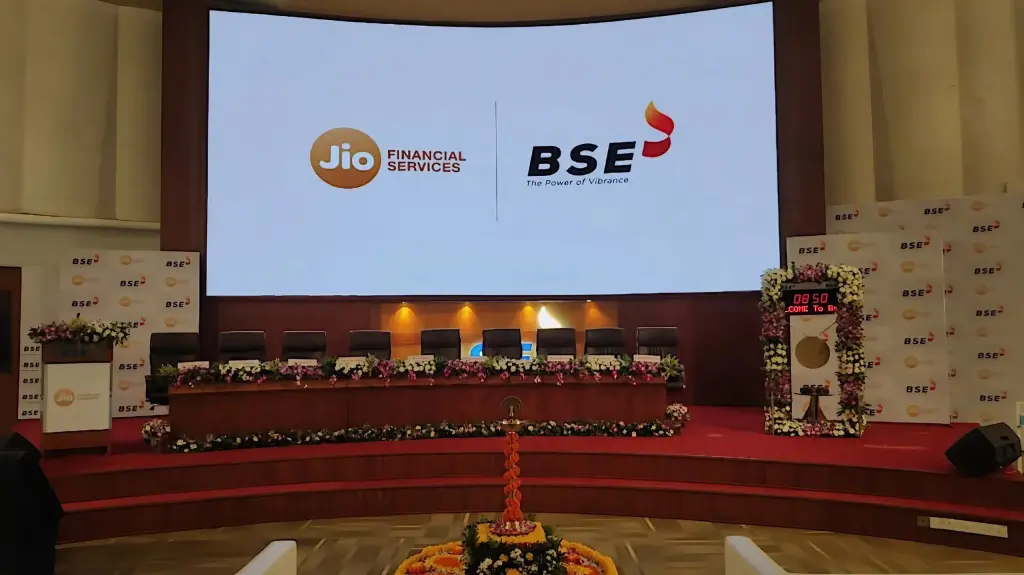
Photo credit: Bombay Stock Exchange
Yesterday, India’s Jio Financial Services (JFS) listed on the National Stock Exchange of India and Bombay Stock Exchange, a month after separating itself from parent entity Reliance Industries (RIL) and subsequently rebranding.
However, its stock price promptly dipped 5% – the maximum daily limit – on its first day of trading.
This led the company’s market capitalization to drop to 1.6 trillion rupees (US$19 billion). At the demerger, it was valued at 1.7 trillion rupees (US$20.5 billion).
That said, the event still leaves JFS as India’s third-largest non-banking financial company.
Index and mutual funds appeared to be a key reason behind the stock price’s fall. When a demerger happens to a public company in India, the resulting entity’s stock is automatically included in whichever index its parent entity is in for stability reasons.
The stock is then removed after three days, provided it has not undergone a lower circuit (5% decrease in price) or an upper circuit (5% increase in price) for two consecutive days. Should that occur, the exchange may extend the date of removal to after the stock has stabilized.
But many mutual funds decided to sell JFS stock for its first trading day, which led to the price drop. This is because these mutual funds currently hold both RIL and JFS shares, which may put them over a maximum allowable exposure limit of 10%, said Priyam Shah, an investment analyst at a Mumbai-based wealth management firm.
In the demerger, shareholders of RIL had received one share of JFS (then called Reliance Strategic Investments) for every share they held in the conglomerate.
US$19 billion valuation justified?
JFS’ information memorandum, filed with stock exchanges, provides little detail of its specific business activities. Reliance’s head honcho, billionaire Mukesh Ambani, is expected to share more in an August 28 annual general meeting.
However, the firm’s areas of business may include retail lending, merchant lending, bank operations, payments solutions, and insurance broking.
Much of the market’s expectations are based on JFS’ likely access to large amounts of data from Reliance’s businesses, which would give it an upper hand in the lending space.
Recently, global investment firm BlackRock partnered with JFS to form Jio BlackRock, with both firms investing US$150 million each into the entity. The joint venture aims to provide accessible investment products to Indian consumers.
RIL has also transferred US$1.9 billion worth of cash and liquid investments to JFS, whose liquid asset base now totals US$2.5 billion. JFS also owns a 6.1% stake in RIL.





Stay updated on the go with our mobile app.
Get latest insights with smoother, more personalized experience through TIA mobile app.