Samantha Cheh · · 7 min read
Amartha banks on grassroots strategy to drive financial inclusion

Summary:
- To create real prosperity, rural communities need financial services that match local realities like farming cycles and informal business patterns.
- Tech alone is insufficient, however, as rural areas often lack credit histories and digital infrastructure.
- This is where Amartha comes in: It uses field agents to build community trust and collect data that allows it to bring credit scoring to rural Indonesians.
- Through its comprehensive suite of solutions, the firm is focused on sustainable business growth that creates meaningful, measurable social impact.
- Learn more about Amartha and how it’s doing well by doing good.
Building financial services has always been a challenge in Indonesia, where everyday communities face an uphill battle against everything – from complex geography to fragmented internet infrastructure.
Those living in remote and rural areas have it especially tough, with adults being 10% less likely to have a bank account than their urban counterparts. It’s no surprise, as accessing even basic financial services like bank accounts can involve hours of travel on land and sea, a costly and time-consuming journey.
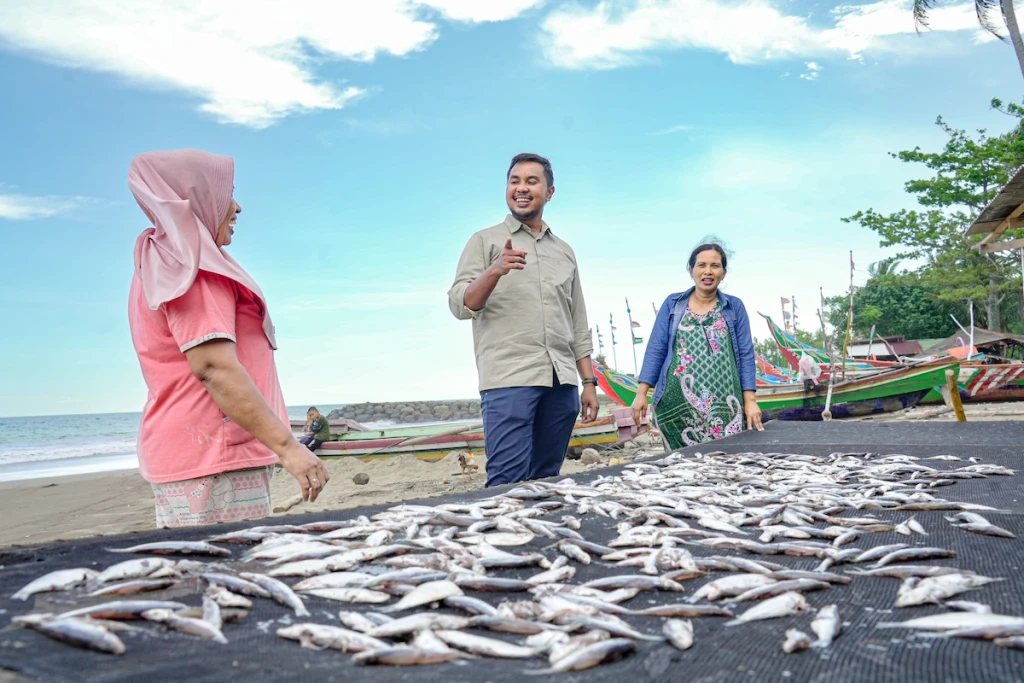
Andi Taufan Garuda Putra, founder and CEO of Amartha, with the female micro entrepreneurs that Amartha supports / Photo credit: Amartha
Andi Taufan Garuda Putra, founder and CEO of Jakarta-based fintech company Amartha, says there has been real progress in recent years to close the financial inclusion gap in the country, with the rise of digital banking platforms like e-wallets and fintech lenders, as well as national programs like Kredit Usaha Indonesia.
“Millions of people who were once invisible to the financial system now finally have a door they can knock on,” he adds.
Taufan himself founded Amartha in 2010 to provide small loans to microentrepreneurs – mainly women – in rural parts of the country.
“We began with the simple belief that by giving rural women fair and affordable access to capital, we can empower them and unlock their entrepreneurial potential,” he recalls.
However, as Amartha expanded and grew, Taufan and his team found that access alone is not enough to solve Indonesia’s financial inclusion problems.
All breadth, no depth
“Access to capital is only the first step on the ladder to prosperity, because grassroots users also need ways to better save, transact, invest, and protect themselves from shocks,” says Taufan.
He explains that, because so many financial inclusion proponents have largely focused on expanding access, the industry doesn’t have sufficient “depth” to match the lived realities of Indonesia’s rural and remote communities.
“The industry is still weak in providing emergency buffers and adaptive loan products that follow local livelihood patterns, whether that’s farming cycles, home-based industries, or informal micro businesses,” Taufan adds.
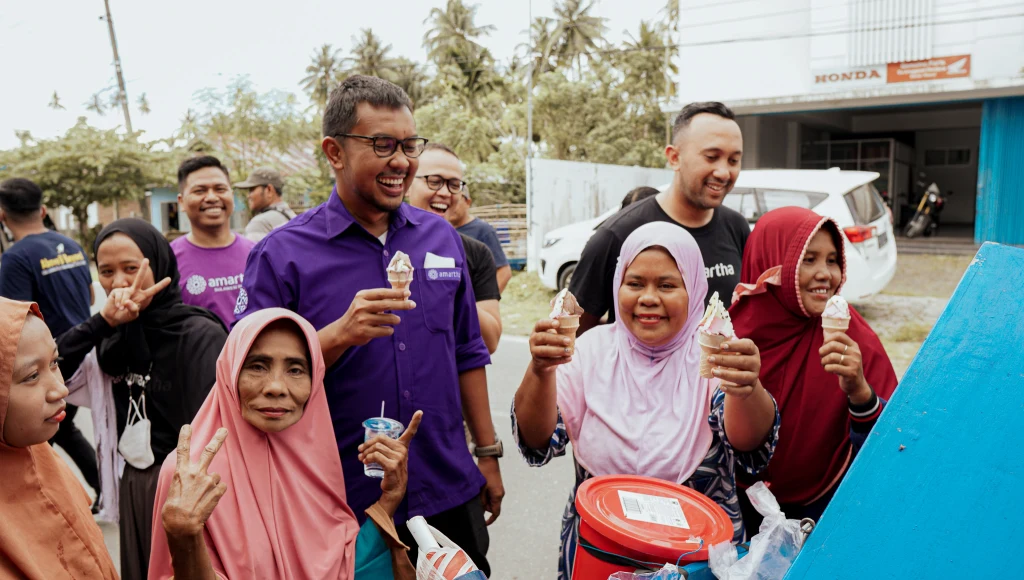
Photo credit: Amartha
He attributes this to “data fragmentation” between different sources and organizations, which makes it hard to build holistic risk profiles. This is especially apparent for grassroots and the country’s most remote communities, for whom reliable data may not even exist.
This revelation catalyzed a transformation for Amartha. The company embarked on an ambitious digitalization program in 2016 to scale and expand its services.
Amartha still provides working capital microloans for rural entrepreneurs. But its portfolio now includes a digital wallet payment solution, micro investment products starting at 10,000 rupiah (US$0.59), and zakat payment capabilities.
These products are designed to help users achieve long-term financial health. After starting businesses, they are encouraged to set aside some of the revenue as investments, allowing them to earn interest and build up their assets. Meanwhile, the digital wallet solution helps users reach wider markets and reduce the cost of physical transactions.
To address the lack of access to digital infrastructure in rural areas, the firm’s AmarthaLink Network appoints certain users to act as “hubs.” This allows local communities to access financial services such as bill payments, transfers, and top-ups.
“Our mission remains the same, but our tools have expanded,” says Taufan. “We want to catalyze the untapped economic potential in Indonesia’s villages by combining technology, human insight, and community trust.”
The human touch
Amartha has relied on a few tools in its arsenal in developing its game-changing loan solution.
First is the company’s “deep, on-the-ground” understanding of grassroots communities, carefully built by a network of more than 9,000 field agents deployed across Indonesia’s villages.
“Our field agents are able to collect rich, community-level data through direct surveys and in-person verification,” Taufan shares. This includes information on business scale and type, family and income profiles, housing conditions, and regional characteristics.
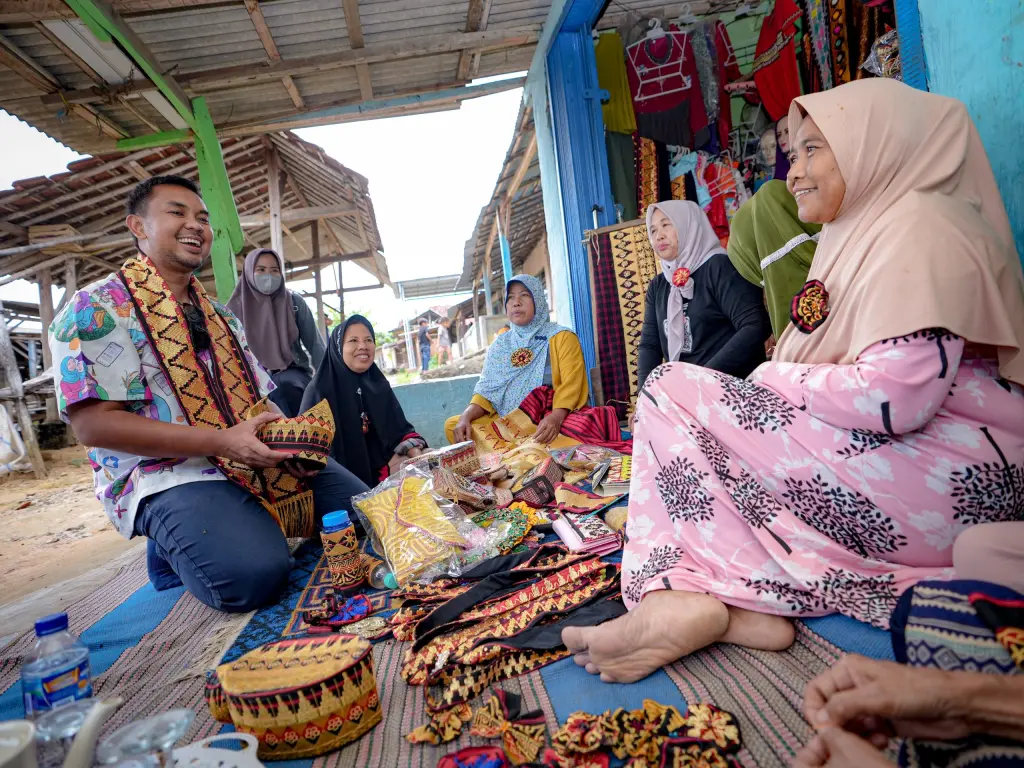
Photo credit: Amartha
Amartha feeds all this information into a proprietary adaptive credit-scoring engine, enabling it to tackle one of the biggest pain points in financial inclusion: the lack of credit history.
“With our engine, we’re able to generate highly accurate behavior-based risk profiles that we can use to design fair and accessible loan products and touch segments previously considered unscorable,” Taufan explains.
The success of Amartha’s approach comes down to its belief in blending technological capability with human sensibilities.
“For the grassroots, trust and touch are essential,” Taufan further notes. “Our field agents live and work within the communities we serve, so they’ve observed firsthand how they navigate daily challenges and make financial decisions.”
Spreading out the risk
For some investors, the biggest hurdle to backing MSMEs is that these businesses tend to be relatively risky because of their lack of financial resources and vulnerability to economic shocks. This reality tends to limit grassroots communities’ access to crucial funding.
To mitigate these risks and boost the appeal of purpose-driven investments, Amartha has designed a highly diversified portfolio to match each investor’s preferences, factoring in risk appetites alongside sector and asset interests.
Developing its Amartha Prosper solution in this way allows the company to spread out risks and maintain stability during disruptions.
“By balancing exposure across healthier regions and varied economic activities, our portfolio remains resilient while continuing to support MSMEs nationwide,” says Taufan.
Learn more about how Amartha is doing good and doing well
Supporting this portfolio is Amartha’s network of partners, which includes banks such as Standard Chartered Indonesia, as well as global organizations such as the International Finance Corporation, Swedfund, and Accion International.
Amartha also relies on AI to manage its portfolio. By analyzing community-level data, the firm’s model can provide smarter risk profiling and align investor preferences with the right MSME profiles. This ensures that capital is flowing efficiently, transparently, and sustainably to borrowers who can benefit most, according to Taufan.
“Our AI tool is also able to continuously track borrower performance across geographies and segments, helping identify both healthy and risky pockets early,” he adds.
Social impact at the core
Despite these changes at the tech level, Amartha remains focused on its north star: a commitment to building responsible solutions with long-term impact.
“For us, transparency is the foundation,” says Taufan. “We ensure every customer fully understands the benefits and risks before they sign a loan agreement.”

The Amartha team / Photo credit: Amartha
This emphasis on transparency – as well as fair pricing – is rooted in a commitment to protecting customers from over-borrowing.
Taufan adds that the company also works to ensure its products remain affordable and accessible to all Indonesians, regardless of their background.
“Responsible products build trust, which is essential when it comes to serving rural communities, many of whom are engaging with formal financial services for the first time,” he says.
Amartha’s innovative blend of tech and human connection has yielded immense results: Since its founding, the firm has disbursed over US$2 billion to more than 50,000 villages, serving more than 3.3 million MSMEs. The fintech company has also grown steadily, and it now employs 10,000 individuals.
Moving forward, Amartha will continue to work toward empowering more grassroots users and supporting the ongoing digitalization of Indonesia’s rural economy.
As part of these efforts, the firm will hold the third Asia Grassroots Forum in May. The goal is to highlight key challenges and opportunities in building grassroots economic development for the whole region.
This major event will offer a crucial platform for collaboration on a range of issues, including community health and financial progress.
“We believe that real inclusive growth begins at the grassroots and when rural families thrive, so does the broader economy,” says Taufan. “Helping microentrepreneurs creates local jobs, supports families’ well-being, and contributes to more resilient village economies.”
“We prove that it’s possible to do well and do good: Sustainable business growth can create meaningful, measurable social impact,” he adds.
Amartha provides digital financial services to grassroots communities all across Indonesia, especially those in rural and remote areas. Its full-stack digital-first platform utilizes 15 years of community-level data – built by humans, for humans – to expand access to high-quality and adaptive loan products that build grassroots resilience.
Learn more about Amartha’s work and the 2026 Asia Grassroots Forum.
This content was produced by Tech in Asia Studios, which connects brands with Asia’s tech community. Learn more about partnering with Tech in Asia Studios.
Stay updated on the go with our mobile app.
Get latest insights with smoother, more personalized experience through TIA mobile app.
Recommended reads
 How Europe wins the AI race in SAP CEO’s view
 Making carbon emissions data auditable for financial regulators
 Making mandatory e-invoicing simple for Vietnam’s SMEs
 This startup is building legal infra for India’s broken traffic system
 Can Southeast Asia build fast enough for the AI era?
 This system is tackling Indonesia’s $422m payment fraud
 How AI is breaking SaaS where trust matters most
 Singapore wants to be an AI superpower. Will it work?
 Why defense tech isn’t a typical startup game
 ‘A thirty second job’: how AI replaces the family office analyst





Editing by Stefanie Yeo, Winston Zhang, and Mina Deocareza
(And yes, we’re serious about ethics and transparency. More information here.)