- Premium Content It takes our newsroom weeks - if not months - to investigate and produce stories for our premium content. You can’t find them anywhere else.
 Elyssa Lopez · · 7 min read
AI’s future could be brain cells in a dish, not silicon chips
Picture this: It’s the year 2050, and AI systems are an ubiquitous part of daily life. But instead of being powered by energy-intensive silicon chips, they run on lab-grown brain cells in a dish.
Does that scenario sound too sci-fi? Turns out, it may no longer be so fictional.
In 2023, Australia-based Cortical Labs went viral after unveiling its DishBrain experiment, which involved setting human and mouse brain cells in a mitroelectrode array – a small enclosed grid that can detect electric activity between cells – and training them how to play Pong.
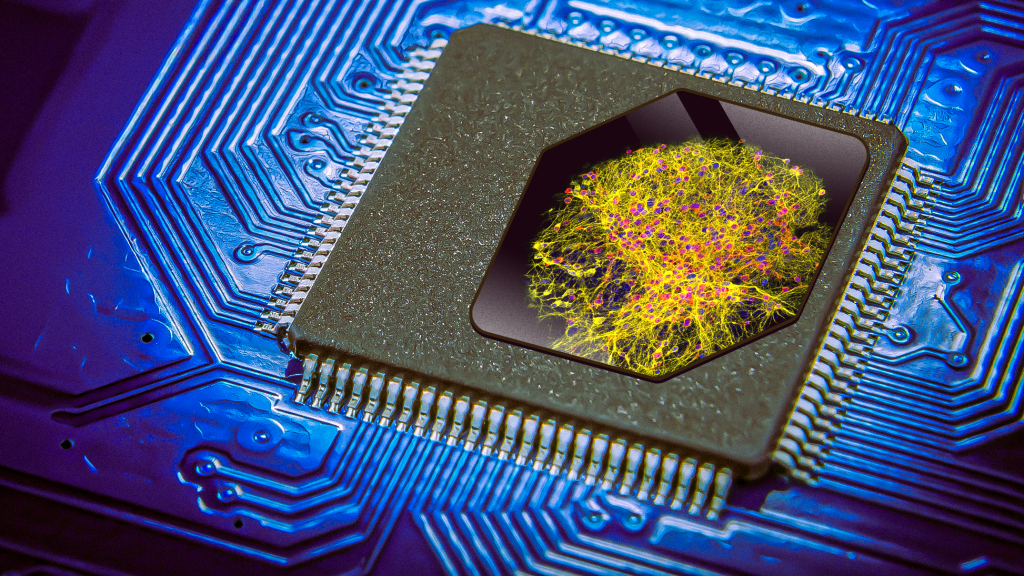
Both Cortical Labs and FinalSpark envision a future where brain organoids run AI systems instead of silicon chips. / Photo credit: Timmy Loen
Considered by many as one of the world’s first video games, Pong simulates table tennis or ping pong. But instead of rackets, players use a visual paddle to hit the ball. For many experts, that in vitro brain cells – meaning they are grown outside of a living body or organism – can learn how to play the game is such a feat.
Writing in Nature Machine Intelligence journal, some scientists noted how the experiment “opened the door to biological AI.” After all, the AI systems we know today were trained to mimic how the human brain processes information.
The experiment showed that a neural organoid – lab-grown tissues that replicate the structure and function of the human brain – can be trained to perform goal-oriented tasks. And Cortical Labs wants to give companies the ability to do just that.
In February, Cortical Labs launched CL1, a device that allows users to do a DishBrain experiment on their own.
According to co-founder and CEO Hon Weng Chong, a wide range of companies could benefit from the product, which Cortical Labs claims is the world’s first “biological computer.” Pharmaceutical firms, for example, could use CL1 for drug testing while biotech companies could harness it for neuroscience research.
But there’s a hitch: CL1 is basically a small laboratory. Depending on who you ask, it is either a piece of revolutionary technology or a costly device for scientific experiments.
Replace silicon chips? Not yet
The CL1, which looks like a slightly smaller toaster oven measuring 22 inches long and 5 inches high, will be sold for US$35,000 before the end of this year.
Anyone who has access to a science lab equipped to grow brain cell cultures can use the device to stimulate them, study their reactions, and train them to act in a certain way – similar to how Cortical Labs conducted its DishBrain experiment.
Chong tells Tech in Asia that CL1 would allow researchers to observe brain neurons and do something previously impossible on a single device: input information into the cells.
He compared earlier devices used for such experiments to a tablet computer – great as a visual medium, but not ideal for typing large documents since it lacks a keyboard.
Wetware as a service
Long journey to commercial viability
Stay ahead in Asia’s tech landscape
This is premium content. Subscribe to read the full story.
Australia’s Cortical Labs and Switzerland’s FinalSpark are working on tech that harnesses lab-grown brain cells to power energy-efficient AI systems.
We know this is not ideal. ⌛ Sign up in 20 seconds. Cancel anytime.
Our subscriber community includes professionals from these companies:





Stay updated on the go with our mobile app.
Get latest insights with smoother, more personalized experience through TIA mobile app.











📅 Upcoming Events
22 October 2026
Payoneer x CSPN Summit 2026