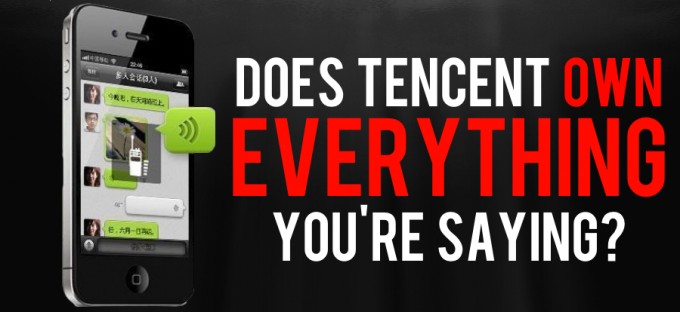
It’s an issue that seems to pop up for every developing social platform that doesn’t spell things out clearly at first: who owns all the content that’s posted to the platform? That’s a question that Chinese WeChat users — especially users of WeChat Open Platform — have been asking since last week, when Open Platform user Wu Hanqing posted on Sina Weibo about the following clause he’d discovered in WeChat Open Platform’s user agreement (our translation):
The intellectual property rights for the content provided by Tencent on this platform (including but not limited to websites, text, images, audio, video, charts, etc.) belong to Tencent in their entirety, but users of this platform already have an exception to [this] IP law prior to posting their content.
If you didn’t completely follow that, well, neither did anyone else. It sounds a bit like Tencent is saying that it owns all content posted to WeChat Open Platform, but that content creators have an exception that allows them to use the content they create, too. It’s vaguely-worded enough that even in the original Chinese, people have had trouble figuring out what it means. “Does this imply the IP rights of the things I’ve written all ultimately belong to Tencent?” asked Wu. “I naively thought the content I was working so hard to write belonged to me!”
Surprisingly, Tencent doesn’t seem able to offer a clear answer either. An IT Times reporter contacted the company for clarification, and was told (this quote is from the article, not necessarily a direct quote of what the Tencent representative said):
The clause primarily concerns the intellectual property that Tencent provides as [the operator of] the platform. As to users’ legal rights to the intellectual property of their content, Tencent protects its legal rights.
Obviously, this doesn’t really clear up the question of who ultimately owns WeChat content. We’ve contacted Tencent for clarification as well, and will update this story when we hear back, but we also thought it might be prudent to check the terms and conditions for WeChat globally. These may differ from the terms users of the app must agree to in China, but the global terms don’t seem to address the question of who owns the content users create and transmit through WeChat one way or the other. Hmm.
The one thing that is clear is that users overwhelmingly (and unsurprisingly) think they should own the rights to the content they create. In a poll conducted on TechWeb, more than 80 percent of respondents said users should own their own WeChat content, and only 6 percent feel the content should belong to Tencent.
China tech watchers may recall a similar debate about Sina Weibo unfolding after a magazine stole a writer’s weibo posts and republished them without permission. That scuffle went all the way to the courts, but ultimately led to the decision that Weibo posts are the sole property of their creator.
And ultimately, the law may decide who owns WeChat content too, at least in China. Legal experts contacted by the IT Times suggested that under Chinese law, the clause in question might well be considered unreasonable and thus unenforceable, even though users have agreed to those terms. With that said, no one has actually taken this to court yet, so there’s no way to be sure how a judge would rule.
It’s also not clear how international users fit in. Tech in Asia has its own WeChat account; does the content we post there now belong to Tencent? I’m genuinely not sure, but I can tell you for certain that if it does we’re not going to be posting there much longer, and thats why I suspect that whatever Tencent originally intended, it will soon come out and say that all content posted to WeChat by users belongs to the user who posted it. To do anything less would be to sentence its own monetization plans to an early death. After all, who the hell is going to post news or games on the platform if that means sacrificing exclusive IP ownership rights? Absolutely no one.
(IT Times via TechWeb)





Stay updated on the go with our mobile app.
Get latest insights with smoother, more personalized experience through TIA mobile app.