Nadine Freischlad · · 3 min read
Blossom offers Islamic micro-financing in Indonesia using Bitcoin
 A startup that recently relocated from San Francisco to Jakarta aims to shake up micro-finance in Indonesia. Blossom‘s concept can be said to be breaking ground: it operates on Bitcoin and targets the global Muslim community.
Here is how Blossom works, in a nutshell: it collects money from investors around the globe, keen on lending money to entrepreneurs who are ready to start a small business, say a food stall or tailor. Blossom does not hand down the funds to business owners directly, but via an experienced microfinance institution on the ground. After a 12-month investment cycle, Blossom collects profits from the microfinance institutions and distributes them back to the investors. Blossom expects returns in the range of 7.5 to 12.5 percent, and itself takes a 20 percent cut on the returns.
No margin trading, no alcohol, no interest
Blossom has two key features that set it apart from other micro-financing schemes. First, all of its money transfers are based on Bitcoin. Using Bitcoin, says founder Matthew Joseph Martin, has obvious advantages. Fees for international transfers are lower, and all Bitcoin transfers can be monitored in real-time via the Bitcoin Blockchain. This creates transparency and trust between investors and the fund recipients. “In conventional investment, I have to rely on the statements and numbers publicised by my partners. With Bitcoin, it’s clear to everyone what’s going on,” explains Martin.
However, that Blossom runs on Bitcoin is not necessarily visible to investors, since Martin chooses not to mention Bitcoin in the company’s communication. Martin prefers to not make Bitcoin itself the topic of conversation, but the benefits it brings to investments, namely transparency and low cost. Investors and recipients do not have to handle Bitcoin themselves, as the Bitcoin-based funds are converted to local currency at the time of pay outs.
Second, Blossom chooses its investors and microfinance institution partners based on Islamic principles. This means it won’t take capital investment that is derived, for instance, from margin trading or alcohol, both of which are prohibited under Sharia law. And Blossom will only give out money to microfinance institutions which operate on a profit-and-loss sharing principle called Musharakah instead of interest-bearing loans. This way, Blossom positions itself as a micro-financing platform for the global Muslim community.
Martin’s interest in Bitcoin comes from his past experience working at several financial tech startups including Xoom and Boku. His background is in engineering and product development. He became a Muslim in 2010, and thus developed an interest in Islamic finance.
Moving to Indonesia to tap the world’s largest Muslim market
Martin initially founded his company in San Francisco but soon found the market potential there to be too small for his idea, which is why he chose to take his company to the world’s largest Muslim market: Indonesia.
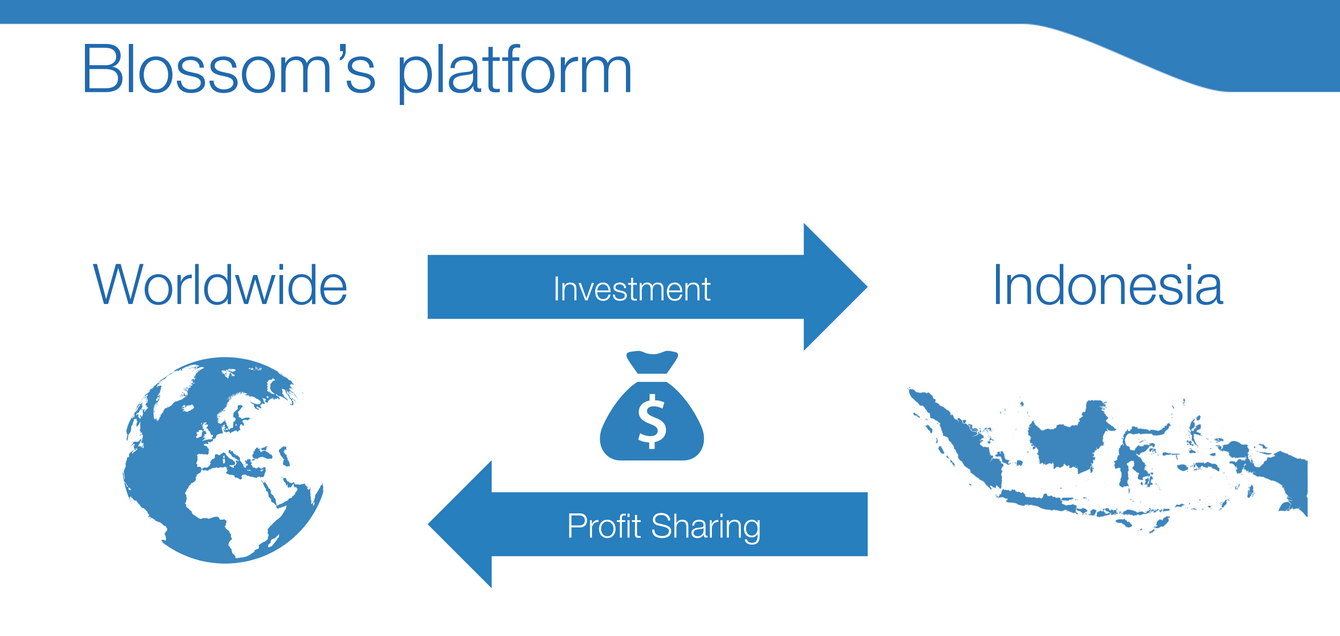
The potential for Islamic microfinance in the country is tremendous, according to Martin. He wants to focus investments entirely on Indonesia for now, where some 80 percent of the population aged 15 years or older does not own a bank account, and almost 90 percent of the population is Muslim. Investors can come from anywhere. Blossom is getting ready for its first investment to an established microfinance institution in Indonesia, but says details will not be made public until May 15.
Martin may be new to Indonesia, but he has partnered up with Ahmad Hermanto as regional manager, who has twelve years of experience in microfinance in Indonesia, and has worked for Bank Mandiri, Care, and HiVos. Blossom also claims to have an international advisory board including former CEO of Flickr, Dave Bagshaw, and Tim Draper of DFJ Ventures.
Editing by Michael Tegos and Paul Bischoff, image from Danumurthi Mahendra





Stay updated on the go with our mobile app.
Get latest insights with smoother, more personalized experience through TIA mobile app.