Disclosure: Rui Ma owns a few bitcoins.
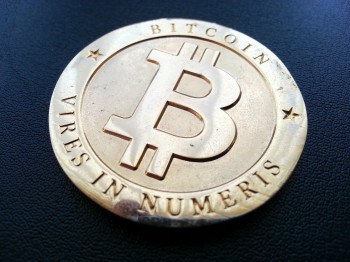 On a chilly November evening, on the usually neglected third floor of a popular expat hangout called the Boxing Cat Brewery, a group of geeks gathered in the name of a Bitcoin Startup Mixer to enthuse over the digital cryptocurrency known as Bitcoin. As organizers, we had expected a turnout of about 40, but by 7:45 pm (45 minutes after the official start time), 96 people had arrived, standing shoulder to shoulder, resembling the Shanghai People’s Square subway exchange at rush hour.
The audience was surprisingly diverse, with perhaps one-third of attendees being expatriates and two-thirds local Chinese. A quick survey revealed that most were in their 30s, but a handful were in their 20s, and one in this 50s. The only uniformity was that 95 percent of the attendees were male – only a few females dotted the sea of bespectacled faces.
Among the 96 folks in attendance, we had the CEO or co-founders of five Bitcoin startups, including BTC China and OK Coin (the two largest China exchanges), itBit (a recently launched, venture-backed exchange based in Singapore), BTC Jam (a Bitcoin P2P lending site started in Brazil), and a representative of the Bitcoin Foundation.
However, these people are already well-known, and there are already numerous stories that broadly describe the Bitcoin community in China. We wanted to talk to real local investors and enthusiasts who are driving the Bitcoin market in China into the spotlight. Luckily for us this past Monday evening, some of the most notable members of the local Chinese Bitcoin community were also in attendance, many of whom are clustered around the Jiangzhehu (Shanghai and the bordering Zhejiang and Jiangsu provinces) region. They included some of the earliest and most hardcore adopters of Bitcoin in China, many of whom are worshipped on local forums and information sites such as btc123 or 8btc by more recent fans of the currency.
Who’s who of China’s Bitcoin community
 For those who are unfamiliar with the Bitcoin community in China, first things first. The most influential advocate of Bitcoin in China is Xiaolai Li (pictured right), a former teacher at New Oriental (NYSE: EDU), the most famous English-language institute in China and publicly listed with a multi-billion dollar market capitalization. Xiaolai was an active investor in educational enterprises before becoming a serious Bitcoin advocate and entrepreneur in 2011. Rarely without his cigarettes, he can be often found in one of the geeky hangouts in Beijing’s high-tech cluster, Zhongguancun, where he is working on more than a few Bitcoin-related projects of his own.
While Xiaolai believes in the long-term viability of Bitcoin as a currency, he is also practical. He notes that most Chinese Bitcoin investors are opportunistic businessmen, drawn in by the prospect of sharp, short-term investment gains. They lack knowledge, or simply may not even care about, the fundamental characteristics or ideals of Bitcoin. In his latest post on the popular Bitcointalk forums, he warns heavily against those who are trying to trade quickly in and out of Bitcoin to take advantage of the volatility in price, staying consistent with his long-held views that buying and holding Bitcoins is the only path to long-term wealth and value.
This sentiment was echoed by a group of Bitcoiners who, by their own judgment, are the second-most influential group in China (We corroborated their reputation with the other Bitcoin enthusiasts in attendance, who are in general agreement on the identities of top influencers of China’s cryptocurrency world).
On a miserably cold outdoor patio in downtown Shanghai, we interviewed five core members of this shadowy group that in total consists of roughly 20 people, mostly based in the aforementioned Jiangzhehu region. They refer to each other by their “Bitcoin identities” and not their real names, which seemed to also double as their nicknames on Bitcoin forums. They were named after vegetation, pastries, animals, you-name-it, and one was obviously a reference to his hefty body size. Names that if translated would be something akin to Bitcabbage, Bitdog, and yes, Bitfatty. They asked us not to disclose their names in full, and so we will refer to them by their first initials.
S, whose name is inspired by plants, is clearly the ringleader, although also the newest of the group to become acquainted with Bitcoin – only as of April this year. He notes in between cigarettes that the group believes virtual currencies will be a mainstream source of wealth and financial products for those in China born after 1980, commonly referred to as the post-80s generation. It is not hard to understand why he thinks this way; even the most optimistic of Chinese do not think the phenomenal economic boom of the past 30 years will continue in perpetuity. Most acknowledge that the next stage of wealth creation will be significantly slower and will come from very different avenues.
G, who is named after a pastry, is older and more measured in his pronouncements. When asked to describe the current Bitcoin community in China, he answered simply – there are really three fairly distinct and separate groups who generally stay out of each others’ way. The first group consists of the earliest adopters. While tech sites such as Netease Tech began reporting Bitcoin news as early as 2009, and there was a slew of coverage by finance sites in 2011, the early adopters didn’t start buying in on a large scale until 2011. Most of those early adopters had a multidisciplinary background, typically a combination of finance and IT, and were thus able to understand the immensity of the opportunity earlier than nearly everyone else.
G estimates that this early group consists of only around 50 or so people, and they bought in at such a low price in the first quarter of 2011 when prices where less than $2 per bitcoin), that most are now likely quite wealthy. Some of these people have effectively retired, he says, and he nonchalantly mentions that “a few people have since then traveled the world, and are probably contemplating which islands to buy.” The remaining few, like Xiaolai, are devoting their lives and careers to furthering the adoption of Bitcoin. Most, however, have taken a hands-off approach and prefer to remain in the shadows.
Concurrently, a second and much larger group of people also got involved in Bitcoin in early 2011: these were the first Chinese Bitcoin miners. Miners were mostly composed of hardware engineers and other IT geeks who learned of Bitcoin through tech blogs. These folks, G estimates, number in the tens of thousands in China. Y, an early miner who is often cited as the second most influential person in Bitcoin in China after Xiaolai, hurries to agree. He heads up a series of QQ groups that are about 9,000 strong. There are, he estimates, at least a few other communities of similar size. Due to the inherent costs related to mining, however, most of these miners are not necessarily the largest holders of bitcoins, as they would have had to periodically sell a portion of their holdings to support operating costs.
Gold diggers come forth





Stay updated on the go with our mobile app.
Get latest insights with smoother, more personalized experience through TIA mobile app.