
Luzhou, China. Photo credit: Mingwei Li / Unsplash.
In a small, bright office filled with books, Huamin Qu gives me a bird’s-eye view of WeChat, arguably China’s most influential app. His screen shows a red pinwheel of nodes that map how content is shared throughout the enormous social network of almost a billion users.
Called WeSeer, the internal tool is the ultimate gauge of China’s netizen hivemind: it can predict which articles will go viral in the next hour, pinpoint key accounts driving the spread of information, and identify stories of interest for different communities, whether it’s locals in Beijing or people who love AI.
It’s an advertiser’s wet dream – or a powerful tool for information control.
“It’s a double-edged sword,” says Qu, a professor of computer science at Hong Kong University of Science and Technology (HKUST), which opened a joint artificial intelligence lab with WeChat in 2015. Big data analytics can be used to capture criminals, but it can also target other groups of people, he says.
“We are more working on the technical side,” he emphasizes.
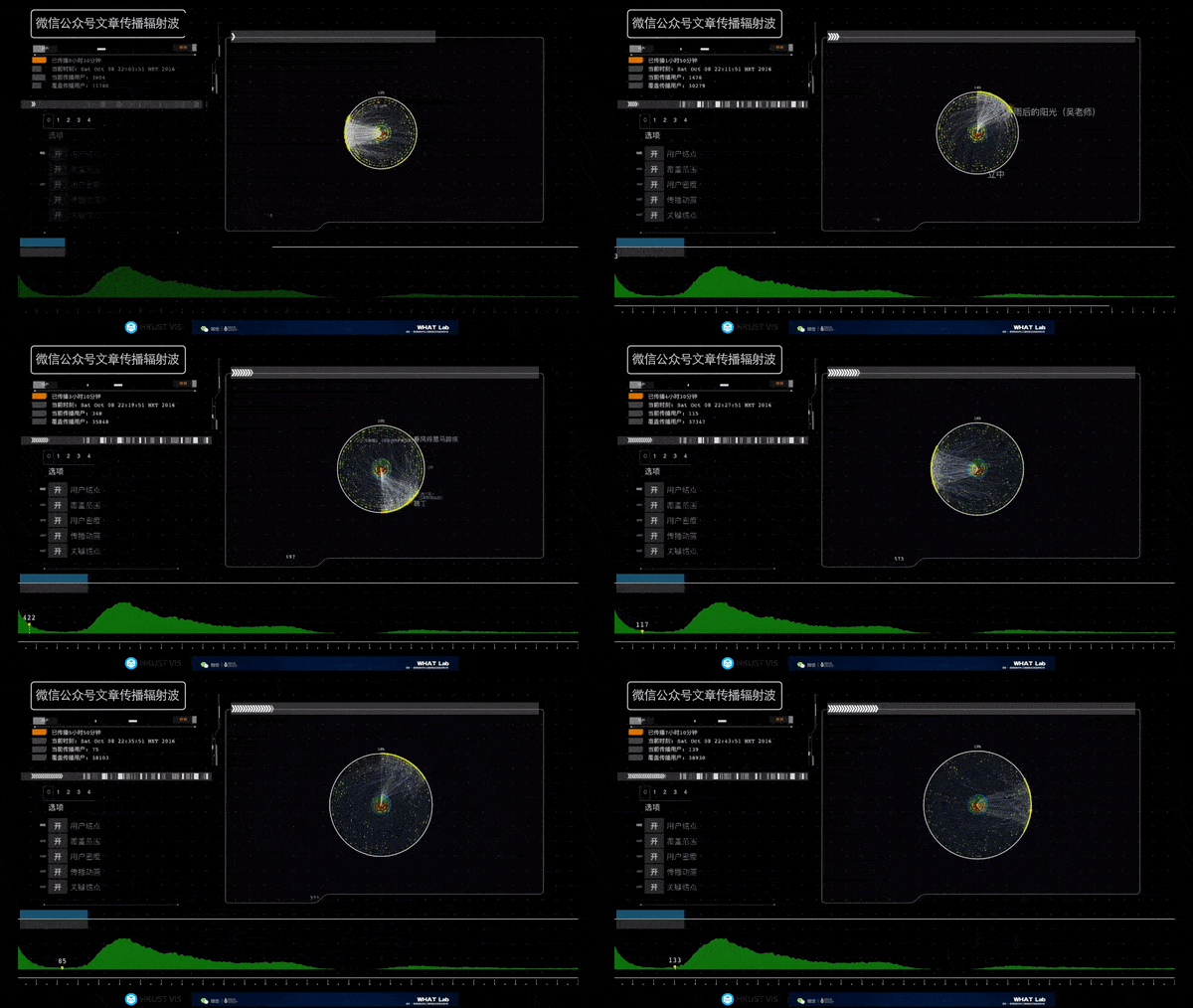
A demo video of WeSeer shows how an article spreads through WeChat over time. Image credit: WeChat-HKUST Joint Lab on Artificial Intelligence Technology.
Fake news is the new scourge of the modern world. As people increasingly turn to online platforms to understand the world, fake news has the power to sow doubt almost anywhere, as evidenced by how it disrupted the recent democratic elections in the US. At the center of it all is Facebook, whose platform encompasses a user base of roughly 2 billion monthly active users – larger than the population of any single nation.
But while the Silicon Valley juggernaut has sought to distance itself from the fake news epidemic, Chinese tech firms are taking it head on. In China, there are no debates around the role that companies play in deciding what the public sees. The Great Firewall, which blocks thousands of sites like Facebook and The New York Times, might keep information from the outside world from filtering in, but domestically, the government expects tech giants to take responsibility.
Tech companies must balance the cost of censorship with running a business.
For online content platforms, blocking keywords and taking down ‘illegal content’ – which can range from celebrity gossip to sensitive political topics – is par for the course. The more influential the company, the more culpable they are.
“Effectively, the government authorities are pushing responsibility for content control and other types of information control down to the companies, who then also offload that to users in some sense,” says Masashi Crete-Nishihata, research manager at The Citizen Lab, a research lab at the University of Toronto that has conducted numerous studies on online censorship in China.
“For the companies, they’re trying to balance keeping their business active, keeping users interested in the platform, having a good user experience, and of course, doing all that while staying within the line set by the government,” he adds.
Wrangling fake news
Cost center





Stay updated on the go with our mobile app.
Get latest insights with smoother, more personalized experience through TIA mobile app.









📅 Upcoming Events
22 October 2026
Payoneer x CSPN Summit 2026