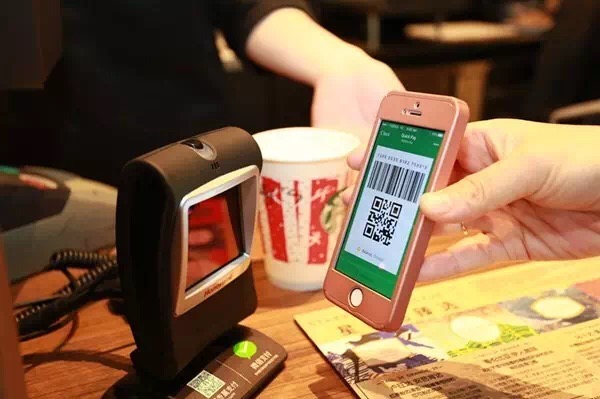
Paying for Starbucks coffee. Photo credit: Tencent.
In China, tech giants tend to delineate their influence around certain industries – Alibaba has made ecommerce its calling, while Tencent owns social and gaming. But as their empires continue to expand, overlap is inevitable.
Mobile payments is one of those areas of contention. It’s a lucrative and high-growth market, growing more than 200 percent year-on-year during the fourth quarter of 2016, when it hit US$186 billion. Mobile payments are also a key access point to consumer data, especially in China, where more than half of online sales happen through a smartphone.
Ant Financial, Alibaba’s financial affiliate, has long dominated the market with Alipay, its mobile wallet. Launched in 2009 as one of the earliest mobile payments solutions, Alipay owned about 80 percent of the market for five quarters straight, starting in the third quarter of 2013. But that stronghold is slowly slipping.
WeChat Pay has become Alipay’s biggest competitor.
“Because of WeChat’s traffic and social advantage, in these past two years, WeChat Pay has become Alipay’s biggest competitor,” Wang Pengbo, finance analyst at research firm Analysys, tells Tech in Asia. WeChat Pay, which launched in 2013, is the mobile wallet inside Chinese social messaging app WeChat.
Last month, Analysys published a report on China’s mobile payment market for the fourth quarter of 2016. Alipay had a market share of 54.7 percent; Tenpay – which includes WeChat Pay – came in second with about 37 percent. And while Alipay saw higher transaction amounts – influencing its overall market share – Tenpay had almost double the number of active users.
So how did WeChat Pay catch up? By doubling down on two key areas: social payments and offline retail.
Step one: red packets

Exchanging red packets stuffed with cash is a tradition during Chinese New Year. Photo credit: razihusin / 123RF.
If ecommerce is the backbone of Alipay, social interactions are the driving force behind payments on WeChat.
In particular, WeChat Pay has capitalized on China’s tradition of gifting cash-filled red packets with tremendous success. After debuting its own virtual red packet, which lets users send up to US$29 to fellow WeChat friends, the mobile app saw around 16 million red packets exchanged during Chinese New Year’s Eve in 2014, according to Tencent. A year later, that number jumped to 1 billion.
“WeChat Red Packets originates from one of Tencent’s company customs and broader Cantonese tradition that every manager in the company gives each employee a red packet with a small cash gift on the first work day after the Chinese New Year holiday,” wrote Y Combinator in a blog post last week about WeChat, written in partnership with China Tech Insights, one of Tencent’s internal research teams.
“As the company expanded, it became exhausting for some managers to give out so many Red Packets, so they asked for technical solution to solve the issue – they had no idea that the result would become the prototype of WeChat Red Packet.”
Step two: connect the dots
Step three: expand offline
Victory uncertain





Stay updated on the go with our mobile app.
Get latest insights with smoother, more personalized experience through TIA mobile app.











📅 Upcoming Events
22 October 2026
Payoneer x CSPN Summit 2026