Jum Balea · · 5 min read
After making waves at protests, FireChat wants to help save lives during disasters
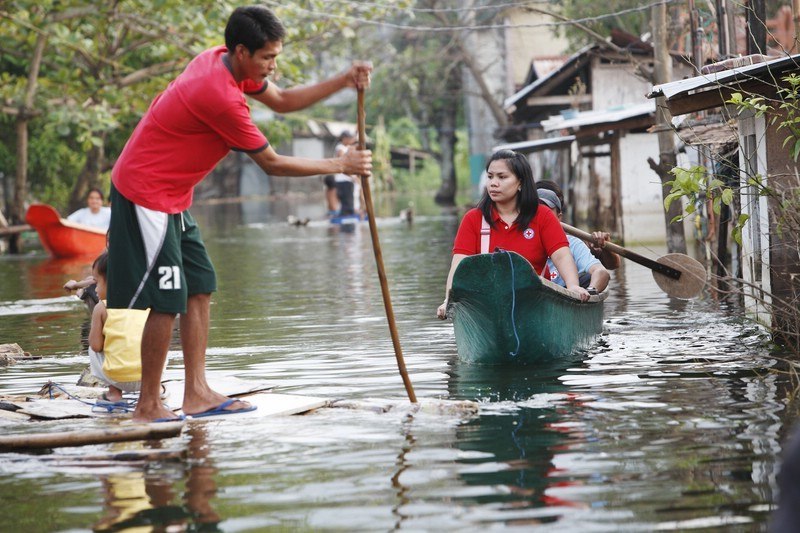
Calamba city, Laguna province, the Philippines. October 2009 (Image by International Federation of Red Cross and Red Crescent Societies)
We’ve all experienced it: that time when you so badly needed to send a message to someone but you couldn’t get a signal and there was no internet connection either.
FireChat by San Francisco-based startup Open Garden is a solution that’s gonna boggle your mind.
The app allows its users to communicate with each other without being connected to the internet or in the absence of a cellular network. It made headlines around the world last year when it was used as a chatroom during protests. Last month, it launched an update, allowing private messaging off the grid.
How, you ask? By creating a mesh network using phones’ Bluetooth or wifi. This means two devices with FireChat installed can send messages to each other across a distance of 210 feet.
But if more devices are connected, the range increases in a sort of a daisy chain – messages hop from one device to another until they reach you. “In the case of private messages, only the sender and receiver can see the messages since they are encrypted end-to-end. The devices between the endpoints act as ‘blind postmen,’” explains FireChat’s Marina Azcarate.
So in a city, Marina estimates a message would take an average of 10 minutes to travel from any point assuming that 5 percent of the population has the app installed.
For those who still can’t grasp the concept, the app is useful on airplane or subway rides, or in situations where it’s necessary to cut off the signal like when a high-level global official visits your area.
It could be used in festivals or civic events, where networks get bogged down by heavy traffic. Remember the “Occupy Central” protests in Hong Kong? Demonstrators thought the Hong Kong government would shut down the internet so they downloaded the app. Though this never happened, the app proved to be a big help when networks got congested. It was the same story for the “Sunflower Movement” in Taiwan.
While the app has become a popular tool in protests, in developing countries like the Philippines, it wants to serve another purpose. It wants to help people during disasters and save lives.
Disaster recovery and preparedness
Each year, the Philippines is hit by an average of 20 typhoons, which are named according to the local alphabet, starting from A and ending at Y.

(Image by Edward Allen Lim)
In 2013, so many typhoons came that the government ran out of letters to name them, and had to start at A again. That same year, Super Typhoon Yolanda – known as Haiyan internationally – one of the strongest ever recorded on land, tore through a large portion of the Philippines, leaving thousands of people dead or missing.
New gadget





Stay updated on the go with our mobile app.
Get latest insights with smoother, more personalized experience through TIA mobile app.