 Tay Tian Wen · · 4 min read
The key players in Southeast Asia’s online grocery market
Charts and visuals, only for subscribers
This is the latest version of the article that was published on Feb 2, 2021. We’ve added more data and visuals.
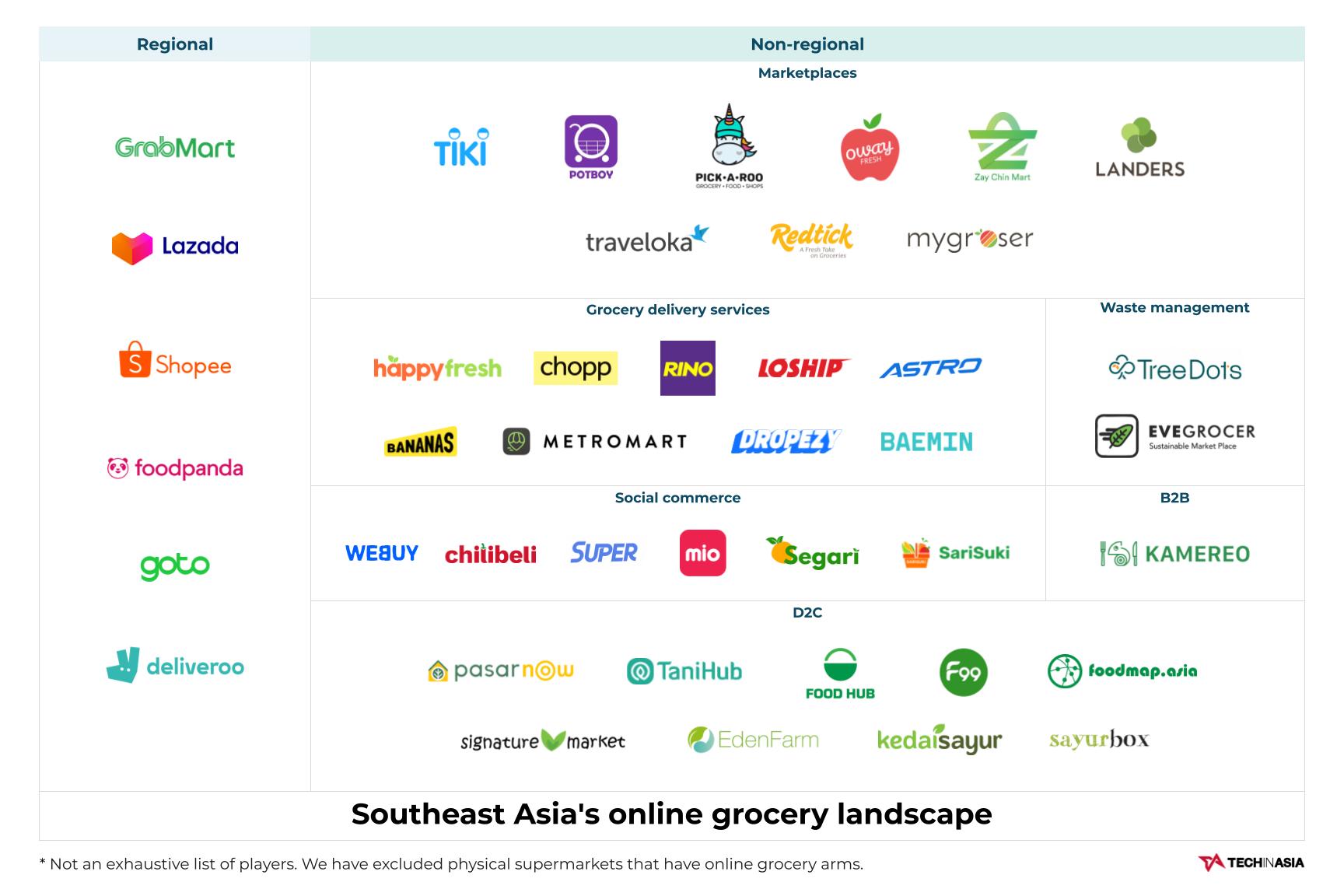
Southeast Asia’s online grocery space has been heating up since the global pandemic paralyzed many parts of the region. The surge in demand prompted many ecommerce service providers to place their bets on the sector.
Before the pandemic, heavyweights including Grab, Lazada, and Shopee had already been testing the waters, offering grocery and fresh produce delivery across the region. Then in the past year, Singapore, Malaysia, Thailand, and Indonesia became battlegrounds in a grocery war as regional players dialed up their efforts.
In 2018, Singapore-based food delivery super app Grab teamed up with Indonesia’s HappyFresh to launch its grocery delivery feature GrabFresh in the country and in Thailand; its accelerator unit Grab Ventures is a HappyFresh investor.
Grab then expanded its offering in 2020, introducing GrabMart across the region and GrabSupermarket in Malaysia. It continued its thrust into e-groceries this year when it acquired Malaysian supermarket chain Jaya Grocer.
See also: Making sense of Grab’s Jaya Grocer acquisition
Rival Lazada also began offering grocery delivery services in the region through LazMart after it had acquired Singapore’s RedMart in 2016.
Similarly, Sea Group-owned Shopee moved into the space in 2018 with Shopee Mart, which has since become a pan-regional online grocer.
More new players and counting
There are also new joiners vying for space in the industry. For example, food delivery platform Foodpanda launched a new delivery service named Pandamart in June 2020. Its industry peer, Deliveroo, also rolled out a grocery delivery service in Singapore in the mid 2021.
Myanmar-based ride-hailing firm Oway made its foray into grocery delivery as its core business struggled amid the pandemic. Indonesian unicorn Traveloka was in a similar predicament and recently launched its Mart e-grocery service.
Fellow Indonesian tech unicorns, Bukalapak and Tokopedia, have also entered the e-grocery fray. The former launched its online grocery service in March last year and bought a 4.76% stake in Indonesian retailer Matahari Putra Prima, while the latter announced a joint venture in January this year with CT Corp subsidiary Trans Retail to set up an e-grocery business.
Over in Vietnam, ecommerce loyalty platform Society Pass has also ventured into the e-grocery space, acquiring online grocery delivery service Handycart. Chinese tech titan Alibaba also recently bought a 5.5% stake in Vietnamese conglomerate Masan Group’s TheCrownX, which operates the Vinmart supermarket chain.
The state of SEA’s e-grocery scene today
A long road to profits
Credits
Share, tag us, and land on our Wall of ❤️ !
Stay ahead in Asia’s tech landscape
This is premium content. Subscribe to read and use our charts, graphics, and other visuals legally
Incumbents and startups alike are vying for a piece of the pie as the region’s online grocery market heats up.
We know this is not ideal. ⌛ Sign up in 20 seconds. Cancel anytime.
Our subscriber community includes professionals from these companies:





Stay updated on the go with our mobile app.
Get latest insights with smoother, more personalized experience through TIA mobile app.