Bree Chan · · 5 min read
These SG companies are changing the game for beauty and transport

In the beauty and skincare industry, advance bookings, hour-long sessions, and the pressure to purchase packages have long been accepted as industry norms.
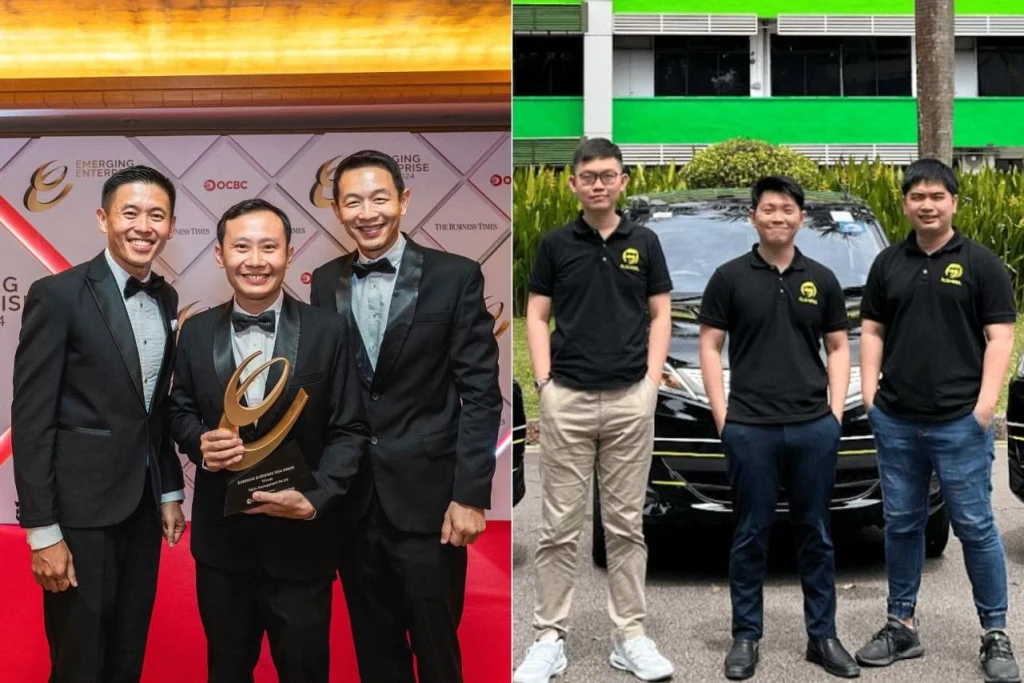
(From left) Brian Ng, Bernard Ng, and Samuel Pei, co-founders of KC Group; and Song Yan Ho, Shin Ng, and Kris Lee, co-founders of RushOwl / Photo credit: Kskin Management and RushOwl
Because of these barriers of time, cost, and pressure, many potential consumers are priced out. What if there was an alternative business model that makes professional skincare more accessible?
This was the challenge that inspired Brian Ng to establish Kskin, a business specializing in on-demand express facial treatments where customers can pay S$28 (US$20.85) for a 15-minute session.
“Our customers prioritize efficiency and value,” says Ng, who operates Kskin as a subsidiary under the KC Group, an established local brand in the haircare and beauty industry. Other brands under the KC Group, which Ng heads with two other co-founders, include Kcuts and Apgujeong Hair Studio.
Kskin was set up in 2020 to cater to customers who lead busy lives but still value professional care for their skin. Its outlets, numbering 65 in Singapore, do not take appointments. Instead, customers take a queue number after selecting their desired treatment.
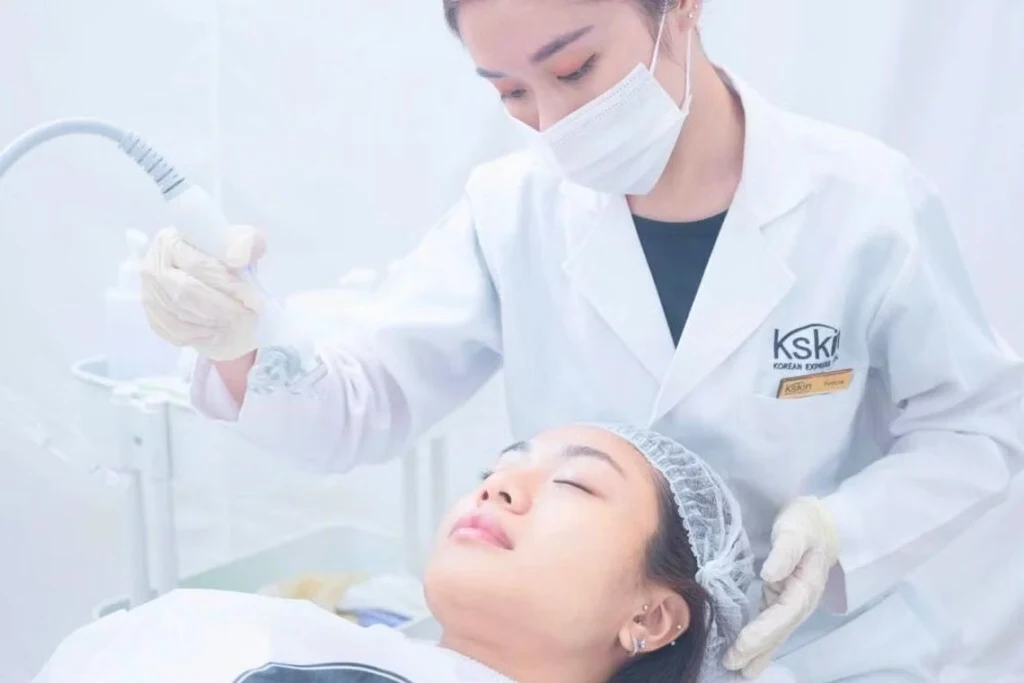
A Kskin therapist performs a 15-minute express facial, part of the brand’s efficient, no-frills service model / Photo credit: Kskin Management
From its first outlet in Clementi Mall, the brand’s convenient, no-pressure approach has resonated strongly with consumers. The company now serves over 100,000 customers monthly across more than 80 outlets in Singapore, Malaysia, and the Philippines.
It is also looking to expand further, with sights set on big markets like Indonesia and the US. “We’re in talks with partners in different markets to grow the Kskin presence through physical locations and localized marketing campaigns,” says Ng. The company has an ambitious goal to serve 10 million customers.
The brand’s no-frills approach has attracted an unexpected demographic: male customers, who make up 20% of its clientele, far exceeding the industry average of 3% to 5%.
“Men like that it’s fast and hassle-free. After they try it, they share it with their male friends,” notes Ng.
Kskin’s success stems from its innovative approach to both customer experience and operations. By keeping its outlets small but strategically located in outlets that have small rental footprints in high-traffic areas, the company maintains strong revenue-to-cost ratios that have enabled rapid expansion.
As recognition for its innovative approach and responsive business model, Kskin is one of the recipients of this year’s Emerging Enterprise Award.
Bridging public and private transportation
While Kskin is transforming beauty services, another Singapore company is tackling a different pain point that affects many people – finding it difficult to get to work on time. RushOwl bridges the gap between private hire ride-hailing and public transport by operating bus shuttle services that adjust their routes dynamically based on real-time demand.
The company has found its niche serving business clients such as Amazon and Asia Pacific Breweries, ensuring their employees enjoy a hassle-free commute to work. This is especially important for industries with remote worksites that require workers for time-sensitive operations, such as warehousing and manufacturing.
Users of RushOwl’s internally developed app, RushTrail, indicate their travel needs, while the company’s AI software generates the most optimal routes for bus drivers. The system now coordinates a fleet of 500 vehicles, handling 4,000 trips a day with guaranteed timely transport.
The company also operates a school bus service. Thanks to its AI software, it can organize its buses such that students whose schools are in the same neighborhood are picked up together. The aggregation of destinations and optimized routing results in more efficient and timely transport, with fewer buses and drivers needed to make the trips.
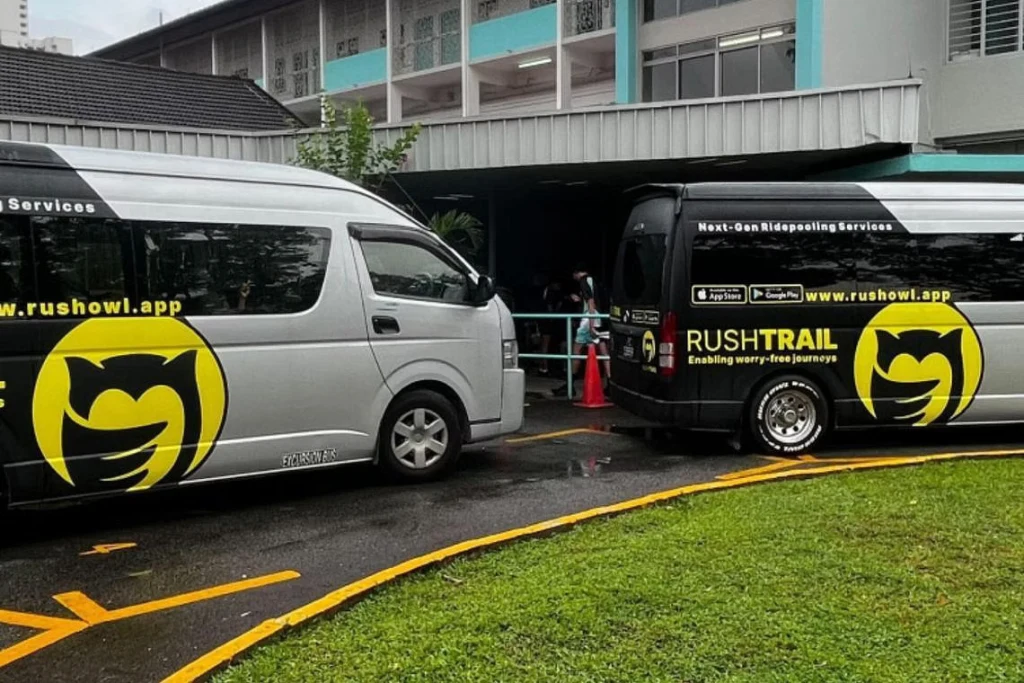
RushTrail shuttle vans featuring RushOwl’s AI-powered transportation service stand ready for optimised commuter journeys./ Photo credit: RushOwl
CEO Shin Ng says that RushOwl’s business model was initially software as a service. But it was “super hard” to convince bus transport operators to run their fleets on demand.
“Many of the drivers are near retiring age, and usually not tech-savvy. In the early days, we would go down to the industrial park at 6am to teach the drivers how to use our app,” he recalls.
Thankfully, technology and smartphone adoption have accelerated since RushOwl’s incorporation in 2018. While the firm continues to work with bus operators in Singapore, it is also running its own bus fleet.
The company has since expanded beyond Singapore, adapting its model for markets like India.
“In India, access to public transportation is a luxury,” says Ng. Working with land developers like Capitaland and JTC, RushOwl connects industrial parks to metro stations, focusing on rural connectivity.
RushOwl’s smart routing system does not just benefit commuters – it is also making strides for the environment. The company is able to reduce “dead mileage” – the wasted transport potential of empty seats – by about 30% compared with private-hire vehicles.
The reduction in dead mileage has positive environmental effects, from reducing carbon and air pollution to decreasing road congestion.
This commitment to sustainability has earned RushOwl the Emerging Enterprise Sustainability Award. The company is now investing in electric vehicles, with plans for half of its Singapore fleet and all Indian operations to be electric by 2025.
As RushOwl grows its global operations, it is also collecting mobility data to shape future transport solutions. The company plans to use these insights to develop an effective electric vehicle deployment plan, which is something that many traditional fleet operators currently lack.
“Finally people recognize that, from an operational aspect, we can do more to decarbonize our current transportation system,” says Ng.
Recognizing bold ambition
Now in its 17th year, the Emerging Enterprise Awards continue to highlight the innovation, resilience, and excellence of SMEs under 10 years old. The awards are a joint initiative by The Business Times and OCBC.
For the second consecutive year, applications were extended to emerging businesses across the region, broadening the awards’ reach beyond Singapore.
In the sustainability category, the Emerging Enterprise Sustainability Awards honor enterprises that embrace opportunities in the green economy – whether by embedding sustainable practices in their operations or leveraging technology and innovation to drive the transition to low-carbon economies.
Additionally, the Most Promising Sustainability Startup Awards celebrate businesses with unique, commercially viable ideas and significant long-term potential. Find out more here.
This story was republished with permission from The Business Times. It was moderately edited to reflect Tech in Asia’s editorial guidelines.
Stay updated on the go with our mobile app.
Get latest insights with smoother, more personalized experience through TIA mobile app.
Recommended reads
 Indonesian AI startup goes global
 Forrest Li on scaling Sea, building smarter bots, and founder grit
 An AI assistant that joins sales calls and scores team skills
 Beyond the check: Why VCs need more than capital
 SGX’s CEO says it doesn’t need a unicorn to win
 SMEs want AI too, but not the kind Big Tech is selling
 Oatside’s alt-milk rise hits a profitable gear
 Alibaba’s financial health in 12 charts
 Asia’s telcos bundle AI into mobile plans. Will it pay off?
 M-Daq chases bigger clients as revenue falls, losses grow





Editing by Lorenzo Kyle Subido
(And yes, we’re serious about ethics and transparency. More information here.)