Stripe’s take on driving fintech product growth


Most companies would envision their product growth strategy as starting at the birth of a customer’s journey.
But Valerie Wagoner, head of product for APAC at Stripe, says that the most important aspect to focus on comes at the end: retention.
“It’s the most important driver of how any product grows,” she said during a session at Product Development Conference (PDC) 2022. “That’s because retention is what really compounds your growth.”
(Don’t worry if you missed out on these expert-led insights last year. We’re bringing back PDC in Jakarta this year, along with an early bird sale for tickets. Get them here!)
One important factor with retention is how often your users encounter the problem your product is trying to solve. Subsequently, users’ core behavior needs to be defined as well – in other words, clarifying the actions they take that indicate your product is actually solving that problem.
With a payments platform like GoPay, for instance, a user may need to pay through cashless methods a few times each week. The core behavior here would be the user using GoPay to execute a transaction.
“It’s not that they’re just logging into the app or checking their balance – they have to actually make a payment,” Wagoner pointed out.
Using these metrics, product leads can create a frequency histogram to determine if the assumed performance for a product matches how often users actually performed the intended action. Based on subsequent findings, a firm may need to tweak the product or reevaluate whether it misunderstood the problem it’s trying to solve.
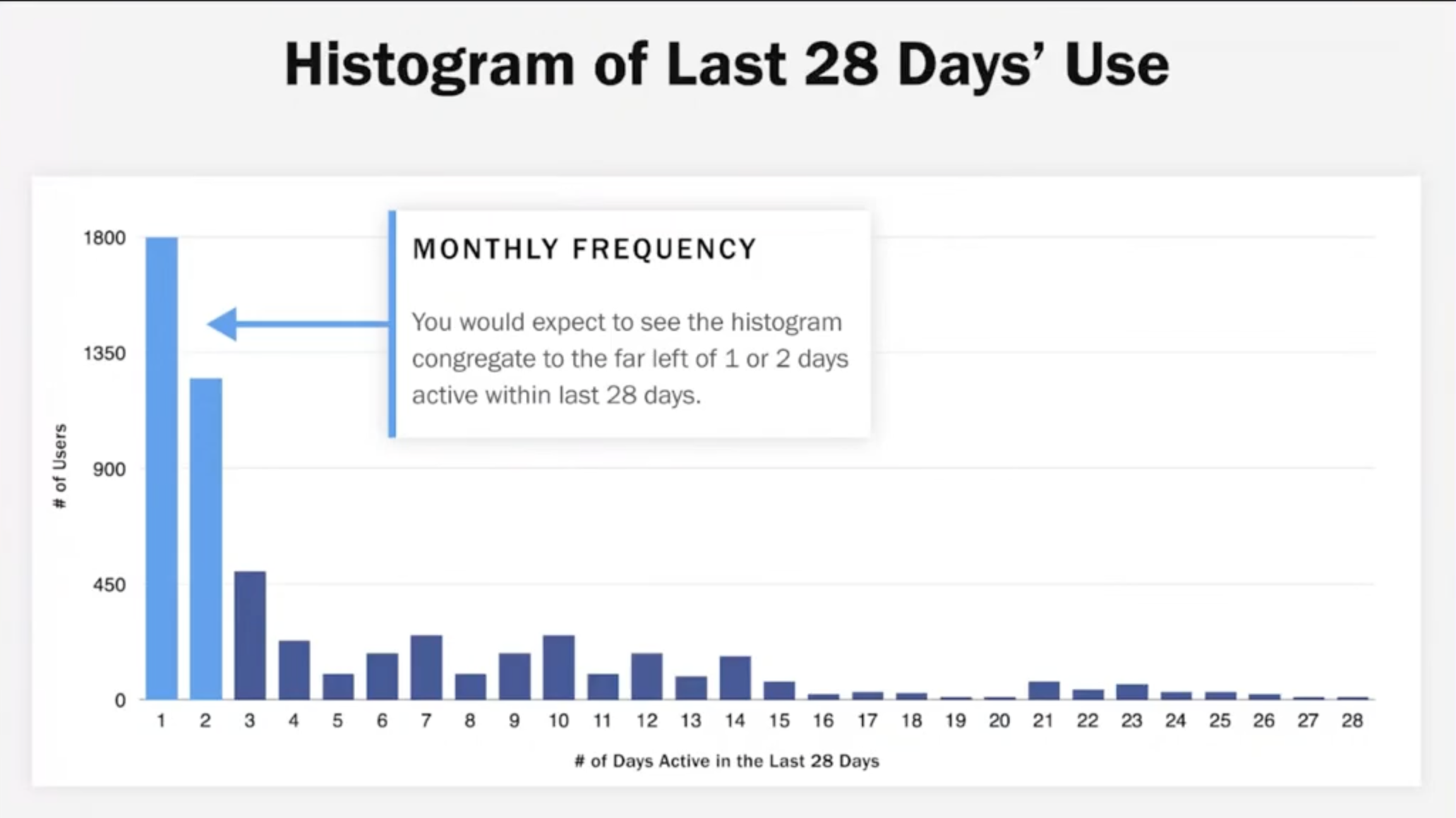
Photo credit: Valerie Wagoner
Working backwards from retention, we arrive at activation. The key idea here is creating habitual behavior from users.
It’s important to know that when it comes to habit creation, cold starts kill momentum. As such, it’s crucial to reduce friction when users experience your product for the very first time, allowing companies to encourage full engagement and, therefore, activation.
For example, using digital wallets like GoPay could include lots of friction if users needed to manually top it up or link their bank accounts, among other steps.
“To create a “warm start” experience, if someone used Gojek for a ride or deliveries, instead of giving price discounts, we gave cashback in the form of GoPay balance,” Wagoner explained.
“Now, a new user can easily experience GoPay’s value proposition for the first time, encouraging them to come back again.”
Last, but not least, we arrive at user acquisition.
“Acquisitions are not about funnels,” the head of product emphasized. “Those are just linear tactics that don’t compound on each other.”
Instead, companies need to think about acquisition in terms of four main loops: viral, content, paid, and sales.
While each of them have their own stages, Wagoner said that the important thing is ensuring that each step is optimized. For instance, paid loops consist of the following stages: New user sign-ups, monetizing a portion of these new users, and using that profit to fund more advertising campaigns, which then leads back to new users coming in.
Focusing on each and fixing the unique challenges at those points is critical in helping businesses establish a successful acquisition loop.
All in all, when it comes to growth, one thing becomes clear: Establishing a compounding repetitive action or framework is the basis of any great product.
That applies to self improvement too – learning and practicing leads to perfection. That is why since 2017, we’ve brought back our annual PDC to give companies a way to level up their product development teams. At this year’s edition, attendees can look forward to a whole range of sessions that are just as insightful as the one you just watched.
Whether you’re just starting out as a product manager or a seasoned product professional, adding PDC 2023 to your self-improvement framework should trigger your growth loop.
Stay updated on the go with our mobile app.
Get latest insights with smoother, more personalized experience through TIA mobile app.