 Eva Xiao · · 7 min read
This startup is shooting for a Pixar moment in China’s fragmented but huge VR space
Photo credit: supernam / 123RF.
On a clear afternoon in Beijing last month, China’s small community of virtual reality filmmakers and animators gathered at Sandbox, one of the few VR film festivals in the country. Some of the world’s best VR films were on display: Oculus Story Studio’s Dear Angelica and Henry, Penrose Studio’s Allumette.
“Even though a lot of people [in China] discuss VR, most of them haven’t actually seen good pieces,” Eddie Lou, co-founder of Sandman Studios and organizer of Sandbox, tells me.
High-end headsets, like Oculus Rift and HTC Vive, can be too expensive for casual viewers, and many VR films are scattered across different platforms, he explains. “If they don’t have a deep understanding of the industry, they don’t know where to find the best stuff.”
China’s VR scene still suffers from a dearth of quality content.
Despite the hoopla around China’s VR industry last year – with some expecting it to hit US$8.5 billion by 2020 – the country’s VR scene still suffers from a dearth of quality content. That’s a problem Sandman Studios aims to solve, not only through its own animated short films, but by organizing regular VR film showings at Sandbox to inspire and entice Chinese artists, filmmakers, and game developers into the nascent industry.
“Right now, [creating VR films] is so difficult because you need to understand game engines, coding, and algorithms, but at the same time, you also have to understand how to tell stories,” says Lou.
“These two groups of people are actually separate – the animation and visual effects people and game developers. But because of this industry, everyone has to work more intimately together.”
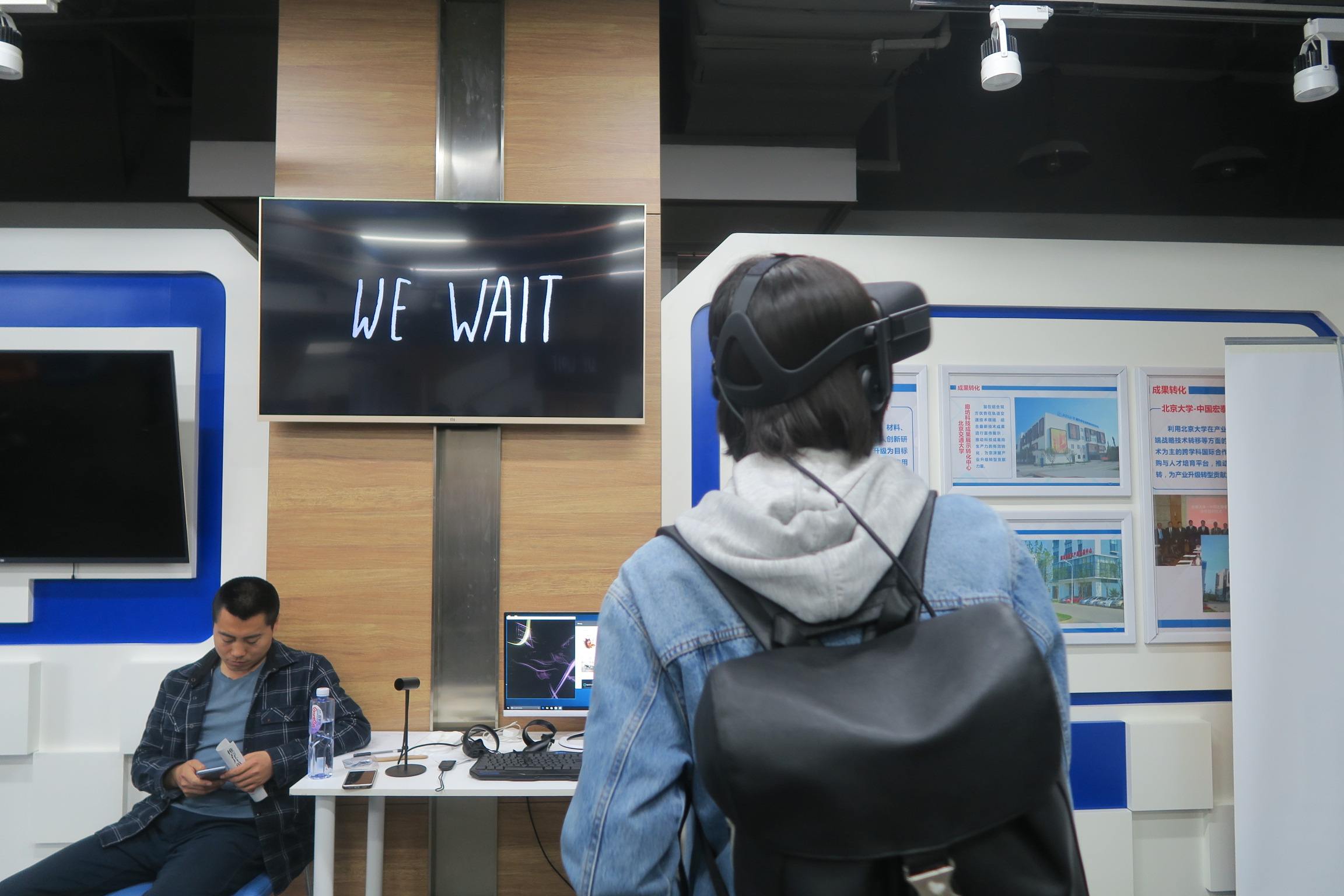
A Sandbox attendee straps up for a VR short film. Photo credit: Tech in Asia.
China isn’t the only one with a content problem – VR experts worldwide have lamented the lack of a “killer app,” which is why Spaces, Facebook’s latest virtual reality hangout app, has caused such a furor online. Unlike other multi-person VR apps, Spaces takes socializing to another level by connecting users both in and outside of virtual reality. You can hang out in fantasy 360-degree environments with other avatar-ized friends, or call someone who doesn’t even have the app installed.
VR experts worldwide have lamented the lack of a “killer app.”
The VR content space is incredibly fragmented, with videos, films, and games spread across disparate platforms, such as Steam, Vive Port, Google Play, and Oculus Home. Currently, there’s no dominating platform, which means content creators have to publish their work on multiple platforms, or risk alienating users. It can also create compatibility issues across different headsets.
In China, video streaming sites like Youku and iQiyi have their own VR platforms. Brick-and-mortar virtual reality arcades, where users can pay less than US$5 to play games, are another distribution channel.
Connecting dots
Uphill battle





Stay updated on the go with our mobile app.
Get latest insights with smoother, more personalized experience through TIA mobile app.












📅 Upcoming Events
22 October 2026
Payoneer x CSPN Summit 2026