Michael Tegos · · 5 min read
Study: Singapore should invest in more risks and stop supporting “zombie” startups

NUS Enterprise director, Dr. Wong Poh Kam, speaking at Innovfest Unbound 2017. Photo credit: Tech in Asia.
You’ve heard of unicorns and even their ten-horn-festooned cousins but there’s another member of the startup animal kingdom you should pay attention to: enter the gazelle.
A gazelle is a company that can achieve fast and profitable growth – increasing its revenue at a rate of 20 percent annually for more than four years, starting from US$1 million. While the term is far from new, we definitely don’t hear it much.
Singapore just doesn’t have many gazelles.
The findings of a new study by NUS Enterprise, the National University of Singapore’s business and entrepreneurship center, point to why that might be: Singapore just doesn’t have many gazelles.
NUS Enterprise director Dr. Wong Poh Kam presented the study titled Growth Dynamics of High-Tech Startups in Singapore: A Longitudinal Study during the Innovfest Unbound conference yesterday. According to it, gazelles in Singapore are as elusive as their savannah-roaming namesakes, accounting for only 8.1 percent of tech startups in the ecosystem.
On the flipside, 56.8 percent of startups are found to be “struggling,” or to use another vivid term, “zombies.” Those are the companies that generate little employment and growth.
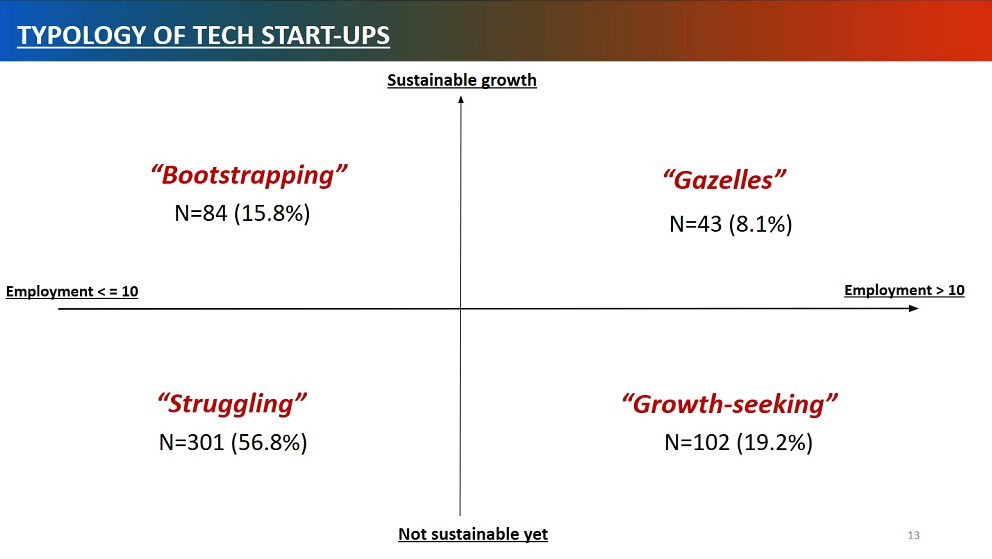
Image credit: NUS Entrepreneurship Center.
The study was conducted over a five-month period in 2016 and surveyed 530 tech startups in Singapore. The findings show an ecosystem that is increasingly relying on government support (69 percent rate of participation in government schemes compared to 19 percent in 2010) but is more active and dynamic than in the past. It has great innovation potential but uneven translation of this potential to commercial products.
Here are some of the most striking findings of the report:
Singaporean firms have a higher survival rate but don’t take risks
Companies in Singapore have a five-year survival rate of 53 percent compared to 49 percent in the US and 42 percent in the UK. On the one hand, this means there is the funding and the infrastructure to keep these businesses going. The flipside is, a lot of companies keep surviving without significant breakthroughs and not enough risks are being taken.
“A high survival rate perhaps means too many zombies remain,” Dr. Wong tells Tech in Asia during a round-table interview. The problem there, in comparison to the US, is that not enough companies take the kinds of risk that birth gazelles.





Stay updated on the go with our mobile app.
Get latest insights with smoother, more personalized experience through TIA mobile app.