
China Mobile's M-Zone: a SNS and mobile services store that's bleeding new users.
A new school year in China, a new battle for mobile subscribers amongst China’s three mobile telcos. It’s an annual campus battle, in which the competing companies see a chance to lock-down a customer to one phone number – and one brand – perhaps for life. But China Mobile (HKG:0941), the country’s largest mobile network, is rapidly losing this fight for freshman customers, and that risks its entire market domination.
Compared to its previous amazing success of up to 98 percent market share on China’s campuses, China Mobile is really suffering an unhappy time seeing a decline all over the country – down to as low as 70 percent of new sign-ups amongst university students in many cities this semster.
Early in May this year, a Chinese tech site, ChinaByte.com, published an essay which warned of China Mobile’s slow demise, saying:
Unless it can make a success of its 3G mobile communication services, the world’s biggest telecoms operator enterprise won’t be able to retain its customers even with price reductions.
It painted a picture of the inevitable shrinkage of China Mobile’s business, inspired by a report from ccidcom.com, and of a previously monopolistic company that might be killed by a greater choice of apps and platforms, and by a strengthening China Unicom (HKG:0762), and China Telecom (HKG:0728).
In the past, when everyone was clutching feature phones, and the notion of apps hadn’t caught on, China Mobile’s “M-Zone” was the best and hippest deal in town. M-Zone was the biggest and greatest source of apps and paid mobile services in China, as well as a huge social network. Now it’s just one of many choices – and looking quite rusty and boring.
M-Zone was key to bringing on-board younger users, too. But now many Chinese youngsters have iPhones or Android smartphones, and now they can get games easily from numerous sources. So now the campus market will not be the exclusive domain of China Mobile any longer. This is really a big red flag, which – to mix metaphors – could trigger a butterfly effect of losing new and prosperous (and gadget-loving) 20-something customers way into the future. It’s threatening to China Mobile, in spite of the impressive-sounding performance of an average 80 percent share in the Chinese campus users market.
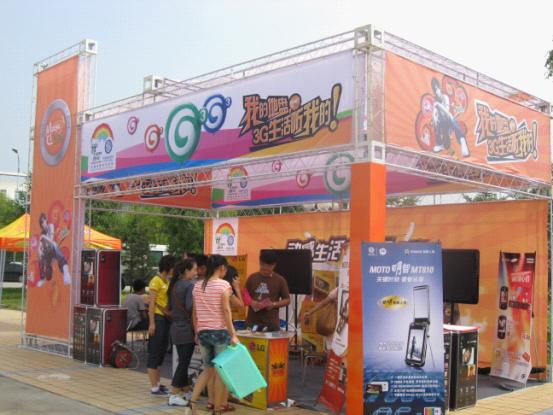
A China Mobile booth at a university campus, trying to sign up new users. (Image source: china-zhongzhi.com)
From M-Zone to ZZZZZZ-Zone
China Mobile made a smash hit in 2001 when pushing out the M-Zone brand, which it aimed at students. With an SMS package service offering free SMS between China Mobile’s users, M-zone got hundreds of millions of students thumbing their little mobile phones over the years. Also, its VPMN (Virtual Private Mobile Network) service also meets the needs of college students, allowing them to talk for hours on the phone and pay very little money. Sometime later came Fetion,,an instant messenger (IM) software which enable users to send massages from both the PC client and the mobile app – a sort of precursor of the current trend for group messaging apps. These services were really welcomed by younger customers at that time when 3G was not so mature in China, and smartphones and high-end cell phones were not so popular as they are today.
But things change so fast. China Unicom now has its ‘Wo You’ group-messaging app, and China Telecom launched one last week as well. Meanwhile, China Mobile offers free public broadband and WiFi to its own customers in hundreds of cities. Competition is tougher now, and the choices for users are more appealing.





Stay updated on the go with our mobile app.
Get latest insights with smoother, more personalized experience through TIA mobile app.













📅 Upcoming Events
22 October 2026
Payoneer x CSPN Summit 2026