- Premium Content It takes our newsroom weeks - if not months - to investigate and produce stories for our premium content. You can’t find them anywhere else.
 Emmanuel Samarathisa · · 5 min read
Malaysian startup collects profits from e-waste recycling
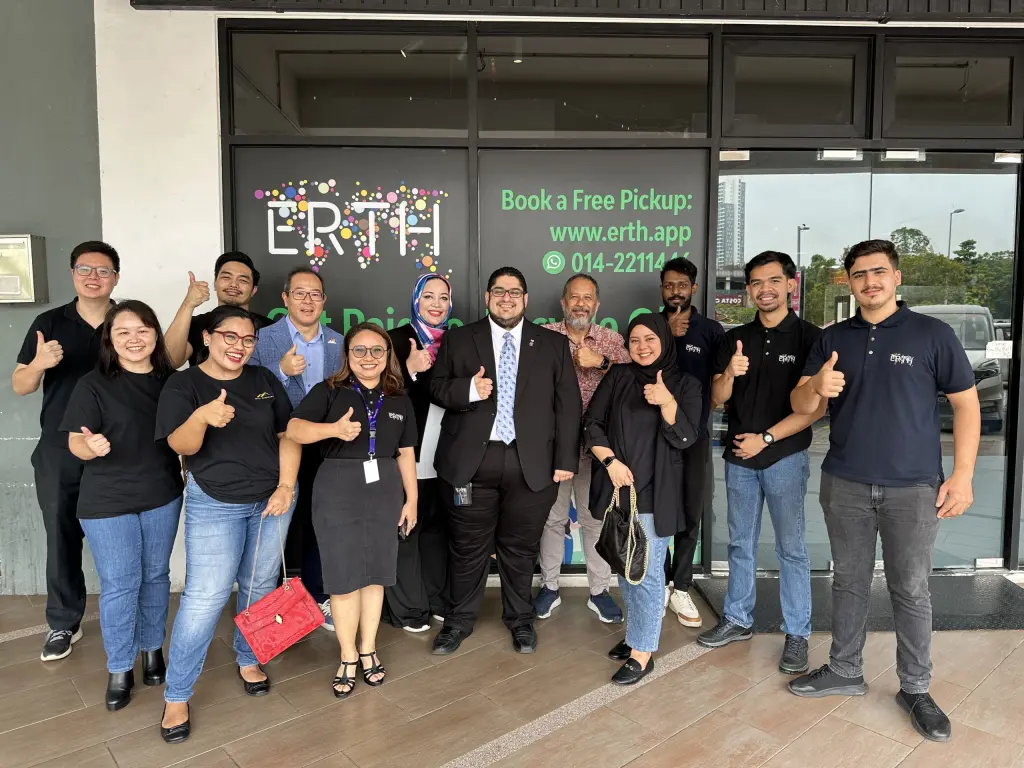
Erth founder Mohamed Tarek El-Fatatry (centre, black suit) seen with his staff at the startup’s headquarters in Cyberjaya / Photo credit: Mohamed Tarek El-Fatatry
“One man’s trash is another man’s treasure” is a perfect idiom to describe what Cyberjaya-based startup Erth has been doing since its inception.
Founded by Finnish-Egyptian entrepreneur Mohamed Tarek El-Fatatry, the startup not only removes people’s e-waste but also pays them for it. Erth, which stands for Electronic Recycling Through Heroes, was conceptualized in 2018 after China decided to ban e-waste imports, El-Fatatry tells Tech in Asia.
It’s a simple yet familiar concept among Malaysians, who are accustomed to on-the-road recyclers – usually individuals who will show up at people’s doorstep and pay pocket change for recyclables, mostly newspapers and magazines.
The only difference between the traditional recycler and Erth is that the latter tackles digital devices such as discarded handphones and laptops. The startup is also fueled by the gig economy with its army of 100 collectors or “heroes”.
Erth’s business – which is net profitable – has also received coverage from local media publications and radio stations as well as the attention of investors Gobi Partners and Malaysian sovereign wealth fund Khazanah Nasional. Gobi took up a strategic stake in Erth via its fund that has Khazanah as a limited partner in September this year.
El-Fatatry was already in the social enterprise space prior to Erth. He was running a company focused on deploying solar energy systems to African countries.
The turning point was when an investor threw him a “curve ball” and asked him if he could “commit” to collecting the solar units from the villages at the end of their lifetime, he says.
“After 25 years? I told him, of course I cannot commit, as that would require an enormous cost. The investor then told me, ‘In that case, you’re solving a 25-year electrification problem but creating a 250-year e-waste problem.’”
A year later, El-Fatatry would attend a summit in Silicon Valley, where he’d meet his partner and wife Nahed Bedir Eletribi, a social entrepreneur herself, who’d share with him stories of how poor communities struggled to dispose of e-waste. That led the two to focus on waste management.
The phone seller has been around for 25 years while the recycling plant has been here for 15 years. But both are not talking to each other.
Malaysia came calling with the China ban as an added incentive. The Malaysian government has a long history of dealing with illegally imported waste that it even irked then Environmental and Climate Change Minister Yeo Bee Yin, who was famously quoted in the media for saying Malaysia is not the world’s dumping ground.
El-Fatatry and Eletribi then took the opportunity to visit Malaysia, as they were familiar with the country. They rented an AirBnB in Kuala Lumpur for two weeks and went hunting for deals.
El-Fatatry’s big break came when he visited a famous IT shopping mall called Low Yat Plaza, where he met a seller who needed to dispose of 4,000 broken Nokia phones.
The missing link
Three-pronged strategy
Heating up
Stay ahead in Asia’s tech landscape
This is premium content. Subscribe to read the full story.
Erth aims to expand nationwide and in other Southeast Asian markets following a strategic investment from Gobi Partners.
We know this is not ideal. ⌛ Sign up in 20 seconds. Cancel anytime.
Our subscriber community includes professionals from these companies:





Stay updated on the go with our mobile app.
Get latest insights with smoother, more personalized experience through TIA mobile app.