- Premium Content It takes our newsroom weeks - if not months - to investigate and produce stories for our premium content. You can’t find them anywhere else.
 Emmanuel Samarathisa · · 4 min read
Malaysia’s Islamic fintech scene: fool’s gold?
Dan Lain-Lain (Malay for “and others”) is a weekly column by TIA journalist Emmanuel Samarathisa that dissects the goings-on in the Malaysia tech scene but with a heavy mix of current affairs, policy and politics. Click here to read past articles.
Since we’re still in the Eid al-Fitr season, let’s talk about Malaysia’s Islamic fintech scene.
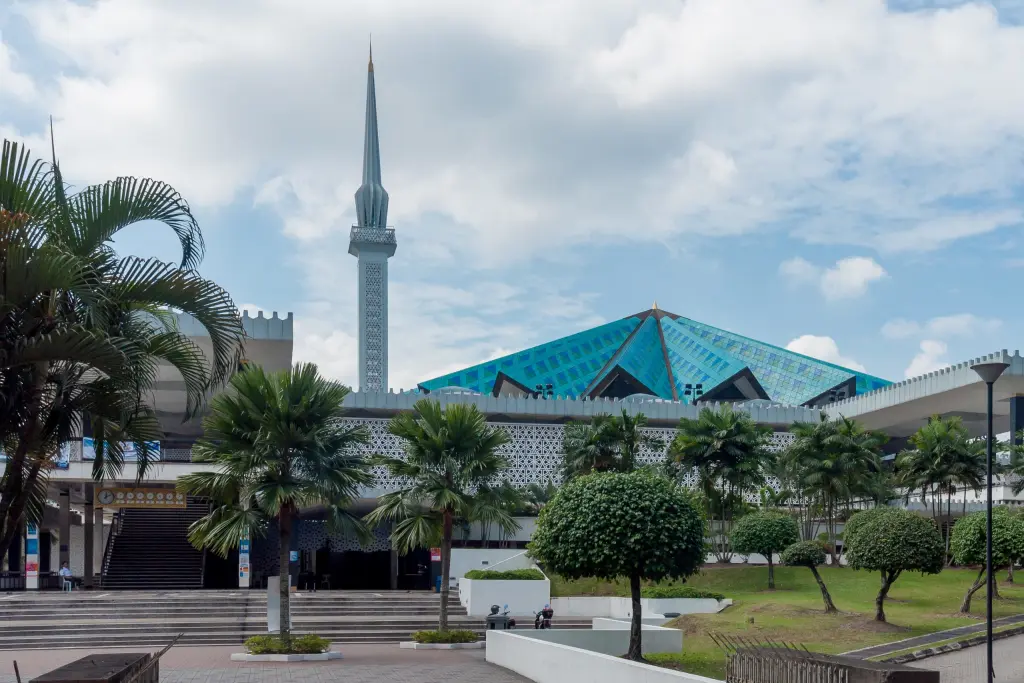
Malaysia’s national mosque in capital Kuala Lumpur / Photo credit: Wikimedia Commons
You may think that since Muslims make up roughly 65% of the population, Malaysia is a goldmine of an opportunity. A startup comes in, launches a fancy app, and boom! A unicorn in the making. But the truth may be far off.
Let’s check out the lay of the land first. The country has 294 fintech companies but only 5% of them are Islamic fintech firms, according to the Malaysia Fintech Report 2022.
Some names in this space include MadCash, PayHalal, Microleap, Ethis, Wahed, Pewarisan, and Wakaful. Some, like US-based Wahed, are not headquartered in Malaysia.
Now, what makes a fintech company “Islamic”? Obviously its products adhere to Shariah principles, with distinct features including the prohibition against charging of interest (known as riba) and an emphasis on risk-sharing as well as ethical investing.
The latter, too, is guided by the Islamic law. So, obviously, no investments or dealings with companies that produce alcohol, for example.
But despite a large population and a somewhat conducive environment, Malaysia hasn’t had a Shariah fintech unicorn. Heck, we don’t even have a fintech unicorn.
For comparison, Indonesia has Ovo, a fintech unicorn that also offers Islamic products.
The lack of a mythical beast aside, here are four major challenges for Malaysia:
Powerful incumbents
This is pretty obvious but worth spelling out. The country’s financial services space is dominated by incumbents, including some of the country’s largest banks like Maybank, CIMB, and RHB.
Naturally, their Shariah banking arms also command attention. According to The Asian Banker’s rankings, six of the world’s top 20 Shariah banks – Maybank Islamic, CIMB Islamic, Bank Rakyat, RHB Islamic, Bank Islam Malaysia, and Public Islamic Bank – are headquartered in Malaysia.
These players are household names and since they’ve been around for some time, they have a lot of dry powder to roll out digital services. You could even say their tech capabilities are superior to the regular fintech upstart.
Too many stakeholders
Lack of investment options
Funding concerns
Stay ahead in Asia’s tech landscape
This is premium content. Subscribe to read the full story.
A Muslim-majority population is no panacea for hopefuls trying to make a dent in the Shariah fintech space.
We know this is not ideal. ⌛ Sign up in 20 seconds. Cancel anytime.
Our subscriber community includes professionals from these companies:





Stay updated on the go with our mobile app.
Get latest insights with smoother, more personalized experience through TIA mobile app.











📅 Upcoming Events
22 October 2026
Payoneer x CSPN Summit 2026