 Annie Teh · · 5 min read
Snapcart wants to turn shopping receipts in the Philippines into gold

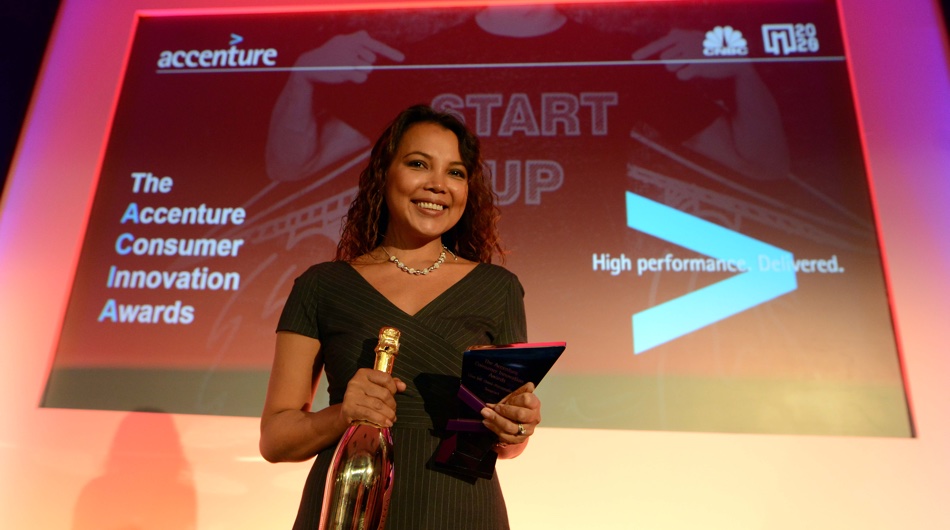
Teresa receives Snapcart’s award at the Accenture Consumer Innovation Awards. Photo Credit: Daniel Lynch via Accenture.
Each time you toss a paper receipt into a bin, you may be throwing out a data treasure trove.
Paper receipts collect a wealth of information on shoppers’ behaviors, from the time of purchase to items in a basket. Indonesia-based startup Snapcart taps into this data by incentivizing shoppers to take photographs of their receipts in exchange for a small cash rebate.
The crowdsourced data gives brands a better understanding of their shopping habits, helping them make important marketing decisions.

Photo Credit: Snapcart.
Snapcart is led by founders Reynazran Royono and Teresa Condicion, who have a combined experience of 26 years in Procter & Gamble. Less than a year after launching, Snapcart has been able to raise a bridge round of US$1.7 million from investors like Wavemaker Partners, SPH Media Fund, Sinar Mas Digital Ventures (SMDV), and parent company Ardent Capital.
Much of the bridge round will be invested in expansion. Rey shares with Tech in Asia that Snapcart plans to expand into at least one new country every nine months. Their first stop — the Philippines.
Hungry for data

Photo Credit: Wikimedia.
Indonesia and Philippines are the two biggest markets (by population) in Southeast Asia, and the latter has a large market of fast moving consumer goods (FMCG), with 42.7 percent of household spending going to food in 2012.
The big retailers in the Filipino market also don’t share information, according to Teresa, who is leading the expansion into the Philippines. This creates a large demand from FMCG brands in the Philippines for more information.
“There is half of the market that is not known and read by our clients,” said Teresa.
Snapcart will fully launch the product in the Philippines after a month-long soft launch in July. Within the first day of advertising, they’ve had 1,500 downloads of the app. Teresa is confident that their Philippines launch will beat what they’ve already achieved in Indonesia.
While their ambitious expansion plans take up most of their spending, some of the investment money will be put into improving the app’s optical character recognition (OCR) technology, which automatically collects data from photographs that flood their systems daily. The rest may go into creating new features.
Rey declined to reveal the product roadmap, but hints at what a possible new feature could look like:
“Imagine that we’ve already collected information of historical purchases of shoppers and the different pricings of what they buy,” said Rey. “The easiest feature that we can create from that is, of course, generating a shopping list for our users.”
This shopping list would have the potential to provide advice on the places with the best deals and cheapest products.
Going millennial

Finalists at Millennial 20:20, with Snapcart co-founder Teresa Condicion taking center stage.
According to Teresa, there is a demand for unique data amongst brands. The market research industry is worth more than US$40 billion, yet most FMCG market research is still conducted through surveys and inventory tallies. Their unique method of data collection gives them a head up on the retail industry, and also caught the eye of the judges of the Accenture Consumer Innovation Awards (ACIA).
The awards ceremony is part of the inaugural Millennial 20/20 event held in London, and celebrates companies that can connect brands to the millennial market and communicate with them. They won the category “Give ME Omni-Personalisation”, which awards companies matching brands with individuals through an omnichannel platform. The next Millennial 20/20 and ACIA will be held in Singapore in September.
The omnichannel approach, according to Snapcart, is especially relevant in Asia. Mobile penetration may be high, but traditional local shops like the waroeng in Indonesia or Sari-sari stores in the Philippines remain popular retail options. Snapcart brings both together, leveraging offline platforms but influencing purchases through mobile.
Snapcart works well in Southeast Asia because it merges familiar technology, like the smartphone camera, with new technology, says Teo Correia, senior managing director of consumer goods and services at Accenture. Snapcart’s business model is in tune with Asian millennials, who are still drawn to offline shopping experience as a leisure activity. They’re more sensitive to price than their European counterparts.
According to Teo, companies should focus on how new technology can fit into the consumers’ lifestyle, instead of just making everything digital of the sake of it.
“Startups and brands that understand their consumers’ lifestyles, pain-points and needs – and build their products to add value to their lives – are the companies that will succeed,” said Teo.
Accenture is a leading global professional services company, providing a broad range of services and solutions in strategy, consulting, digital, technology and operations. Combining unmatched experience and specialized skills across more than 40 industries and all business functions—underpinned by the world’s largest delivery network—Accenture works at the intersection of business and technology to help clients improve their performance and create sustainable value for their stakeholders. With more than 375,000 people serving clients in more than 120 countries, Accenture drives innovation to improve the way the world works and lives. Visit us at www.accenture.com.
Accenture is looking to recognise and reward start-ups that are enhancing customer experience and personalisation, increasing sales revenue, improving product sourcing and delivery, and enabling a more digital workforce. We are looking for new brands, cool technologies, marketing tools, e-commerce platforms and B2B / B2B2C start-ups. Judging will be done by an exclusive panel of Executives from leading brands, influencers and investors from across retail, consumer goods, travel and hospitality sectors; and the winners will receive their award on the main stage at the Millennial 20/20 Summit on September 8th in Singapore.

Stay updated on the go with our mobile app.
Get latest insights with smoother, more personalized experience through TIA mobile app.
Recommended reads
 Fave names ex-Touch ‘n Go exec as chief product officer
 How financial infrastructure powers global startups
 Greentech firm launches after $525k raise from SG’s Wavemaker
 Baby boom: SEA’s mom and babycare startups meld content with commerce
 SEA food delivery spending tops $16.3b in 2022: report
 Can Sociolla become the AWS for smart retail?
 East Ventures leads seed round of Indonesian logistics firm
 Quickbytes: How Twilio can help unlock the power of customer data
 GoTo takes a knife to costs, but market remains unconvinced
 The XaaS revolution: lessons and benefits for startups





Editing by Terence Lee
(And yes, we’re serious about ethics and transparency. More information here.)



📅 Upcoming Events
22 October 2026
Payoneer x CSPN Summit 2026