Osman Husain · · 5 min read
This entrepreneur dropped out of high school, discovered engineering, and built a $1 million startup

Bilal Athar knew he was a cultural misfit from a very early stage. His lack of interest in conventional education, coupled with a poor relationship with his teachers, meant that he had trouble responding to authority. Athar wanted to do more than just sit in classrooms – he had a creative spirit that was urging to be utilized. Deciding that education would not help him, Athar dropped out of high school altogether.
In conservatively-minded Pakistan, this decision was tantamount to suicide. Athars’ beginnings may sound similar to a typical western IT entrepreneur, but no such culture existed in Pakistan.
Athar’s father, a serving officer in the Pakistan military, implored him to resume his education and pursue a “socially-acceptable” career. His mother was even more aghast – she demanded her son put aside his interests and pursue a line of education which would earn him steady income. For them, it was unthinkable that Athar was not interested in attending college. They feared that he would become a social outcast, and no girl would want to marry him. After immense cajoling from his extended family, Athar enrolled in a diploma program studying Chartered Accounting.
Unfortunately, this proved to be an unmitigated disaster. The dreary nature of number crunching and balance sheet formulation did not appeal to Athar’s free-minded nature, causing him to quit the program after just a few months. A lack of funds meant that he had to move back in with his parents, who made their reservations regarding his lack of career prospects extremely vocal. Fiercely independent, Athar knew he had something to prove. Acting upon a friends’ suggestion, he enrolled in a course to become a Cisco-certified systems engineer.
During the course, Athar realized the realm of IT, coding, and software architecture came naturally to him. His creative and inquisitive instincts were well-utilized, helping him excel in the field. Soon after graduation, he landed a cushy job in the UAE, training network administrators in cybersecurity.
“After I left Pakistan, my parents were finally happy to see me settled and earning good money,” Athar tells Tech in Asia. “However, despite having more money than I could spend, I was not satisfied. I craved to do more.”
Quest for personal ambition
Athars’ stint in the Middle East did not last very long. Fueled by an entrepreneurial spirit and a desire to “build solutions that would help common people,” he moved back and established a startup selling software solutions to large-scale manufacturing units. The substantial cash reserves he had built during his earlier job helped – he was able to rent out an office and hire a team of developers. However, despite a significant amount of early traction, his startup soon started to lose clients and burn through his savings. It was only after he was dead broke – even selling his iPad to help cover the last payroll – that Athar called it quits. Yet again, he was forced to seek help.
“Retrospectively, I came to the conclusion that the Pakistani market was not ready at the time for innovation and automation. Furthermore, to develop a truly successful company, I needed to build a product that would be popular amongst early-adopters,” explains Athar.
Flush out of cash, Athar moved in with a friend and began work as a freelance developer. His expertise in coding started to shine through and soon he was overwhelmed with projects. However, despite once again having a steady stream of income, Athar again found himself dissatisfied and eager to launch a new startup. After carefully sifting through the plethora of ideas in his head, Athar conceptualized Wifigen and convinced a friend to come on board as a co-founder. There was no looking back.
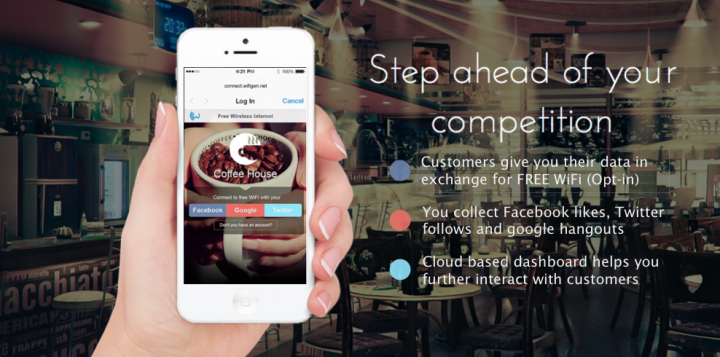
The idea behind Wifigen is fairly straightforward. The service provides free wifi in public spots in exchange for some customer information. Companies who embed Wifigens’ solution into their existing wifi hotspot will have the option of offering their clients free use of the service as long as they log in with one of their social media accounts, such as Facebook, Twitter, Google+, or LinkedIn. People who choose to check in or share their current location can be offered freebies or discounts on their purchases.





Stay updated on the go with our mobile app.
Get latest insights with smoother, more personalized experience through TIA mobile app.