 Erik Crouch · · 3 min read
Uber: we have 35% market share in China. Didi Kuaidi: LOL nope
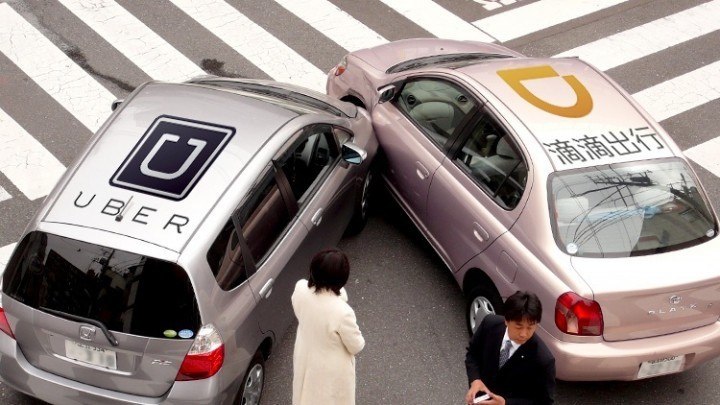
Photoshop by TiA. Original image from Wikimedia
Kalanick’s chief claims were that Uber has “30 or 35 percent market share” in China, and that a principle reason why it’s losing to Didi Kuaidi in mainland China is that Didi is spending massive amounts of money on subsidies to encourage people to become drivers.
“Our best information right now is that Didi is spending US$70 to US$80 million a week on subsidies – that’s US$4 billion a year,” Kalanick said. “Over the last year we have gained significant market share in China and have spent far less than that.”
Shade, thrown
“Those numbers are outright untrue,” a Didi Kuaidi representative shot back in an email to Tech in Asia.
“We don’t comment on how others arrive [at] or disclose their numbers,” the email continued, “But the different [sic] in scale and market share should be obvious when comparing our operation in 380 cities in China with a business in only 22 cities.” While Didi offers app-connected taxi rides in nearly 400 cities, the private car service akin to UberX and UberBlack is available in 199 cities at the last count.
“[Uber’s] numbers are outright untrue,” a Didi Kuaidi representative shot back.
Citing third-party research firms, the Didi Kuaidi representative claimed that the company “holds over 80 percent of [the] private car hailing market in China” and provides about 4 million private car rides per day.
According to a leaked internal memo last summer from Uber’s CEO, Uber was “completing almost 1 million trips per day” in the mainland. If that were still true today, then it would fit with Didi’s claim of more than 80 percent market share.
But if Uber’s China operations saw at least 50 percent growth over the past six months, then Kalanick’s 30 to 35 percent figure could be accurate.
Uber has yet to release its numbers for the rest of 2015, but that level of growth is certainly within the realm of possibility – the service was only available in 11 cities when the aforementioned memo was first leaked, and it is now in more than 20 – and will be in 37 within a few weeks.
Didi Kuaidi is obviously bigger than Uber’s China operation – it also provides taxi-hailing, access to private buses, and a plethora of other transportation services. But when each company’s private-car services are compared, Kalanick’s claims of 30 to 35 percent certainly could be off, but Didi has not provided figures that would disprove it.
Into the weeds
The matter of the subsidies is a bit more complicated. Kalanick claimed that Uber has “spent far less” than Didi on driver subsidies – that is, the amount that each driver is paid for using the service on top of their share from each fare. But when Tech in Asia inquired about how much Uber was paying in driver subsidies in China, the company did not comment.
Didi Kuaidi’s representative also did not provide specific numbers, but said that “companies with smaller scale have to bleed subsidies to make up for insufficient drivers and riders.”
Noting that Didi was emphatically not a smaller-scale company, the representative said, “Didi is maintaining 10 times the size of a driver/passenger network than the lesser competitor [i.e. Uber] at 1/4 the unit cost.”





Stay updated on the go with our mobile app.
Get latest insights with smoother, more personalized experience through TIA mobile app.











📅 Upcoming Events
22 October 2026
Payoneer x CSPN Summit 2026