- Insights This article was written by a TIA community member. Insights pieces undergo the same rigorous editorial process that newsroom-produced articles have.
 Tim Romero · · 5 min read
How this robotics startup found its early adopters
This article is from an episode on Disrupting Japan. This is heavily revised from the original show transcript. For the full episode, go here.
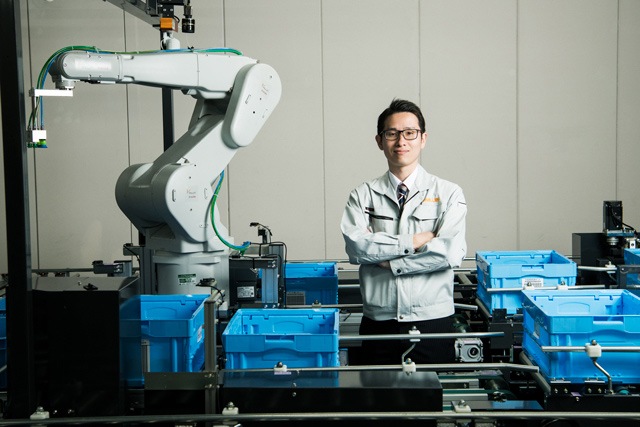
Issei Takino, CEO and co-founder of Mujin / Photo credit: Mujin
Japan has been a global leader in robotics for decades, but in recent years, local firms seem to be losing ground to the better-funded and better-publicized companies coming out of the US and China.
I sat down with a founder of a company that’s already starting to change that. Issei Takino established Mujin with his co-founder Rosen Diankov to develop an operating system for industrial robots.
Perhaps the clearest illustration of Mujin’s success is a project they did for Chinese ecommerce giant JD.com: the world’s first fully automated logistics warehouse where almost no humans work. Robots unload the trucks, stock the shelves, pick the items for delivery, pack them, and ship them out.
Takino and I went into some of the details of the technology, but we also talked about Mujin’s early days and how it acquired its first customers.
How did you and Rosen meet?
Rosen previously worked at Microsoft, Intel, and Willow Garage, which is one of the most famous robotics startups. He graduated the best in his class at University of California, Berkeley, and then entered Carnegie Mellon University, which is most famous for robotics. He got a doctorate degree when he was 26 years old.
We met in Japan when his team came over for an exhibition. At that time, I was working in an Israeli company where I was top sales.
He’s a super straightforward guy. He tried to convince me to do business with him, but I was just ignoring him. He would frequently send me long emails, and since I was busy, I just replied with two sentences.
After 10 months, he sent me another email and said he’ll have a postdoctorate job at Tokyo University. Then, he texted me and asked, “Can I meet you?” And I said, “No, I’m pretty busy. I’m actually in Osaka.” (I was just actually at my parents’ house, relaxing.) A couple of hours later, he texted again: “I’m at the Osaka Station right now.” I already told him I’m in Osaka, so I couldn’t really give him any excuse.
So we met in a cafe and he gave me about two hours of PhD lecture in motion planning tech. I couldn’t understand almost 98% of it. He didn’t have a product, but only the technology potential for a product.
Nevertheless, I decided to make a team with him because I thought I could be successful with him. I thought maybe even if we failed, we could start again.
How did you acquire your first customer?





Stay updated on the go with our mobile app.
Get latest insights with smoother, more personalized experience through TIA mobile app.