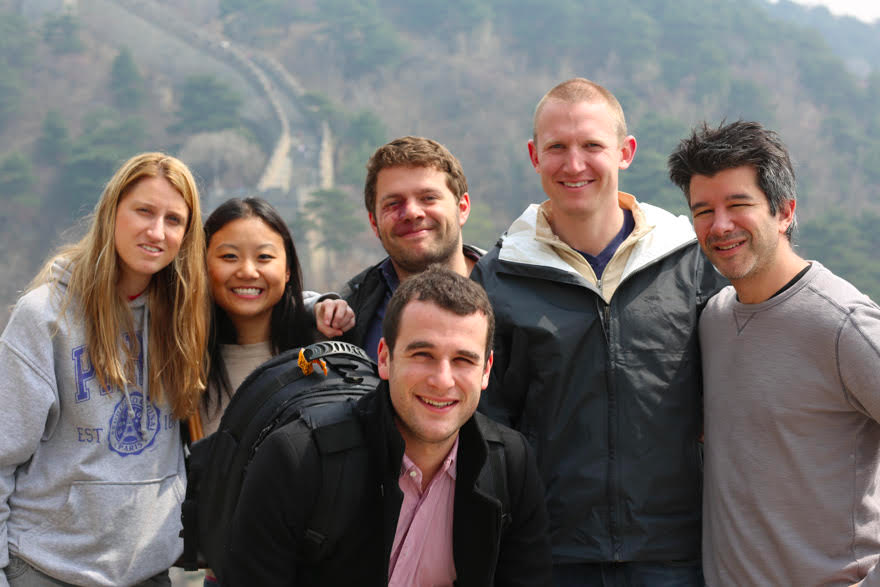
Uber boss Travis Kalanick (far right) with some of the early Uber China team. Photo credit: Kalanick’s Facebook.
Here’s a thing you already know: Uber sold its China business to rival Didi yesterday. Plenty has already been said about this, but many people are understandably interested in the thoughts of Uber founder and CEO Travis Kalanick, who publicly released a letter he sent to the folks of Uber China yesterday.
We published this letter without much comment. But since most of our commenters seemed to give Kalanick a pass, I want to return to take another look at how he, and by extension Uber, are framing this sell-off. Because to be perfectly frank, what Kalanick wrote is a bunch of revisionist bullshit.
The letter
In the letter Kalanick presents Uber’s decision to enter China as “big” and “bold,” something that most people would never have done. “Being an entrepreneur means you are an explorer by nature, doing what everyone thinks is impossible,” he writes. “And of course, anytime we got into a discussion about our efforts in China, most people thought we were naive, crazy – or both.”
That sounds great, but it doesn’t really reflect the truth of the situation.
First of all, there’s nothing particularly bold or exploratory about an established American tech company targeting the Chinese market. It’s not some niche backwater that the “explorer” Kalanick discovered, it’s the largest consumer market on earth. Most companies that reach Uber’s level at least consider making a China play.
Secondly, most people were not saying that Uber entering China was impossible, crazy, or naive. Go back and read the news coverage from around that time and this is plainly evident. TheNextWeb‘s Jon Russell (who’s now with TechCrunch), for example, wrote that “China is an obvious market for a global startup like Uber.” Here at Tech in Asia, my colleague Steven wrote that China was “crying out for Uber.”
It reads like Kalanick wants people to think this was a brilliant strategic decision he took.
Certainly, people knew that Uber entering China wasn’t going to be a cakewalk. But this idea that Uber was defying conventional wisdom with a gutsy China play is just PR spin. Uber’s China play wasn’t gutsy or against-the-grain. It was pretty much exactly what everyone expected the company to do.
Kalanick’s letter also puts an amazingly positive (and personal) spin on Uber China selling out to its main rival. The decision to sell to Didi, Kalanick says, came about because he knew to listen to his head, and because he saw that this was the best way to serve China’s cities and riders. To me, it reads like Kalanick wants people to think this was a brilliant strategic decision he took, sacrificing his own business interests for the good of China’s car riders.
In reality, it’s probably a decision he was forced into by investors who were sick of watching Uber bleeding cash in China without gaining much ground on Didi. Rumors to that effect had been swirling for a while – I made reference to that in a piece I wrote dismissing the possibility of a merger last week. Sure, yesterday’s acquisition makes me look dumb for writing that (in my defense, both companies had denied it), but it also seems to lend even more credence to the reports that Uber investors wanted out.
In other words: don’t pretend this was some brilliant strategic move you made for the good of China’s ride-hailing market, Mr. Kalanick. Your company was bleeding money and your investors wanted to pull the plug. That may not sound as pretty, but I’d bet it’s a lot closer to the truth.

Photoshop by TiA. Original image from Wikimedia.
Is this a success?





Stay updated on the go with our mobile app.
Get latest insights with smoother, more personalized experience through TIA mobile app.