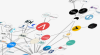
 Twitter was a pretty important communication tool for many people immediately after the Japan earthquake. Over on the Twitter blog this morning, there are a couple of great visualizations showing how Tweets spread across the globe after the disaster hit. It’s strikingly beautiful, until you reflect on what many of those messages meant — then it’s far more sobering.
According to Twitter, the replies to Japan-based users are in pink and messages sent to Japan are in yellow. Check it out for yourself.
If you want to drill down to what specific users were saying just before and after the earthquake hit, the service sembo.jp/zengo works nicely for that, although sometimes it throws errors.
Saved by social media?
Twitter received a lot of credit post-quake, and deservedly so. But I’m a little bit more reluctant to sing the platform’s praises. It was undeniably useful to me when telephone service was out. But the fact remains that even in Japan, Twitter penetration (though relatively high here) accounts for only a fraction of the population. Japan’s older demographic, perhaps the ones most in need of a lifeline in emergencies, still used television and radio to get emergency information during the crisis.
I attended a Docomo press conference this past Friday where the company highlighted that while Twitter was useful, there seems to be a distrust about the possibility of false rumors, or concern about the trustworthiness of anonymous users. While experienced Twitter users may have been able to gather excellent information from the platform after the quake (personally speaking, I clung to Twitter pretty strongly), I wouldn’t be surprised if new or casual users were lost at the time.
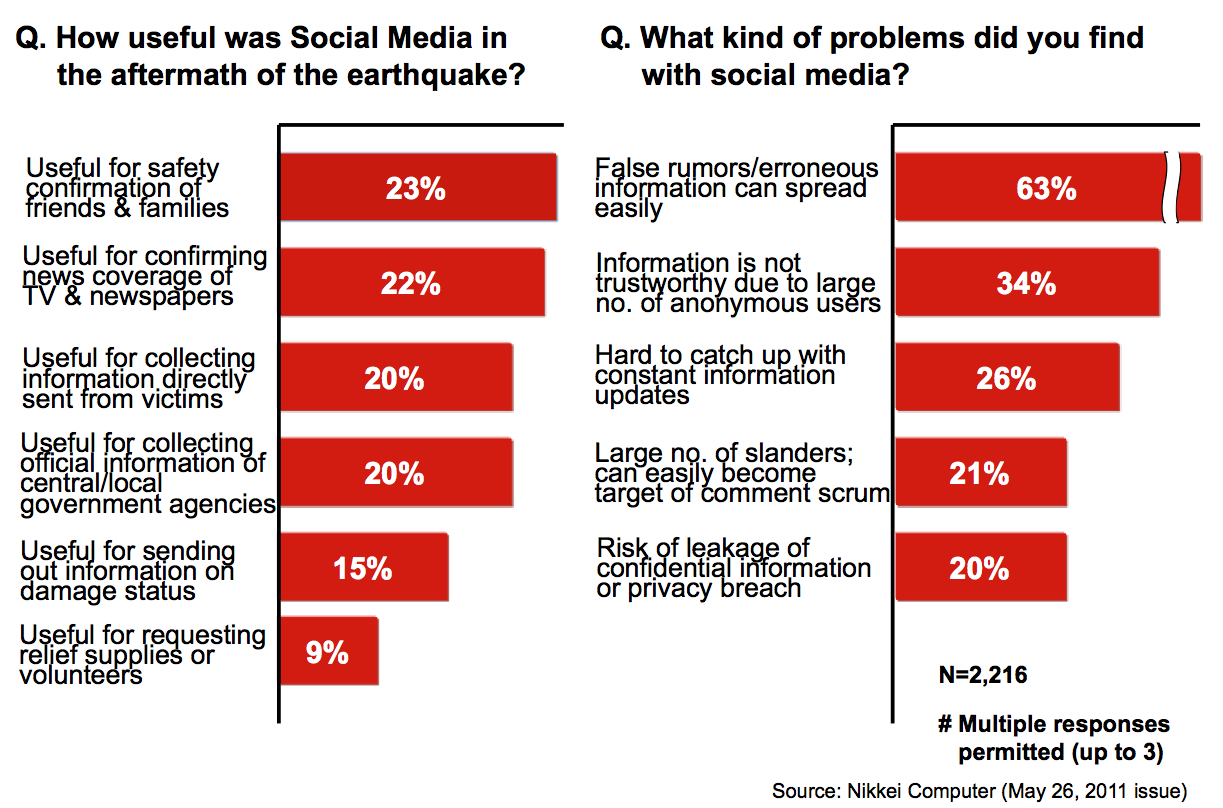
coutesy of Docomo
Docomo expressed hopes to further converge distaster emergency services with social networking services, and I think that’s smart. It certainly does help for those of us who live on those platforms. But it won’t adequately serve the masses.
I can’t help but wonder if Japan needs a more accessible, fool-proof disaster response. When voice calls can’t get through, Docomo’s current disaster voice message service aims to get voice messages through by sending a voice file over the network. This still seems pretty data intensive to me, and I couldn’t help but ask Docomo if there were a simple text-based emergency service that would require less data transfer. Is there something as data-efficient as Twitter that could be used by the entire population?
Perhaps it could be a primitive binary response like ‘Are you ok? Press 1 for yes, 2 for no.’ Maybe I’m being silly, but that wouldn’t clog any networks. I would think that Docomo’s geo-spatial research could play a big role here as well. (i.e. Where on the map do we see the most people calling for help?)
Docomo agreed that user interface needs to be made much simpler in order to be effective when people are panicking, and that this is something that they have to research further. Thankfully the company is making repairs and improvements to its network as well (below), and other operators are doing the same. While I absolutely love Twitter, I really hope I don’t have to depend on it again like that any time soon.
P.S. Japan still needs some help, so donate if you can. Or buy a book.





Stay updated on the go with our mobile app.
Get latest insights with smoother, more personalized experience through TIA mobile app.