Daniel Tay · · 4 min read
3 things Indonesia is doing to create the bank of the future


Photo credit: Bindalfrodo.
Seven years ago, leaders from major economies across the world came together at the G20 Pittsburgh Summit to discuss key issues pertaining to the international financial community. It was here that financial inclusion – access to formal financial services – was first raised as a goal to strive towards.
And rightfully so. For the poor, financial exclusion can be potentially life-threatening. It means that whatever little money they’ve managed to gather over many years could disappear in a flash due to natural disasters and theft. This essentially traps those steeped in poverty in a vicious cycle.
Globally, close to 2 billion people remain excluded from financial services of any sort. In Indonesia, things are starting to look up, but just barely. Around 36 percent of Indonesia’s population above 15 years of age owned an account in a financial institution as of 2014 – up from 20 percent in 2011 – which is still some distance from East Asia and the Pacific, where the rate stands at 69 percent.
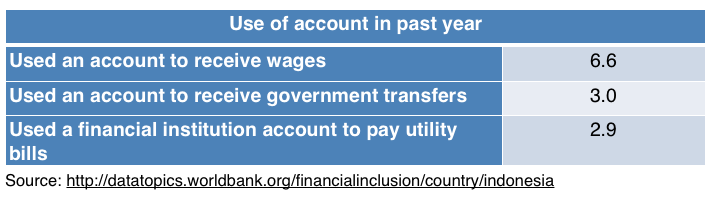
In fact, many of these accounts in Indonesia are largely untouched, as shown by the poor numbers in the table below:
It doesn’t help that Indonesian banks are incredibly inefficient. According to Boston Consulting Group, the ratio of operating expenses to assets – or the cost of providing services – ranges from 2.5 percent to 4 percent. As a comparison, the number stands at 2 percent in Malaysia and 1 percent in Singapore.
Suffice it to say that Indonesia’s finance industry is ripe for disruption – and fintech startups are emerging from all corners to innovate where conventional financial institutions are slow to provide solutions. Here are three things Indonesia is doing to create the bank of the future.
1. Fintech startups are rising to the challenge
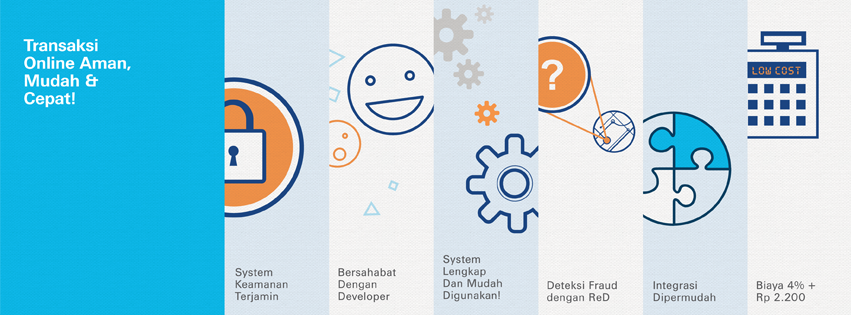
Already, local fintech startups are filling in the gaping hole left by banks. Cermati and CekAja, for example, are educating consumers by providing information and comparisons for various financial products. Veritrans and Doku are working on alternative and more efficient payment gateways.
Looking to the future, the pieces are moving in favor of would-be fintech startups. At the upcoming Indonesia Fintech Festival and Conference 2016, the stakeholders of the fintech industry – regulators, financial institutions, investors, and startups alike – will gather to collaborate and draw the roadmap of Indonesia’s banking future.
Budding fintech entrepreneurs will benefit from events such as Startup Competition, Startup Coaching, and Startup Speed Dating, giving them an edge going forward.
2. The government is paying attention
Photo credit: Bindalfrodo.
However, no startup can survive alone. Having a supportive ecosystem is integral to the success of fledgling ventures. In this respect, communication and collaboration between young startups, regulators, and financial institutions is essential.
Indonesia’s Financial Services Authority (OJK) is crafting regulations to govern fintech companies. This is an essential step to ensure that both startups and regulators are constantly on the same page, and that the consumer is protected. According to Deal Street Asia, the new rules will be launched by the end of the year.
According to The Jakarta Post, the government also promised at a recent conference that the government would provide more funding to stimulate the development of the startup ecosystem.
3. Financial institutions are getting involved too

Indonesian Rupiah. Photo Credit: Wikimedia.
Not wanting to be left behind, the old guard is also taking notice and is making moves to keep up with the future.
Mandiri Capital – the investment arm of state-owned Bank Mandiri – launched a US$37 million fund and an incubator in 2015 and 2016 respectively. The former will look at ecommerce startups, while the latter will focus more on fintech ventures.
About the Indonesia Fintech Festival and Conference 2016
Indonesia Fintech Festival and Conference 2016 is a joint event between the Financial Services Authority (OJK) and the Indonesian Chamber of Commerce (Kadin).
The agenda will consist of events such as: Startup Competition, Startup Coaching, Startup Speed Dating, and a conference that will be attended by stakeholders of the fintech industry, ranging from regulators, financial institutions, investors, startups, incubators, industry associations as well as academia.

Stay updated on the go with our mobile app.
Get latest insights with smoother, more personalized experience through TIA mobile app.
Recommended reads
 Life’s a game, and AI agents are Animoca’s new play
 Indonesian AI startup goes global
 Forrest Li on scaling Sea, building smarter bots, and founder grit
 An AI assistant that joins sales calls and scores team skills
 Beyond the check: Why VCs need more than capital
 SGX’s CEO says it doesn’t need a unicorn to win
 SMEs want AI too, but not the kind Big Tech is selling
 Oatside’s alt-milk rise hits a profitable gear
 Alibaba’s financial health in 12 charts
 Asia’s telcos bundle AI into mobile plans. Will it pay off?





Editing by Terence Lee and Nadine Freischlad
(And yes, we’re serious about ethics and transparency. More information here.)