- Premium Content It takes our newsroom weeks - if not months - to investigate and produce stories for our premium content. You can’t find them anywhere else.
 Jessie Lim · · 5 min read
Singapore’s soaring rents reshape co-working dynamics
While the take-up of flexible workspaces in Singapore fell to the lowest in five years, some co-working operators in the country continued pushing on with their expansion plans in 2024.
An estimated 45,000 square feet of space was taken up by the country’s flexible space operators this year, down from the pre-pandemic peak of around 700,000 square feet in 2019, according to figures compiled by Colliers for The Business Times.
Take-up refers to the new space occupied by flexible workspace operators every year.
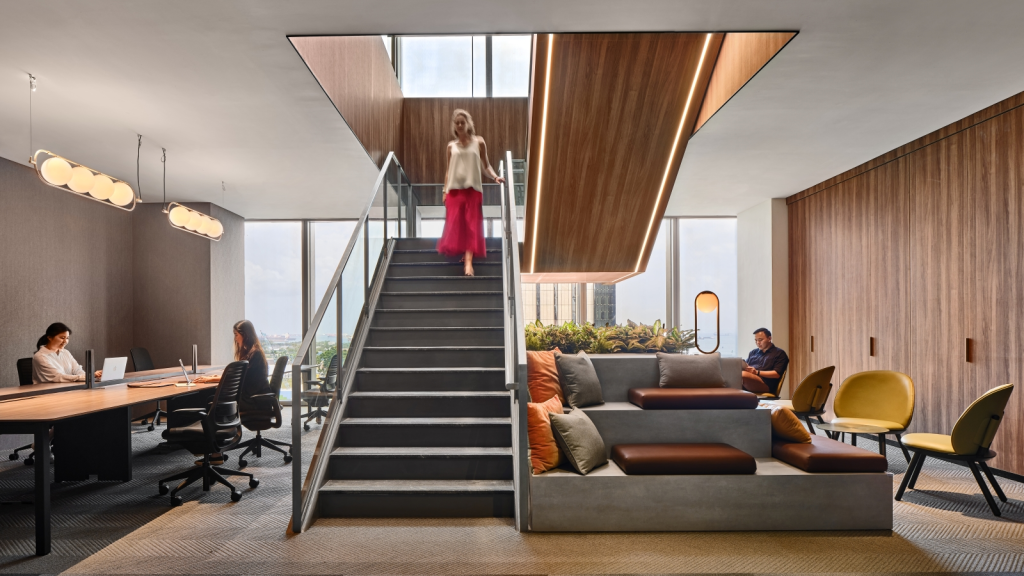
The Work Project’s CapitaSky co-working space / Photo credit: The Work Project
The pace of co-working expansion in Singapore has slowed significantly post-pandemic, as operators take on a cautious stance and prefer a capital-light model amid a heightened interest-rate environment, according to Wong Xian Yang, Cushman & Wakefield’s research head for Singapore and Southeast Asia.
“The business model for some co-working locations, particularly those in certain prime core Central Business District buildings, has become unsustainable,” says Tricia Song, CBRE head of research for Southeast Asia. “High rental costs, coupled with additional fit-out expenses, result in increased costs being passed on to tenants, which undermines the viability of their business case.”
Alan Cheong, executive director of research and consultancy at Savills Singapore, notes how co-working operators are often funded by venture capitalists and thus have a different growth model from traditional real estate developers, placing market share capture ahead of cash flow.
“From 2022, VC funding skewed toward AI-related businesses. Co-working operators are finding greater resistance in fundraising, and this may hamper their expansion plans,” he adds.
Still, Singapore’s flexible office market continues to grow, albeit at a slower rate, according to CBRE’s Song.
As of the end of the third quarter of 2024, net of closures, there was a marginal expansion of 1% in the overall flexible workspace market in the country compared to end-2023, according to CBRE data. Year-on-year growth stood at 3% in 2023, after peaking at 34% in 2018.
Exits and entrances
This year marked notable closures across Singapore’s co-working space sector. In March, Distrii vacated about 60,000 square feet of space in Republic Plaza, after it failed to pay City Developments Ltd (CDL) over S$2 million (US$1.5 million) in rent as of February 2024. The space has since been taken over by CDL’s subsidiary City Serviced Offices.
WeWork has given up about 60,000 square feet of space in Manulife Tower at 8 Cross Street, Bloomberg reported in November. It will also not be renewing its co-working space at UE Square in the Clarke Quay area when the lease expires in 2025.
JustCo surrendered its premises in Asia Square Tower 2 earlier this year after its lease expired, while it is expected to vacate its Samsung Hub outlet by the end of the year. Both locations were opened more than 10 years ago.
Partnering with landlords
Stay ahead in Asia’s tech landscape
This is premium content. Subscribe to read the full story.
Tighter margins have led some of the country’s co-working space operators to adopt an asset-light strategy.
We know this is not ideal. ⌛ Sign up in 20 seconds. Cancel anytime.
Our subscriber community includes professionals from these companies:





Stay updated on the go with our mobile app.
Get latest insights with smoother, more personalized experience through TIA mobile app.










📅 Upcoming Events
22 October 2026
Payoneer x CSPN Summit 2026