Annie Teh · · 7 min read
Beginner’s guide to tracking non-monetary social media goals


Photo Credit: Unsplash.
Social media is a great medium for companies trying to reach their audience in a targeted way. Social media spending is projected to account for 16 percent of the digital ad market by 2017, and you would be hard-pressed to find a business without at least a Facebook page.
But how do you justify the spend and the time, especially when your goals are not linked to monetary gain, revenues, or sales? When the goals are as intangible as awareness and sentiment, social media metrics can get tricky.
What is social media ROI?
ROI, or Return on Investment, measures how your investments are making returns. The formula is simple.
ROI = ($return – $investment) / $investment
This formula could calculate social media ROI if there is a monetary link to your objectives. The formula will get an ROI figure which is easy to justify. Positive returns are a good sign of a campaign worth running.
If your returns don’t link to any monetary value, you could assign values to them. For example, if you gain some new followers, you can multiply the lifetime value of each customer by the conversion rate, or the possibility that those new followers will become customers.
If you’re driving traffic to your site, you could use the average revenue per site visitor.
But your business objectives can’t always be linked to a monetary sum or revenue. Depending on how mature your business is, your social media efforts would change with your business needs, and thus influence the metrics you should track.
Brand awareness
Awareness is almost always the first non-monetary goal a startup would have. Kenneth Lou, who’s running early-stage startup Seedly, the priority of his social media activity is to increase a follower base and supporters, so that “it will be easier to reach them and let them know about the latest features or launches” in the future.
If you’re running a social media awareness campaign, your social media monitoring plan could track a variety of metrics to help you meet your goals.
- Total impressions: Impressions measure the potential audience that your brand has reached, based on the networks of the authors generating mentions of your brand.
- Engagement: this includes likes, clicks, shares, retweets, comments. Shares metrics are especially important, as it amplifies the content you publish.
- Mentions of your brand name: the number of times your brand name was used across social media, which gives you an idea of the amount of attention your brand has received.
- Social share of voice: the percentage of mentions about you within the industry versus what percentage is about your competition.
Event attendees

Photo Credit: Pixabay.
You may promote an event on social media, but that doesn’t necessarily mean people will sign up or even show up. Tech in Asia content marketing manager Cheong Hui Min knows it can be difficult to see how effective social media campaigns are in driving event attendees.
To get a clearer idea of how much traffic your social media campaigns drive to your event, include a UTM tag in the event URL in your social post. UTM tags are codes that Google Analytics can track, allowing you to distinguish which campaigns get more traffic or conversions.
Here’s an example:
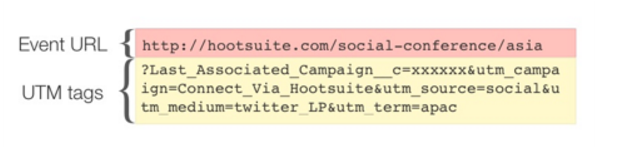
This particular campaign is named “Connect Via Hootsuite” and is tailored to track a social media campaign on Twitter for the region of APAC. You can customize each parameter to your choosing. If you’re using a customer relationship management (CRM) system to record event registrations, include a parameter called ‘Last Associated Campaign’ among the UTM tags.
Once the event is over, collect the email addresses of the attendees and run that list against the list of registrations generated through social to determine how effective your campaign was.
App usage, not downloads

Photo Credit: Pixabay.
App downloads are a common concern, but what about app use? Spark Asia’s CMO Vera Ho says that one of her main concerns for Spark is increasing usage of the app, especially the Perks feature within the app that allows offline redemptions of promotions and offers.
“If users are redeeming these perks in-store, the reconciliation process is a lot tougher,” explained Vera. “This prevents us from ascertaining actual revenue generated from our ads which also mean businesses may think our ads aren’t as effective.”
To increase app usage, determine trackable use cases for your app. This could be anything from downloading an update to using a feature within the app. Once you have determined the use case, craft a social media campaign or series of social media posts with calls to action (CTA) to drive the desired behavior.
In Spark’s case, the social media messages should address how to make users aware that the app offers discount coupons for restaurants and then drive them to redeem those discount coupons. The social media posts can showcase the range of restaurants and size of discounts covered by the app with a CTA sending users to check out that feature in the app.
Analyze the app data to find which coupons are redeemed most often and follow up with a series of messages promoting that particular restaurant and coupon with a CTA directing users to redeem. If you want to measure which of your social channels is driving this behavior more effectively, use a different series of discount codes for each social network.
You can create three or four use cases and craft social media posts and CTAs for each one. Track click through’s and related metrics to measure how social media is impacting app usage.
Thought leadership

Photo Credit: Atos.
Perhaps the most intangible goal of all is creating thought leadership — how much people see your brand as an expert and leader in the field. Attaining thought leadership builds credibility and trust among their target community, but it’s difficult to measure. While social media management tools may help measure positive or negative sentiment, respect is a very different animal.
The first step is to find out what your audience is interested in. The next step is to create and share content that positions you as an expert on those topics. Tracking your content gives you a better idea on what content your followers prefer.
Next, set goals for the kind of metrics you want to meet. The kind of engagement can you tell a lot about how people perceive a brand. For example, thought leaders are more likely to get tagged on questions, comments, and posts relating to the topic that you’re trying to position yourself as a thought leader on.
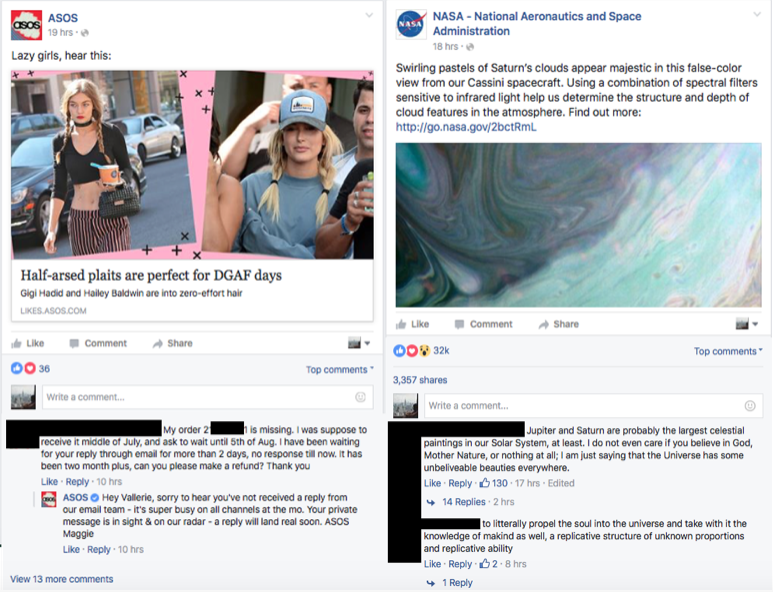
Note that different businesses and content can inspire different types of engagement. For example, an ecommerce site like ASOS would get more people asking for help, while an institution like NASA would have more shares. For a better idea of what kind of engagement you should expect, look to social media pages of market leaders and competitors.
Track, track, track
When running social media campaigns, remember to be consistent in your tracking. There are several tools out there that can help you track metrics and find opportunities to improve your social media ROI. Keep a pulse on what is producing results and what is not, or you will lose valuable time and resources on unsuccessful campaigns.
If you’re interested to learn more, Hootsuite will be hosting Connect via Hootsuite, a free online social media conference. On September 7, join 4,000+ social innovators and industry experts to discuss how brands and businesses can measure and grow social media ROI to support their business objectives.

Hootsuite is the most widely used platform for managing social media, loved by over 14 million people around the globe and trusted by more than 800 of the Fortune 1000. With Hootsuite, brands harness the power of social. Our platform brings together your social networks and integrates with hundreds of business applications. It’s the one place to build customer relationships, listen to the needs of the market and grow your revenue. To learn more, visit www.hootsuite.com.
Stay updated on the go with our mobile app.
Get latest insights with smoother, more personalized experience through TIA mobile app.
Recommended reads
 Animoca co-leads $1.75m round of IreneDAO creator
 WhatsApp could be incubating the region’s next billion-dollar startup
 UMG IdeaLab pours seed money into Indonesian influencer marketing platform
 Will virtual humans replace ‘real’ influencers, models, and more?
 Engaging Gen Z through interactive gaming
 Gojek to take on GrabAds with the launch of digital ads solution GoScreen
 High-voltage drama in the world’s fastest-growing video-streaming market
 Breaking down WhatsApp and Facebook’s super-app ambitions
 A VC’s advice for startups looking to take the next step in their growth journeys
 Meta launches Avatars Store in Singapore





Editing by Terence Lee and Steven Millward
(And yes, we’re serious about ethics and transparency. More information here.)