
Tired of ads? Enjoy an ad-free experience by signing up.
Chad Bray · · 6 min read

Trade war is killing overseas investment by Chinese, US tech companies, analysts say

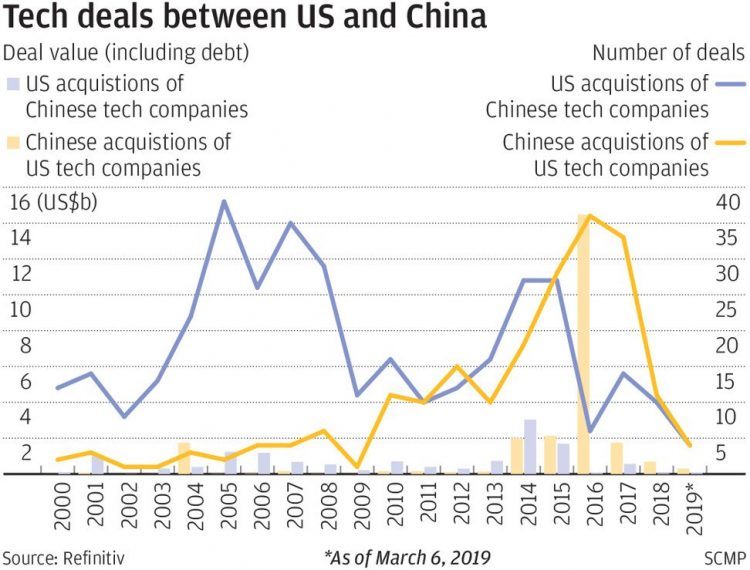
Efforts by the US to block Chinese access to its latest technology is weighing on cross-border investment in both countries as tensions over trade and technology policies have escalated between the superpowers in the past year.

The stand-off between the world’s two largest economies could ultimately cause a long-term split in future research and development between rival tech leaders based in Shenzhen and Silicon Valley, according to analysts and market observers.

Copyright: bingfengwu / 123RF Stock Photo

Tencent headquarters in Shenzhen / Photo credit: bingfengwu / 123RF

Investments by Chinese firms in the American semiconductor and technology hardware segments dropped by nearly five times in 2018 to US$203.4 million from US$1.03 billion the previous year, according to the latest data from S&P Global Market Intelligence.

Software and services was the only area within the US technology sector to see a significant increase in Chinese-affiliated investment last year – driven primarily by an US$8 billion investment in Uber by a group that included Chinese tech giant Tencent Holdings, according to S&P Global.

Photo credit: South China Morning Post

Matthew Doull, head of the internet and digital media practice at the investment banking adviser BDA Partners in Hong Kong, said American and Chinese companies considering cross-border mergers are holding back on deals even if they “are not by any stretch sensitive from a military or intelligence perspective.”

“My experience is that on an informal basis it’s creeping into everything,” Doull said. “For us – digital media, travel tech – frankly rather benign consumer-oriented businesses, we see people on both sides self-censoring.”

The drop in Chinese investment comes after US President Donald Trump slapped tariffs on about half of all of the country’s exports to America in a sharp-elbowed confrontation between the two countries.

US lawmakers have raised the alarm over China’s efforts to acquire technology and advance its manufacturing base, in particular its Made in China 2025 program. The initiative is designed to increase domestic production in a number of key technology sectors, including semiconductors and robotics.

In response, the US has increased its scrutiny of foreign-led mergers and investments and is crafting new rules to restrict the ability of Chinese companies and others to export technology.

It has also banned government agencies from buying equipment from Chinese telecommunications companies Huawei and ZTE. The US is separately pursuing criminal charges against Huawei ranging from financial fraud to violating American sanctions against Iran.

At the same time, fewer funds have been available for investment as Beijing has limited the ability of Chinese companies to bankroll overseas transactions as part of a deleveraging campaign begun in 2016 that has seen some companies forced to sell their foreign holdings.


Stay ahead in Asia’s tech landscape

You've reached your 2 free content limit for the month. Sign up for free to read the full story.

🏄 For casual readers / 👶 Free

Basic

US$0

Free forever

Get instant access to this article and more every month

0 premium content

Unlimited news briefs

5

5 articles

Ad-free reading experience

Just US$0 per day

⌛Sign up in 20s. No payment details needed.

📖 For learners / 👍 Starter

Lite

US$4.92/month

Billed annually at US$59/year

Get instant access to this article and more every month

4

4 premium content

Unlimited news briefs & articles

Ad-free reading experience

Just US$0.17 per day

Cancel anytime

Our subscriber community includes professionals from these companies:

Stay updated on the go with our mobile app.

Get latest insights with smoother, more personalized experience through TIA mobile app.

Community Writer

Chad Bray

Bray is a senior business reporter focused on finance. He joined the Post in 2018 and has previously written for The New York Times, The Wall Street Journal and Dow Jones Newswires.