Jonathan Burgos · · 2 min read
Grab scales up advertising amid ride-hailing, food delivery boom
Dear readers,
Flagging our most read story last week: Jack Ellis’ opinion piece on GrabAds. It’s a deep dive into the increasing traction of the company’s in-app and in-car advertising as well as its merchant marketing services.
As Grab’s ride-hailing and food delivery business thrives, the super app is leveraging its growing user base to build yet another ancillary business in GrabAds. Launched in August 2018, the online-to-offline advertising platform could now be generating annual revenues of over US$245 million and as much as US$700 million by 2025, analysis by Tech in Asia shows.
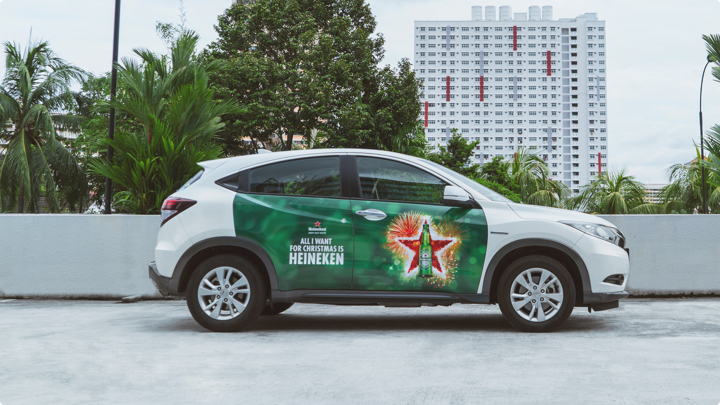
Heineken ads on a Grab car / Photo credit: Grab
If you like these kinds of stories, do take a look at our take on why a merger between Grab and Gojek makes sense. If a merger does happen, our founder and CEO Willis Wee argues that the combined entity could be valued at about $72 billion by 2025.
Grab’s evolution from ride-hailing to food delivery and now to advertising is a good example of how startups that began as business-to-consumer platforms are morphing into business-to-business service providers.
Our chief correspondent Terence Lee reported on this trend in the ecommerce space. B2B ecommerce startups are emerging across Southeast Asia, promising to bring traditional businesses such as the neighborhood stores in Indonesia and the Philippines into the digital age.
In our drive to bring you more in-depth stories on developments across the tech startup space, we are constantly investing in new talent. Last week, Vincent Fernando, founder of Zero One, a technology specialist corporate finance advisory firm, wrote his first piece for Tech in Asia.
In his commentary, Vincent, who has over 15 years experience in investment banking, predicts that China’s online retail sales will exceed offline sales for the first time in 2021 as consumers turn to digital services as the novel coronavirus – now officially called 2019-nCoV by the World Health Organization – continues to spread like wildfire.
Indeed, as Covid-19 – the disease caused by this new microbe – scares people away from shopping malls in Shanghai, Hong Kong and Singapore, ecommerce platforms are filling in the gap.
To read more tech industry insights and inspiring startup narratives, do subscribe to our premium content and support good journalism.
Speak to you next week.
Cheers,
Jonathan
Editor-in-Chief
Stay updated on the go with our mobile app.
Get latest insights with smoother, more personalized experience through TIA mobile app.
Recommended reads
 Indonesian AI startup goes global
 Forrest Li on scaling Sea, building smarter bots, and founder grit
 An AI assistant that joins sales calls and scores team skills
 Beyond the check: Why VCs need more than capital
 SGX’s CEO says it doesn’t need a unicorn to win
 SMEs want AI too, but not the kind Big Tech is selling
 Oatside’s alt-milk rise hits a profitable gear
 Alibaba’s financial health in 12 charts
 Asia’s telcos bundle AI into mobile plans. Will it pay off?
 M-Daq chases bigger clients as revenue falls, losses grow