 Paul Bischoff · · 3 min read
Tone Troubles? Qooco Teaches Tonal Languages on your Smartphone
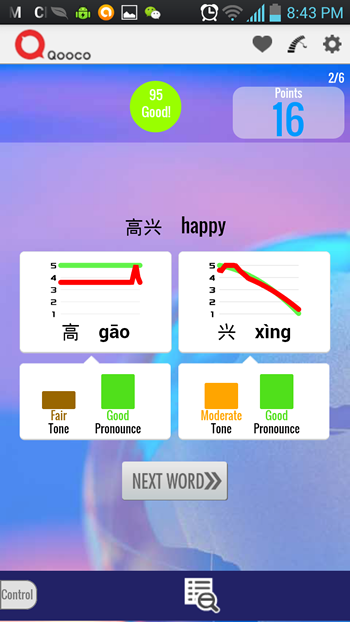 I’ve been studying Mandarin Chinese at varying intensities for almost four years now, but I admit I still tend to neglect the tones, both when listening and speaking. For the uninitiated, almost every syllable in Mandarin has one of four tones that completely changes the meaning of what’s being said. As you might imagine, this causes a lot of confusion for both parties in the conversation and ends with me feeling like a numbskull.
So when Qooco told us about their Mandarin-learning app that includes tonal recognition, I jumped on the opportunity to test it out. QoocoTalk’s proprietary speech technology can not only listen and tell me if my tones are correct, it can provide feedback on how to get better. The app for both Android and iOS offers the first lesson free for anyone to try out. QoocoTalk also offers English lessons, with support languages in Korean, Japanese, Vietnamese, Thai, Indonesian, Malay, German, Russian, and Mexican Spanish. I test-drove Qooco Talk Platinum, but there’s also a kids’ version and a hospitality version for people who work with foreign tourists.
CEO David Topolewski says, “the best way to learn is to continually practice at a high frequency, not necessarily longer durations.” A lesson includes several exercises that can each be finished in about five minutes or less. They include reading, speaking, and listening both with and without the phonetic spellings. The in-house speech recognition is pretty spot on. Users should be aware that it caters to a standard Mandarin accent, so other dialects might be graded as less correct.
A few criticisms
On the downside, I’m not a huge fan of the user interface, which could better utilize screen space. The app has a few features that just seem superfluous. A points system attempts to gamify the experience, but it provides little incentive. I don’t feel any intrinsic reward if I do well. Qooco is developing sharing functions so users can post their scores on Facebook, Twitter, Weibo, and QQ, but I honestly can’t see myself bragging about my awesome pronunciation to cyberspace.
Right now, the lessons don’t get very advanced. I would love to see more lessons for people like me who are above “survival Chinese” level but not fluent, which is where many Mandarin students wash out. I don’t think QoocoTalk can replace a tutor or classroom, but it could certainly supplement them.
On my LG smartphone running Android ICS, headphones were required. The sound from the speaker was almost inaudible. However, Topolewski says Qooco has not encountered sound problems with the volume on other devices tested.
It’s also not cheap. Costs vary depending on your location, but a starter package for 180 days (one “semester”) of usage costs 200 RMB ($33). Make sure you pre-download the lessons you want to work on via Wifi before you head out for the day. Otherwise, you’ll also be paying for a bigger data plan.
Future plans
Qooco is working on expanding its reach further into Southeast Asia and serving more hospitality companies, which is the B2B side of its business model. Topolewski says Qooco is also looking into partnerships with Telecom companies to deliver value-added content.





Stay updated on the go with our mobile app.
Get latest insights with smoother, more personalized experience through TIA mobile app.









