Miguel Cordon · · 4 min read
Singapore’s Transcelestial banks nearly $10m in series A round
Singapore-based Transcelestial, a startup that’s building a space laser network to deliver high-speed internet connectivity, said it has raised US$9.6 million in a series A funding round co-led by Wavemaker Partners and EDBI.
New investors Airbus Ventures, Partech, Tekton Ventures, and Cap Vista – the strategic investment arm of the Defence Science and Technology Agency of Singapore – also participated in the round. Existing backers Entrepreneur First, Seeds Capital, and two angel investors pitched in as well.
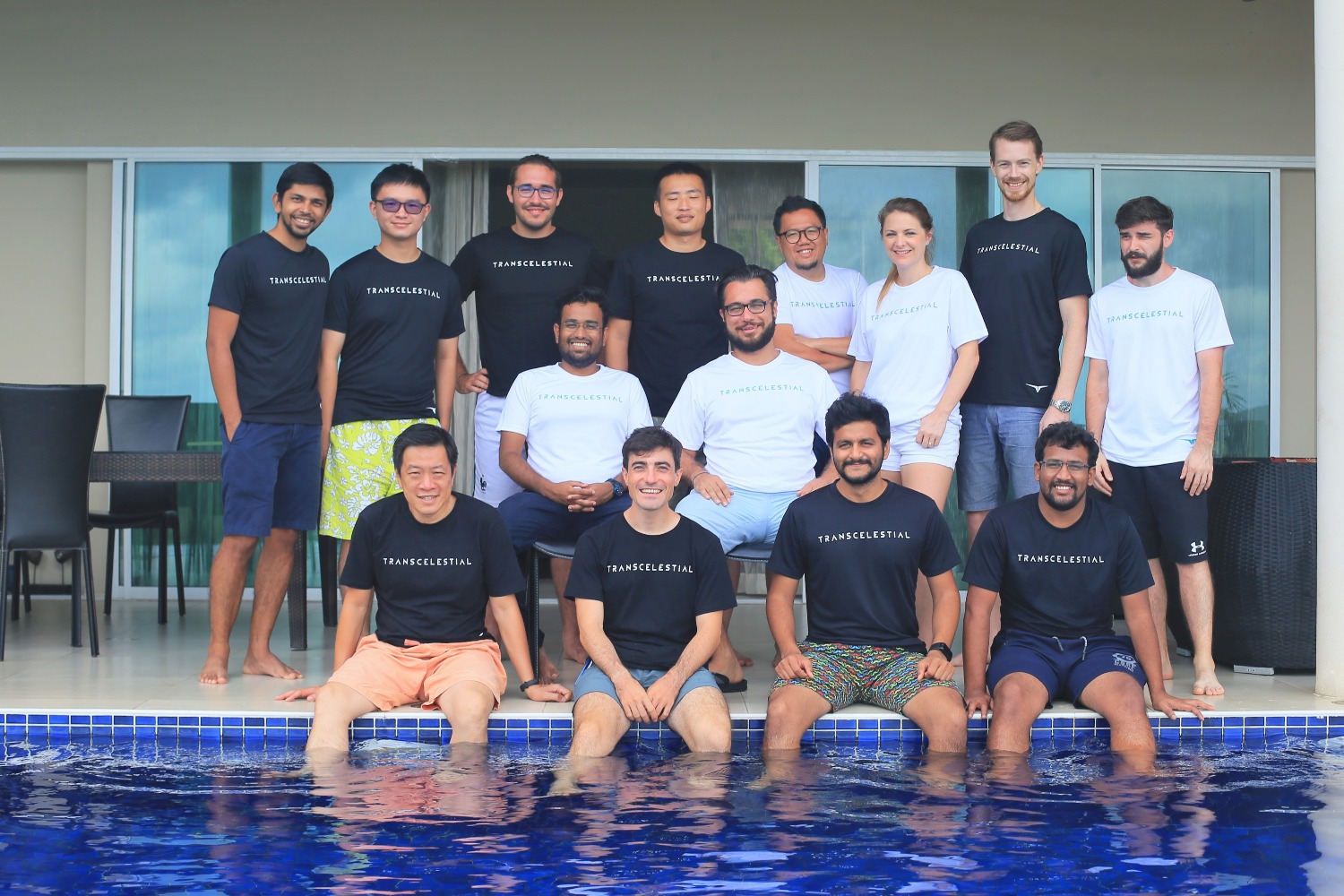
The Transcelestial team / Photo credit: Transcelestial
What problem is it solving? The internet is delivered to connected devices in three fundamental steps. First, undersea cables are used to channel data such as videos and music hosted from one country to another. Once these undersea cables come up to a country or continent, telcos and governments build national fiber grids to carry the data to larger cities and smaller towns.
Finally, internet service providers take the data and use a mix of fiber and wireless technologies to transfer it to end users. This is where Transcelestial’s technologies come in.
Founded in 2016, Transcelestial beams data over to satellites, which then redirect the data to where they’re needed globally. Its proprietary wireless laser communication technology, which it calls “wireless fiber optics,” combines the speed of fiber optics with the flexibility of radio waves to reduce bottlenecks.
Centauri, Transcelestial’s mass-produced network device, uses this type of tech to create a wireless distribution network between buildings, cell towers, street-level poles, and other physical infrastructure. It’s aimed at providing rapidly deployable, affordable, and high-speed last-mile connectivity to speed up the adoption of 4G and 5G globally.
According to the company, bottlenecks in the internet delivery architecture may result in massive rollout costs, leading to more than half of the world left unconnected or with poor access.
What are its future plans? The importance of last-mile connectivity to homes and offices has become critical with the advent of the Covid-19 pandemic, Transcelestial observed. The startup said that almost every country has seen a 35% to 45% surge in internet usage during this period, putting pressure on existing networks.
“Last mile [connectivity] impacts consumers and businesses directly, and around 70% to 80% of our focus will be to work with partners in this industry to help resolve this,” Transcelestial co-founder and CEO Rohit Jha told Tech in Asia.
However, the company believes that the biggest wins can only come from an orbit-based distribution approach to resolve bottlenecks within the first two steps in the internet delivery architecture.
To achieve that, the startup said it will develop a constellation of small satellites in low Earth orbit to deliver affordable and high-speed network connectivity. “The key element will be the usage of Transcelestial’s wireless laser communication technology to deliver end-to-end fiber-equivalent speeds as a data backbone,” it added.
What challenges has it faced recently? When Transcelestial was just building out its technology, the startup knew it had to find out how to get the telecommunications industry, which has been traditionally slow-moving, to adopt its new wireless laser communication system.
According to Jha, the company had to identify telcos that have been early adopters of newer tech in general and work with them. The introduction of Transcelestial’s technology has also coincided with the rise of 5G, which is pushing telcos to try out innovations in the space.





Stay updated on the go with our mobile app.
Get latest insights with smoother, more personalized experience through TIA mobile app.