- Premium Content It takes our newsroom weeks - if not months - to investigate and produce stories for our premium content. You can’t find them anywhere else.
 Katrina Balmaceda · · 7 min read
Thunes is building a superhighway to unify the world’s payments systems
In recent years, mobile wallets and banking apps have made local payments fast and convenient. But moving money across borders has been a less satisfying experience.
When you move funds from one bank to another that’s abroad, you don’t get real-time updates about the status of the transfer. You typically wouldn’t know how much the recipient will get until after transaction fees and markups on currency exchange rates have been deducted.
There’s also less flexibility and few options when it comes to cross-border transfers between mobile wallets or between e-wallets and banks. It’s often hard to transfer money between e-wallets locally as well because they’re not linked to one another.
Thunes, a Singapore-based company founded in 2016, wants to solve this problem and has set its sights on emerging markets in Africa, Asia, and Latin America.

“Think of Thunes as building highways, and the likes of Western Union, MoneyGram, financial institutions or e-wallets are the truck stops,” says Thunes CEO Peter de Caluwe. “In many cases, they are not connected to each other domestically. And in most cases, very few are connected to international systems.”
Thunes is forging connections between all the players and linking them to one central platform.
Who needs an interconnected payments highway?
There appears to be little incentive for cross-border payment providers to create a network that links to every available player in the market. The cost, resources, and myriad government licences required to develop it deter them from doing so.
But with payment and funds transfer options on the rise, de Caluwe believes that integrating them will reduce the complexity and cost of cross-border payments.
For Thunes, it’s a matter of taking first-mover advantage in assembling such a network.
The company currently operates in over 100 countries and has roughly 400 partners in its network. It targets financial institutions, payment companies, and businesses that conduct cross-border trade.
These customers use Thunes to carry out cross-border business payments, send mass payouts to global partners, process remittances, and issue virtual accounts in various countries.
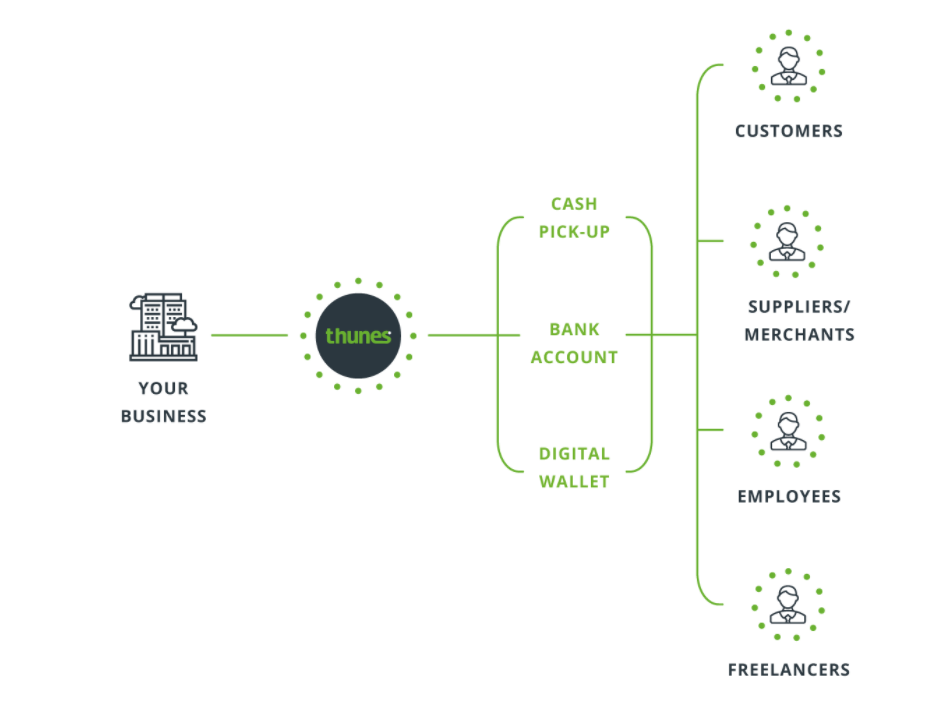
How Thunes issues mass payouts / Image credit: Thunes
Navigating a web of regulations
Risks of global financial crime
A subscription model for the network
Stay ahead in Asia’s tech landscape
This is premium content. Subscribe to read the full story.
With payment and funds transfer options on the rise, integrating them will reduce the complexity and cost of cross-border payments.
We know this is not ideal. ⌛ Sign up in 20 seconds. Cancel anytime.
Our subscriber community includes professionals from these companies:





Stay updated on the go with our mobile app.
Get latest insights with smoother, more personalized experience through TIA mobile app.








📅 Upcoming Events
22 October 2026
Payoneer x CSPN Summit 2026