IGNITION · · 8 min read
How the Japanese robot avatar OriHime fights loneliness
This post has been previously published by our friends at Ignition. It has been modified from the original.
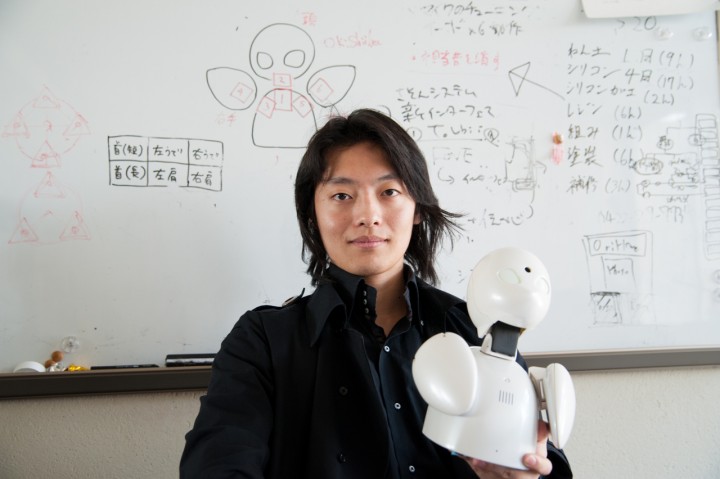
Inventor Kentaro Yoshifuji with Orihime, the robot avatar
In this world there are many who remain unseen, weighted and shut in by their own loneliness. There are hospitalized children who cannot go to school, senior citizens who cannot move freely but whose minds are fully intact, and members of the armed services who only rarely see their families. Solitude continuing over extended periods raises a risk of self-estrangement and feelings of powerlessness, and can lead to depression. In the elderly, it can also hasten dementia.
The robot avatar OriHime aims to eliminate this kind of isolation, but it is not a conversation partner, or something that will play with you and keep you company. Instead of creating an artificial interaction, OriHime is a robot designed to facilitate connections between humans.
For example, consider a child who has been hospitalized for an extended period of time. The child wants to attend school, but cannot. OriHime can be put at the child’s desk instead. The child can then use a smart device or a PC to control OriHime at a distance. OriHime comes equipped with a microphone, camera, and speaker, and its head and arms can be moved by remote control. If you want to look to the right, OriHime can be made to do so by controlling it with the device.
By using the device in the hospital room, the child can have the feeling of chatting directly with their friends. The child can not only take a class but actually participate in it, for example by answering the teacher’s questions. OriHime becomes an alter ego or avatar.
Healing only happens between people
The CEO of Ory Laboratory, the Japanese company that created OriHime, is 27-year-old Kentaro Yoshifuji. As a child he was physically weak, and experienced the solitude of hospitalization and home-bound convalescence.
“From elementary school to middle school, over a period of three and a half years, due to stress and illness I was at home and for the most part could not go to school at all. I became mentally and physically weak from excess stress, and couldn’t bear to meet others. I fell behind in my studies and was racked by feelings of inferiority. I distrusted people, and was tormented by an acute loneliness,” Yoshifuji says.
After this he went on to an engineering-focused high school, and, thinking he wanted to make something of use to people, focused his efforts on designing a wheelchair. His new wheelchair design won third place at the Intel International Science and Engineering Fair, and the achievement was covered in the local media.
For his next project, he decided to tackle the problem of loneliness. Thinking back to his own experience, he set to work on this problem. However, when he began to study the various experiments with artificial intelligence popular at the time, little by little he began to feel something was off. Even if an artificial intelligence robot can reduce feelings of loneliness, it is powerless to eliminate them completely.
For Yoshifuji, the most important part is not connecting human and robot, but connecting human and human. “The reason I could return to society like I did is thanks to the support of various people. I was spurred every time someone said, ‘I don’t want you to give up.’ The most important thing was human-to-human connections. I don’t think any healing can happen without this,” he explains.

Design that recognizes existence
“I watched TV with my family”
A care technology to make patients active
The present and future of OriHime





Stay updated on the go with our mobile app.
Get latest insights with smoother, more personalized experience through TIA mobile app.