- Insights This article was written by a TIA community member. Insights pieces undergo the same rigorous editorial process that newsroom-produced articles have.
 Harshjit Sethi · · 5 min read
The importance of key metrics in building an enduring business
The most successful founders leverage data every day to get better at what they do.
They start with a vision, which they then break down into goals that are relevant for each phase of development.

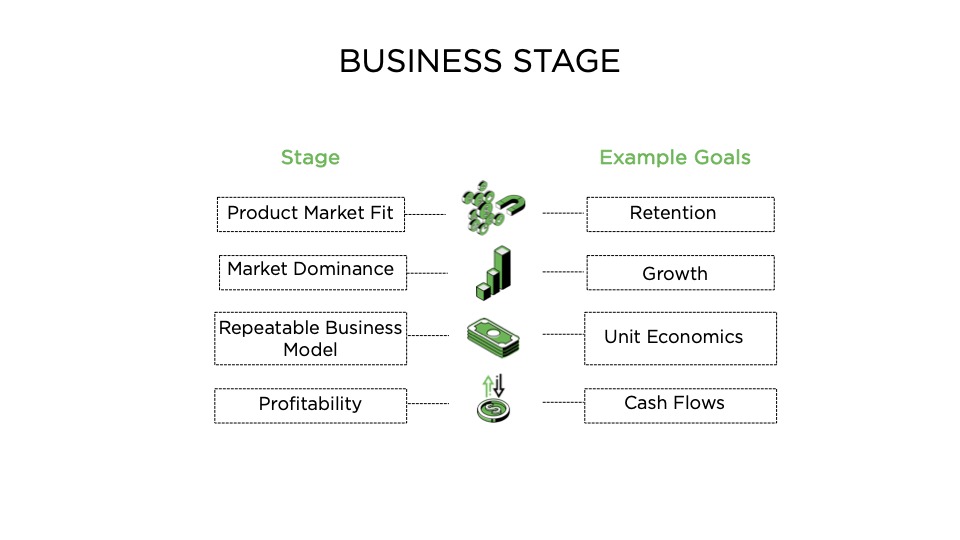
Photo credit: Sequoia Capital
No matter how a business outlines its action plan, it’s best to identify the metric that would matter most in each phase, as well as a counter metric that will help ensure sustainable success.
For example, when scaling its business, a company’s key metric could be the number of active users and the counter metric would be customer acquisition costs (CAC). Then in the revenue phase, the focus may be on the average revenue per user, with the conversion rate as the counter metric.
Once identified, these key metrics should be the company’s North Star.
Translating a goal into a series of measurable steps helps ensure that everybody can do something to move the ball forward each day. And in reviewing data, accountability is assured through a constraint that’s measured with a counter metric.
Picking the right metric for your business goals
Founders typically ask themselves one of three questions to help define their North Star:
- What is the company’s vision? Consider Facebook: Their vision is to connect the world, and their key metric is monthly active users on the platform. For the last 15 years, this has remained their top priority.
- What phase is the company in? A startup’s business goals may change with each phase, which is also applicable to their key metric. A company that’s looking for product-market fit will want to focus on engagement and retention, while a company in the scale phase would likely pay attention to the number of users. Those in the stage of building an economic engine to monetize their startup will want to focus on unit economics. On the other hand, a growth-stage company that’s looking to build a sustainable business will focus on cash flow.
- What’s the biggest risk to the business and how can it be mitigated? This is an important question for any startup in a highly competitive industry or one where the failure rate is typically high. How can I quantitatively track progress against the key risk to my business?
The key metric will vary from startup to startup, depending on their phase and business priorities.
The founders of B2B payments company BharatPe, for example, focused obsessively on driving usage once it learned that it had product-market fit. The company’s key metric was the number of transactions as well as the total payment volume that was flowing through its system.
Shortly after launching, it was doing 50,000 transactions per month; that figure has since grown over 1,000x in the last 18 months. Much of BharatPe’s success can be attributed to its initial focus on that key metric and the drive to improve on it.
Watch the counter metrics





Stay updated on the go with our mobile app.
Get latest insights with smoother, more personalized experience through TIA mobile app.