Josh Horwitz · · 4 min read
The Economist says ‘ni hao’, launches subscription app with Chinese support
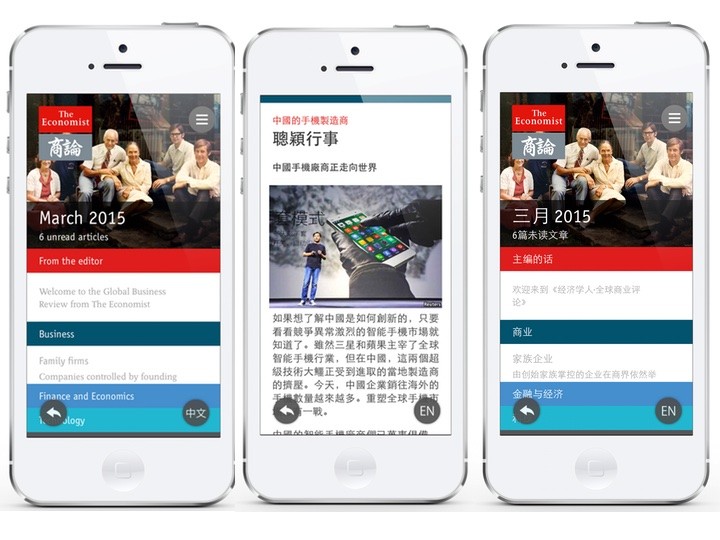
China is a market that many media outlets, both old and new, have eyed with enthusiasm. Reuters, The New York Times, and The Wall Street Journal each have standalone websites for Chinese readers. Even Vice, hippest of the hip news organizations, has a localized Chinese site. Yet while reaching Chinese readers is one thing, earning revenue from them is a separate challenge entirely.
The Economist is one of the few legacy media outlets that has endured the transition to digital quite nimbly, at least domestically. Its print circulation has increased 64 percent in the past ten years, standing now at 1.5 million, though last year saw a dip. But digital is the future, and The Economist is investing. Last autumn, the company launched Espresso, a daily news digest app. Today, it’s looking abroad with its first-ever non-English language product – an app called The Economist Global Business Review – and it is starting out with Chinese.
The Economist Global Business Review will provide readers with 10 articles upfront each month and one daily article. Thanks to a team of paid, professional translators, pieces are readable in both English and Chinese (traditional and simplified) at the flip of a button. Perhaps most strikingly, following a two-month trial period, the app will be subscription only – priced at US$8 a month or US$75 annually.
According to Tom Standage, deputy editor at The Economist, research revealed that beyond its sheer size, the Chinese-speaking market also showed strong demographic alignment for the publication.
“If we want to get people to pay for this product – which we do, because translation is expensive – then we have to focus on people and content who are likely to pay their way. That means we focus on business, finance, and technology,” says Standage. “In China, the people that want to read that sort of coverage tend to be younger and more globalized, but maybe they don’t have good enough English to read The Economist. So we thought there was potential there.”
Standage also points to pent-up demand as a reason for choosing Chinese – specifically, the spread of unofficial translations of The Economist articles across the Chinese internet. Both domestic and international firms regularly see their content get tossed around the web without proper attribution. While some might interpret this as a disincentive for The Economist to target the Chinese-speaking market, Standage takes a more evolved view of piracy.
“Not everyone who is reading unofficial articles from The Economist is going to become a paying subscriber. If they’re doing it at all though, that suggests interest,” says Standage.” We have the same problem in other markets, but we still manage to make money in those markets,” he adds.
Standage will emphasize how the new app marks a foray into the Chinese-speaking market, not China itself. But there’s no doubt that the the bulk of this market resides in mainland China, where foreign publications have at times been cut out by the Great Firewall. Standage acknowledges that China’s media climate isn’t always accommodating. But he says that it won’t influence editorial decisions in the app – especially since other languages will be rolled out in the future.
“We don’t want to get into the business of second guessing how we can change our content in order to maybe avoid those sorts of problems. So we’re going to publish our content and not try to play games in that regard, and we’ll just have to see what happens,” says Standage.
Standage sees subscription-based models as central to The Economist’s business strategy, both digitally and in print. In 2015, this doesn’t sound as bold as it might have ten years ago. In English-language digital media, companies like The Information and Ben Thompson’s Stratechery have experimented with going digital and niche, for a fee.
The Economist will likely fall alongside those two companies for its forays abroad. For one thing, a US$75 for a digital subscription is steep by almost any standard, but particularly in emerging markets. So its target audience will be whittled down to a group of people that can afford the the steep fee, and also find value in the content that justifies the cost. As a curated, analytical publication, it’s arguably at an advantage compared to news dailies like the Wall Street Journal. The main challenge, in Standage’s view, will be building the brand.
“In the past few years, there has been a sort of recognition and willingness to pay for digital content, whether it’s on the Kindle or Netflix or Spotify. My understanding is that we are at an earlier stage in many Asian markets.” says Standage.
“We don’t know to what extent any of these models will work in China, or in other Chinese-speaking markets,” he adds. “What you’re seeing is experimentation. Lots of media brands are going into mainland China and other Asian markets and trying to get their models to work. We are taking part in that experiment, and I don’t think that anybody has the right answer.”





Stay updated on the go with our mobile app.
Get latest insights with smoother, more personalized experience through TIA mobile app.