Apoorva Dutt · · 8 min read
Musk versus Bezos: How two billionaires battled it out for the space race
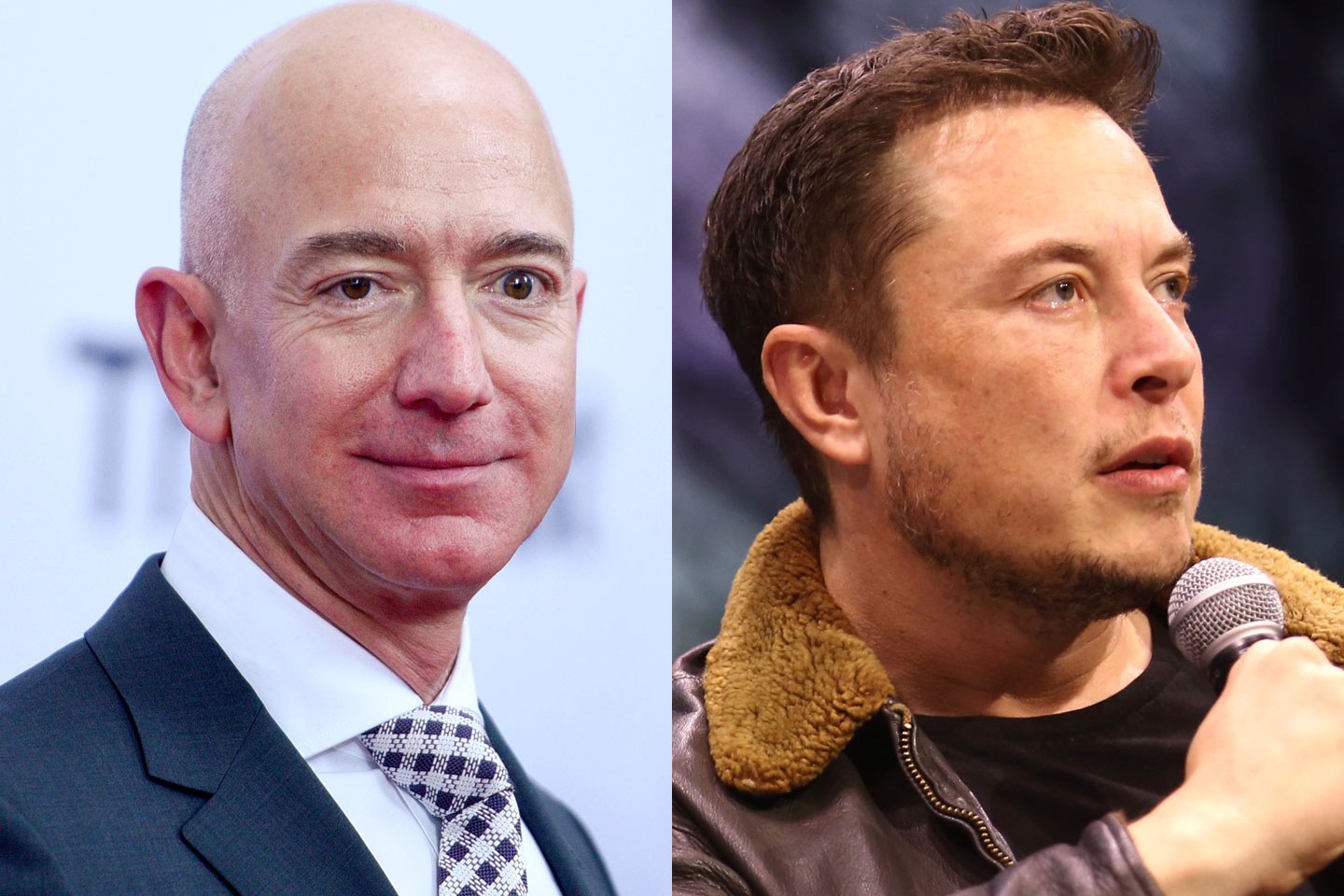
The following is an edited excerpt from The Space Barons: Elon Musk, Jeff Bezos, and the Quest to Colonize the Cosmos by Christian Davenport. The excerpt was provided by PublicAffairs Publishing. You can buy a copy of the book here.
For years, journalists had been banging at Blue Origin’s door, trying to get a glimpse into a mysterious company that operated like the Central Intelligence Agency. Now, on the morning of November 24, 2015, Blue Origin was reaching out to them, ringing their cell phones in the pre-dawn darkness. The groggy journalists were told to check their email for a press release that just went out, and that they’d be assigned a slot to speak with Bezos later that day. He had news to share. The day before, Blue Origin had launched a rocket deep in the West Texas desert that traveled past the threshold of space, hitting a top speed of Mach 3.72.
In his taunt two years earlier, Musk had said that the chances “of unicorns dancing in the flame duct” were greater than Blue Origin’s building a rocket capable of delivering a payload to orbit. But now, here was Bezos saying they were doing exactly that. It would launch in full view of SpaceX’s Pad 39A.
“The pad has stood silent for more than 10 years – too long,” Bezos said at the unveiling ceremony. “We can’t wait to fix that.” Now, with the landing of New Shepard, he had another victory to celebrate. And he took to Twitter – Musk’s preferred medium – to announce the endeavor to the public: “The rarest of beasts – a used rocket,” Bezos wrote in his first-ever tweet, even though he had joined Twitter in July 2008. “Controlled landing not easy but done right can look easy.”
To Musk, the level of celebration surpassed the height of the accomplishment. And now, after the fight over 39A, the patent dispute, the teaming up with the Lockheed-Boeing alliance, and the tensions of employee poaching, he was fuming. Bezos’s celebration was not only unseemly showboating, Musk thought, but factually inaccurate. Years before, SpaceX had repeatedly flown a test rocket called Grasshopper a few hundred feet into the air and then landed it, with one flight as high as nearly half a mile. So, technically, Musk had done it first.
“@JeffBezos Not quite ‘rarest’. SpaceX Grasshopper rocket did 6 suborbital flights 3 years ago & is still around,” Musk tweeted in response. He added, “Jeff maybe unaware SpaceX suborbital VTOL [vertical takeoff and landing] flight began 2013.” But the highest any of those test rockets had traveled was 1,000 meters (3,280 feet). New Shepard’s rocket hit an apogee of 329,000 feet and its capsule went even higher. No rocket had ever made it to space before and then landed vertically. That was a first – and a record for the history books.
What also bothered Musk was that the general public didn’t seem to understand the difference between what SpaceX was doing and what such companies as Blue Origin and Virgin Galactic were attempting. SpaceX’s rockets were launched into orbit; theirs went only to suborbital space and then came back down.
And now, on Twitter, he was again playing the role of Professor Musk, delivering a physics lesson: “It is, however, important to clear up the difference between ‘space’ and ‘orbit,’” he wrote. “Getting to space needs ~Mach 3, but GTO (geostationary transfer orbit) requires ~Mach 30. The energy needed is the square, i.e. 9 units for space and 900 for orbit.”
To get to orbit required a massive amount of energy so that the outward acceleration of the spacecraft balances out the force of gravity and essentially falls around Earth. Given the massive amount of velocity required to get an object into orbit – the space station flies at 17,500 mph and circles the globe every 90 minutes – it makes it that much more difficult to land an “orbital-class” rocket. As Musk once said, “You need to unwind that energy in a meteoric fireball, and if there’s one violation of integrity, you’re toast.”
Musk’s tweets caused a frenzy in the media, which wanted a response from Bezos to keep the rivalry going and to let these two billionaires in space duke it out. But Bezos kept quiet. The tortoise wasn’t going to respond to the hare – at least not yet.
Twenty-eight days after New Shepard’s landing, Musk jumped outside the launch control center onto a causeway at Cape Canaveral, and set his eyes on the launchpad about a mile away. This one he was going to watch live. There was just too much at stake. It was the first launch since the Falcon 9 blew up, and the first since his Twitter taunting. The company could survive one failure; two would be devastating.
It was a huge risk. Failure would broadcast a giant fireball that would surely be played, and replayed, by the media. It stood in stark contrast to the controlled way that Bezos had announced the landing of the New Shepard booster, which had happened the day before the company’s PR messengers woke up journalists to deliver news that by then was nearly 24 hours old – and now packaged in a scripted press release and a slick, produced video. The tortoise might have been deliberate and careful. But the hare was letting it hang out for everyone to see, writing the script live and in public, not knowing the outcome. The hare might have been brash and, at times, off-putting. But it had guts.
After the Falcon 9 made it safely to space, Musk stayed out on the causeway, waiting for it to reappear. About 10 minutes later, it did. At first, a distant glimmer, small like a streetlight illuminating the fog on a cloudy night. It lowered as if on a string, as SpaceX employees on the Cape gasped and broke into tears. Those gathered at the company’s headquarters in Hawthorne, California, just outside of Los Angeles, cheered wildly. “History in the making,” one of SpaceX’s commentators said on the livestream broadcast. Musk watched from the causeway, and could hear and feel what the others at the headquarters could not. An ugly, massive boom that thundered with the force of an explosion hit him like a punch in the chest. Musk assumed the worst. “Well, at least we got close,” he said to himself.





Stay updated on the go with our mobile app.
Get latest insights with smoother, more personalized experience through TIA mobile app.