C. Custer · · 8 min read
Disconnect: your predictions about technology in the future are probably wrong
Disconnect is a weekly column in which Tech in Asia’s Charlie Custer pokes at holes, plays devil’s advocate, or otherwise attempts to rain on the tech industry’s parade.
In 1994, psychologists Roger Buehler, Dale Griffin, and Michael Ross performed an experiment on their own students. They asked 37 psychology seniors to predict how long it would take to finish their senior theses in typical, best case, and worst case scenarios. The students, on average, predicted that if things went wonderfully, they’d finish in 27.4 days. 33.9 days was the most likely time-frame, students said. 48.6 days if everything went as badly as it could possibly go.
Of course, the students were almost all wrong. In actuality, it took the average student more than 55 days to finish his or her thesis. Their predictions, on the whole, had been wildly optimistic.
If you think you would do better than Buehler’s students, think again. We Homo sapiens, it turns out, are pretty terrible at making predictions about our own future. Scientists don’t agree on why – Beuhler, for example, chocks it up to wishful thinking, while Daniel Kahneman and Amos Tversky assert that it’s a failure to account for past experience and probabilities – but experiment after experiment shows that when we’re asked to make predictions about our future, we’re often wrong. We imagine the future is going to be better than it actually is.
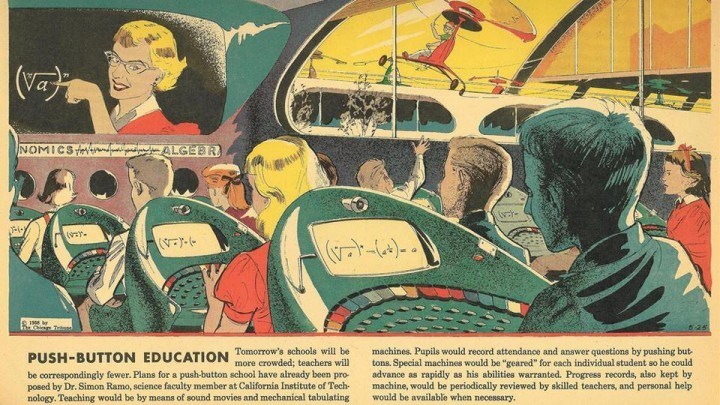
This newspaper page demonstrates one of our common failings when predicting the future. It accurately imagines a future where a large number of students can use computers to learn from one teacher, but assumes that education in the future will share the context of present-day education, and thus puts all of these e-learners into a traditional classroom.
Predicting the tech future
This effect seems to be especially pronounced when it comes to technology. Looking back at a century of predictions about technology and the future, some common themes emerge:
- We tend to assume that technological advances will bring social advances and improve life on a broad scale that often isn’t realized.
- We tend to assume that technological advances are coming sooner than they actually do.
- We have a strong bias towards interpreting the future based on past and present contexts that may no longer be relevant.
- The further into the future we predict, the less accurate our predictions become.
Take, for example, this US News article from the late 1960s, which asked scientists and other thinkers to imagine the world of 1980, 1990, and 2000. The scientists’ predictions for 1980 are mostly reasonable, but by 1990, things have gone off the rails. Scientists predicted “a permanent base on the moon” and “translating machines” that would eliminate global language barriers.
By 2000, the predictions have descended into utopianism. Scientists in 2000, they say, will have “virtually eliminated bacterial and viral diseases,” pushing the human life expectancy out beyond 100. Food will be plentiful enough that no one will go hungry. American astronauts will land on Mars. Megacities will stretch for hundreds of miles, and cars will be banned inside cities to prevent air pollution. Et cetera. The article is litany of predictions that, with the benefit of hindsight, seem absurdly optimistic or just downright absurd.
But perhaps the most important prediction in the article is this:
When incomes double… some of the population will prefer two 20-hour-week jobs, to keep busy and increase income. Others may prefer to work six months and play six. Still others may prefer to work very hard for 10 or 15 years so that they can retire at 40 and indulge in other activities for the rest of their lives.
Techno-utopianism versus reality
Do not be seduced





Stay updated on the go with our mobile app.
Get latest insights with smoother, more personalized experience through TIA mobile app.