 Samantha Cheh · · 6 min read
The tech revolution that’s helping buildings run more smoothly

The only time the average worker thinks about the building they’re working in is probably when they tap in and tap out of the office, but underlying their everyday routines is a labyrinth of entangled, complex systems that whirr along unseen.
From the air conditioning to the fire safety tools that protect inhabitants, these systems make modern work life possible.
“You spend more than 90% of your time inside a built environment, whether it’s residential or an office,” says Vekneswaran T. Arasappan, the head of property and facility solutions at Malaysia infrastructure management company UEM Edgenta.
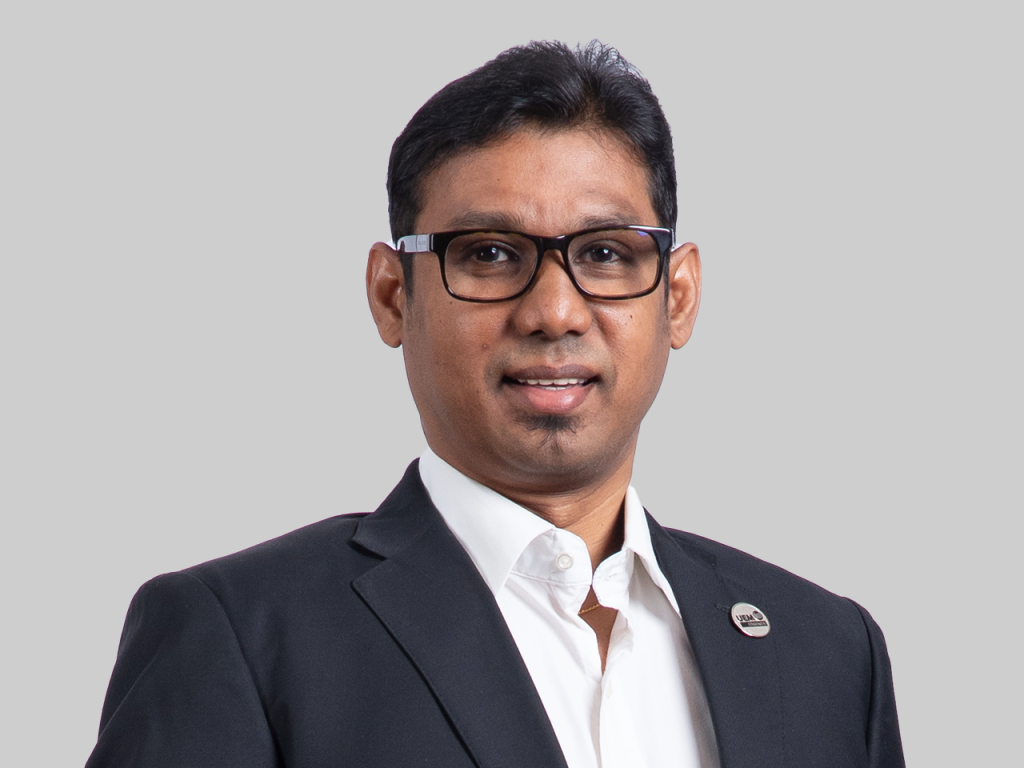
Vekneswaran T. Arasappan, head of property and facility solutions at Edgenta / Photo credit: Edgenta
Over the years, these systems have gotten more advanced. For instance, IoT solutions are increasingly becoming a staple for facility managers to gather data and optimize resources. Sustainability has also become a focal point, as buildings and construction account for nearly 40% of the world’s carbon footprint.
“New-age facility managers will have to think differently,” says Chua Yong Howe, Edgenta’s chief digital officer. “They have to evolve to not only know how to manage a green building but to go beyond the routine to figure out how to bring additional value for asset owners.”
It isn’t cheap
The core challenge for facility managers has remained the same over the years: cost.
“Everybody wants building maintenance to be cheap,” he says. “There’s a lack of awareness about what goes into managing a building, so most people just tend to use it until it breaks down.”

Chua Yong Howe, chief digital officer at Edgenta / Photo credit: Edgenta
These concerns have only grown in complexity amid the current macroeconomic climate, with labor and building material expenses on the rise.
“When costs go up, the first place asset owners look to spend less is in maintenance,” says Arasappan.
It seems like using data to make facility management more cost-efficient would be a good place to start.
Think about how inefficient routine maintenance schedules are: “Why pay someone to service the air conditioning units every month in a commercial building, when it’s only done once a year in residential buildings?” Arasappan adds.
Instead, facility managers can use IoT sensors to capture data about how different components in a building are performing, then run cloud-based solutions to determine normal functioning thresholds. If something goes out of range or shows indications that it might stop working soon, only then will a maintenance team be sent down.
Bringing in AI-powered solutions, such as those offered by Edgenta through its Asseto arm, adds another layer of efficiency. Asseto’s platform leverages IoT, AI and machine learning, as well as real-time dashboards, among other solutions, to help users analyze energy usage more effectively and optimize it.
This opens up opportunities for predictive maintenance, and ensures that repairs and replacements are made only when necessary.
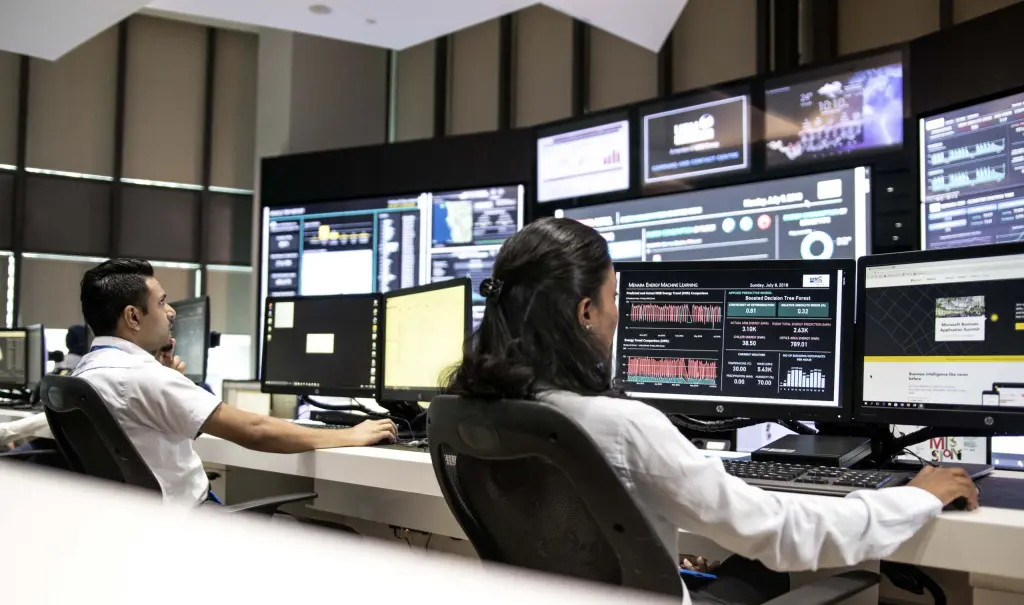
The brains of the entire building’s operations / Photo credit: Edgenta
Chua points out that so far, Asseto’s solutions have helped clients reduce operational costs by up to 30%.
All these solutions help make everything more sustainable, too, as managers only need to spend resources – such as buying replacement parts – as and when needed, rather than based on a fixed schedule. Additionally, understanding which parts of the facility require more or less resources is much more sustainable than doling out the same amount everywhere, regardless of whether it’s needed or not.
For example, one of Edgenta’s clients – a government office building it worked with in 2010 – has used the firm’s IoT sensors and efficient resource management to reduce water consumption by 60% and energy consumption by close to 50%.
“With the information integrated correctly, you can do benchmarking. When this data is overlaid with visualization, you’ll be able to tell how much you’re differing from the norm and what to do about it,” says Chua.
Regulation, where art thou?
Weak regulations are another challenge. In Malaysia, for example, there’s a large number of unqualified maintenance contractors, undercutting prices and intensifying competition, says Edgenta’s Arasappan. “They don’t necessarily even do a good job.”
To solve this, Chua says that facility managers need to use technology to add value and set a higher baseline standard. Once asset owners get a taste of this, then “no one [will] want to turn back.”
This can come in the form of significant energy and cost savings, helping asset owners not just lower spending but also meet new regulatory requirements, such as carbon emission limits.
“Energy is usually about 40% to 60% of the overall cost of running a building. For a hospital with 200 beds, that could come up to 10 million ringgit (US$2.3 million) a year. If I can use tech and data analysis to save them 500,000 ringgit (US$116,000), that’s a huge chunk for them,” Chua explains.
Getting asset owners on board
While technology has a lot of potential in the facility management space, the upfront costs means there’s still some ways to go before asset owners will fully get on board.
However, Chua says facility managers should start with simple fixes to demonstrate value before they pursue higher-level solutions.

Photo credit: Shutterstock
“Let’s say you spend 10 million ringgit (US$2.3 million) a year – what if I could cut your bill by 1 million to 2 million ringgit (US$230,000 to US$460,000) and we take that money and reinvest it in the building?” he posits. “I think the narrative would change quite aggressively because I’d be giving you guaranteed savings and, in the process, you get an upgrade.”
Edgenta is aiming to move beyond maintenance to work on refurbishing older buildings and integrating greener solutions.
“We can replace your lifts and chillers for more energy efficient units, maybe even install renewables like solar panels,” Arasappan explains. “By the end, you’re reducing your energy consumption by 30% to 40%, and the balance you can offset by sourcing from solar energy sources instead. We can actually put your buildings on a zero-carbon journey.”
The new-age facility manager
With the facilities industry primed for a tech revolution, new challenges are emerging on the horizon.
From Chua’s perspective, adopting a lot of new technologies can be a double-edged sword, as facility managers could face the issue of data overload. “With IoT sensors, you’re getting real-time data feeds, but how are you managing all that?” he says.
“As we move toward a more IoT-enabled world, you’ll need another layer of intelligence to digest this information.”
Both Chua and Arasappan agree that keeping up with these changes will require facility managers to keep learning and acquiring new skills.
“Buildings are becoming greener, and it’s our responsibility to enable them to perform as per their design,” says Arasappan. “Buildings are constructed for 100 years and we have to make sure that they can last longer than that.”
UEM Edgenta is an infrastructure company that is reshaping how we manage and maintain our cities. By leveraging cutting-edge IoT and cloud technologies, its solutions help facility managers gain granular insight into their buildings and customize residents’ experiences.
Find out more about UEM Edgenta on its website.
This content was produced by Tech in Asia Studios, which connects brands with Asia’s tech community. Learn more about partnering with Tech in Asia Studios.
Stay updated on the go with our mobile app.
Get latest insights with smoother, more personalized experience through TIA mobile app.
Recommended reads
 Tracking AI hiring in Singapore: OpenAI, Anthropic, and more
 SEA financials tracker: Moladin’s revenue rises 6% in 2025
 On‑demand services lift Line Man Wongnai’s 2025 revenue to $544m
 Flipkart’s costly late push into quick commerce and food delivery
 Inside Singapore’s government team that kills its own products
 Once an IPO hopeful, SCI Ecommerce nears collapse
 Who’s betting big on ChatGPT ads? Not Asian brands
 VC tracker: Granite Asia launches US$50 million fund
 GCash trims IPO ambitions to meet market realities
 Igloo CEO eyes global M&A: ‘We have an appetite to grow more’





Editing by Jonathan Chew, Winston Zhang, and Jaclyn Tiu
(And yes, we’re serious about ethics and transparency. More information here.)






📅 Upcoming Events
22 October 2026
Payoneer x CSPN Summit 2026