It’s bed time and and you’re all tucked in your cozy blanket. Your eyes begin to get heavy and the warmth of the bed is rocking you into deep sleep, but you suddenly jolt out of your sleep because the lights are still on. You wish to yourself: “If only there was a way I could switch it off from my comfortable bed!”
To make this wish come true, Deep Singh and Deepankar Garg started working on building a product that could connect all electrical appliances to one main system that can be accessed through a smartphone.
Singh and Garg studied at the Indian Institute of Technology, Guwahati and graduated in 2005 and 2007, respectively. After serving their personal stints in different corporations, Garg and Singh realized that Indian homes needed to be more technologically advanced to make things more easily manageable. For example, during summer in Bangalore, one would need the fan to be at its most powerful at night, but because of the unpredictable nature of the weather, they might want the fan on low speed in the early morning.
The older construction style of houses in India do not allow as much accessibility to light and fan switches as modern homes do. Many Indian homes also have water heaters that require a minimum of 15 minutes to heat up the water.
So they decided to build something that would ease access to the electrical appliances installed at home. The idea was to integrate technology with daily house management. For example, they wanted to make it possible to switch off the air conditioner, which one might have forgotten to turn off before leaving home, during the commute to work.
The startup began developing its product a year and a half ago. “The idea was to build an affordable home automation system that would blend into the existing electrical plan of the house,” Garg tells Tech in Asia
The startup went on to launch its product, Inoho in May of this year.
Internet of Things
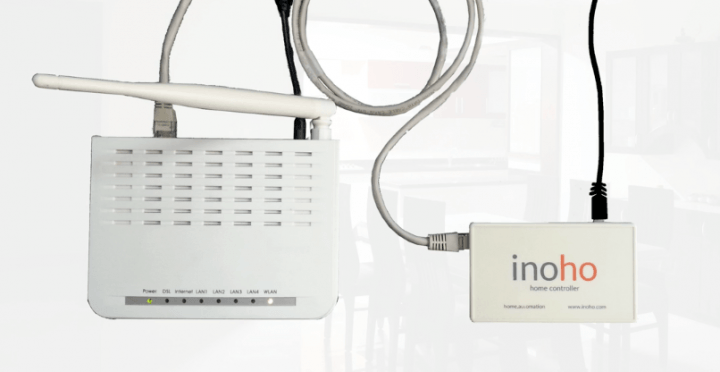
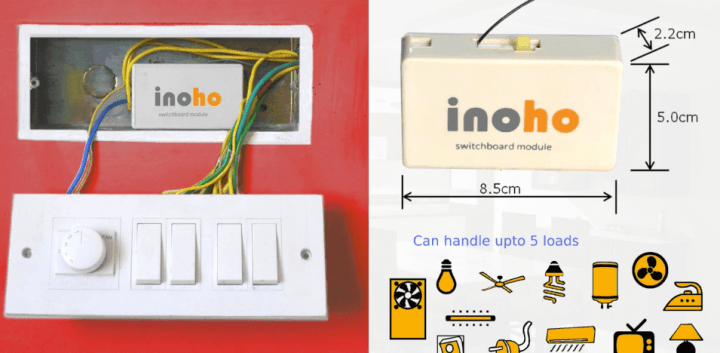
Inoho has three parts: a switchboard module, a home controller, and the app. The switchboard module is installed behind any light switch panel with four or more switches (which is common in India). Depending on the type, the module can control up to five switches. The home controller connects to the wifi router so that you can access the whole system remotely, and can also connect directly to a smartphone, laptop or tablet so you can control the system at home even without a wifi signal. The system of Inoho is modular and hence, users can install additional switchboard modules in more rooms to strengthen the signal. Each module acts as a repeater for the signal across all rooms in a house and can handle the addition of new rooms into the system without losing connectivity.
The app can be used to control all the devices even while away from home. It allows the user to set mood lighting and on or off timers for devices like water heaters or air conditioners as per their convenience.
Affordable home automation





Stay updated on the go with our mobile app.
Get latest insights with smoother, more personalized experience through TIA mobile app.