 Elliott Zaagman · · 6 min read
This youthful startup is trailblazing an innovative company culture in China
Looking around Makeblock’s Shenzhen office at their 460 employees, I wonder to myself, “Where are all the grown-ups?” The feeling of youthful energy is difficult to miss. With an average age of 27, its employees are not far removed from the children and teenagers that make up most of their users.
Makeblock is a DIY robotics construction and education platform for STEM students and educators, as well as anyone who just wants to have fun with their products—what CNN called “Lego for adults.”
I recently visited their 31st “Makerthon,” a regular company event where teams take two days off from their daily work to prepare creative applications for the company and present them to a panel of judges.
The company’s culture of fun, experimentation, and innovation has helped it become a popular startup in China. Here’s an overview:
- From 2015 to 2016, their revenue went from US$6 million to US$17.5 million.
- They’ve sold their products in over 140 countries.
- Earlier this year, they raised US$30 million in series B funding (total valuation of US$200 million).
Perhaps more meaningfully, they represent a generation of tech firms in China that are shedding the low-quality, copycat image of the past.
The spiritual leader of Makeblock is their founder and CEO, Jasen Wang. A soft-spoken 32-year-old from a small village in the Anhui province, his vision for the company involves a hands-on, collaborative, and creative attitude.
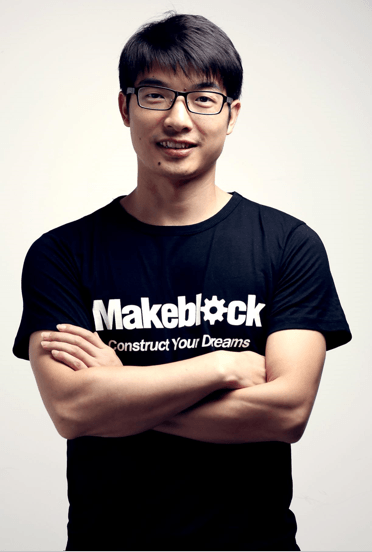
Makeblock CEO Jasen Wang.
How to best foster this kind of culture is clearly something that Wang spends a lot of time thinking about. In a meeting room next to his desk in the company’s open-office floor plan, the two of us discussed his approach and challenges. Here’s what I learned.
Invest time, energy, and money in incubating ideas
“I always want to create new things. I really hate copying,” says Wang. “That means we always need a lot of ideas.” This need for ideas is what inspired the company’s Makerthons in the first place, as it’s a way to encourage, evaluate, and organize ideas from the company’s staff. “We need to create an environment where our people can innovate and […] see their ideas used in our products.”
Creating this environment is not without cost. The company spends an average of US$7,500 on each Makerthon, not to mention the labor cost, as the events draw employees away from their daily work.
Despite what some might view as an inefficient practice, Wang thinks it produces far more long-term value due to the product improvements it produces and the cultural and morale-building effect the events have.
Look for and encourage intrinsic motivation in employees
According to Wang:
Filter out the takers
Growth as a cultural lubricant
Think of managers as service providers
Admitting imperfection and creating feedback channels
Final thoughts





Stay updated on the go with our mobile app.
Get latest insights with smoother, more personalized experience through TIA mobile app.










📅 Upcoming Events
22 October 2026
Payoneer x CSPN Summit 2026