- Insights This article was written by a TIA community member. Insights pieces undergo the same rigorous editorial process that newsroom-produced articles have.
 Eric Feng · · 8 min read
It’s harder to be an investor now vs 15 years ago. So why are there so many VCs?
I was recently catching up with a friend who had just celebrated her 15th year as a VC. We were sitting on a bench in San Francisco’s South Park and, in the course of our conversation, nine different tech investors we both knew happened to walk by at different intervals.
This was pure coincidence, but by no means a rare one—South Park has in recent years become home to more than a dozen investment firms.
“That’s what’s changed most in the past 15 years,” my friend said after the fifth investor walked by. “When I started out, I didn’t interact with all these other investors because there wasn’t anyone to interact with […] I wonder why there are so many more investors now?”
Let’s find out.
Planting seeds
There are 223 new funds raised each year on average. A whopping 60 percent of them are seed funds.
To understand as well as visualize the changes in the VC industry over the past 15 years, I’ve pulled together some metrics from Pitchbook.
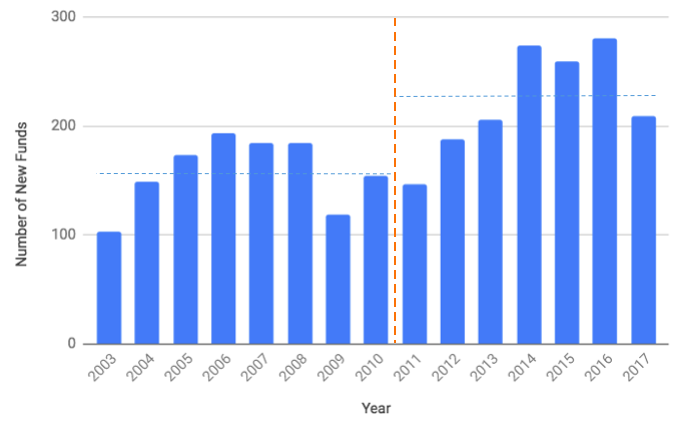
The first chart below is the number of new US-based VC funds each year since 2003. From 2003 to 2011, an average of 157 new funds were raised each year. But from 2012 onward, that average rose to 223—a 42 percent increase. More funds equals more active investors working at these funds.
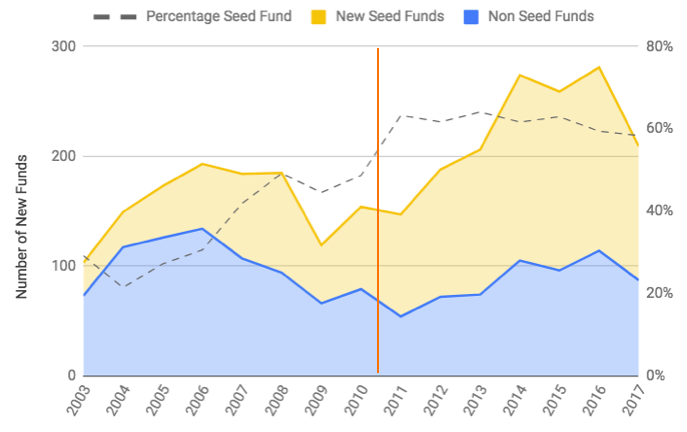
Looking closer at the types of funds being raised, I’ve taken the same data, but broke it down by seed vs non-seed funds.
The rate of non-seed funds raised each year has been relatively stable at about 90. But the rate of seed funds has jumped dramatically.
Between 2003 to 2010, an average of 58 seed funds were raised each year, but in the past seven years, that average spiked to 137 (or a 2.3x increase). Put another way, all the recent growth in the number of funds raised has been from seed funds, not venture or growth funds. And since 2011, a whopping 60 percent of all funds raised every year have been seed funds (compared to less than 30 percent a decade ago).
Because of this, there has also been a bigger increase in the number of active seed investors. So, if it feels like there are thousands of new investors in the industry, particularly seed investors, that’s because there are.
Wheeling and dealing
Exit stage right
Grand slams
Conclusion





Stay updated on the go with our mobile app.
Get latest insights with smoother, more personalized experience through TIA mobile app.









