Some time ago my friend (and co-investor in Clio, Jobber and Unbounce) Boris Wertz wrote a great blog post about “the only 2 ways to build a $100 million business”. I’d like to expand on the topic and suggest that there are five ways to build a $100 million Internet company. This doesn’t mean that I disagree with Boris’ article. I think our views are pretty similar, and for the most part “my” five ways are just a slightly different and more granular look at Boris’ two ways.
The way I look at it can be nicely illustrated in this way:
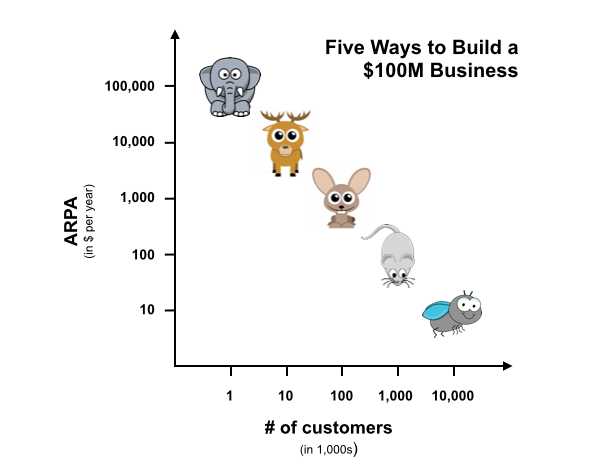
The y-axis shows the average revenue per account (ARPA) per year. In the x-axis you can see how many customers you need, for a given ARPA, to get to $100 million in annual revenues. Both axes use a logarithmic scale.
To build a Web company with $100 million in annual revenues*, you essentially need:
- 1,000 enterprise customers paying you $100k+ per year each; or
- 10,000 medium-sized companies paying you $10k+ per year each; or
- 100,000 small businesses paying you $1k+ per year each; or
- 1 million consumers or “prosumers” paying you $100+ per year each (or, in the case of eCommerce businesses, 1M customers generating $100+ in contribution margin** per year each);
- or 10 million active consumers who you monetize at $10+ per year each by selling ads
Salespeople sometimes refer to “elephants”, “deers” and “rabbits” when they talk about the first three categories of customers. To extend the metaphor to the 4th and 5th type of customer, let’s call them “mice” and “flies”. So how can you hunt 1,000 elephants, 10,000 deers, 100,000 rabbits, 1,000,000 mice or 10,000,000 flies? Let’s take a look at it in reverse order.
Hunting flies
In order to get to 10 million active users you need roughly 100 million people who download your app or use your website. This is of course a gross simplification, and the precise number depends on various factors like your conversion rate, how active your users are, churn, etc. But it doesn’t change the take-away: To get to $100 million in ad revenues, you need dozens of millions of users. I know of only two ways to achieve that (plus one mega-outlier which breaks all rules, Google). The first one is to have a product that is inherently social and has a high viral coefficient (Instagram, Snapchat, WhatsApp). The second one is a ton of UGC (user-generated content), which leads to large amounts of SEO traffic and some level of virality. Good examples of this second option include Yelp or our portfolio company Brainly.
Hunting mice
To acquire one million consumers or prosumers who pay you roughly $100 per year, you need to get at least 10-20 million people to try your application. This is – again – a gross simplification, but I believe it’s order-of-magnitude correct. To get to 10-20 million users you almost certainly need some level of virality, too – maybe not Snapchat-like virality, but some social sharing or “powered by”-virality. Great examples of this category include Evernote and MailChimp. If you’re an eCommerce business you might be able to acquire one million customers using paid marketing, but it requires huge amounts of funding.
Hunting rabbits
Most SaaS companies that target small businesses charge something around $50-100 per month, so their ARPA per year is around $1k. To acquire 100,000 of these businesses you need something in the order of 0.5-2 million trial signups, depending on your conversion rate. Let’s assume that your CLTV (customer lifetime value) is $2,700 (assuming an average customer lifetime of three years and a gross margin of 90%) and that you want your CLTV to be 4x your CACs (customer acquisition costs). In that case you can spend $675 to acquire a customer. If your signup-to-paying conversion rate is 10% that means you can spend $67.50 per signup (assuming a no-touch sales model where your CACs can go entirely into lead generation).
So how can you get one million signups for less than $70 each? Most SaaS products aren’t inherently viral, there usually isn’t enough inventory to make paid advertising work at scale, and cold calling usually doesn’t work at this ARPA level. There’s no silver bullet, but the closest thing to a silver bullet is inbound marketing – besides having a fantastic product with a very high NPS (net promoter score) and being obsessively focused on funnel optimization. I’ve written about this in more detail in my “DOs for SaaS startups” series: Create an awesome product, Make your website your best marketing person, Fill the funnel, Build a repeatable sales process. Another option is a an OEM strategy (i.e. getting your product distributed by big partners), which can work but comes with its own challenges.





Stay updated on the go with our mobile app.
Get latest insights with smoother, more personalized experience through TIA mobile app.