It was recently announced that Facebook are expanding their Place Tips (location information) functionality by giving out free beacons to retailers. Location is determined by Facebook using mobile cellular networks, Wi-Fi, GPS and Facebook Bluetooth® beacons.
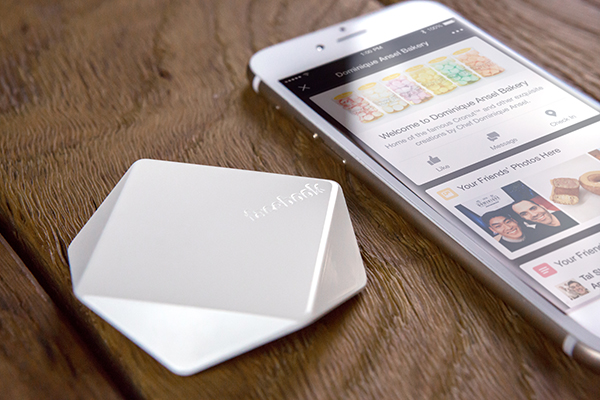
Originally tested in New York they are now expanding out beacon integration into their location identification tools across the rest of the USA. They are missing a massive opportunity to build a connecting layer empowering a US$200 billion retail revolution taking place across South East Asia.
Data from the UK research firm Euromonitor suggests that sales of food and daily commodities in South East Asia (SEA) was greater than US$275 Billion in 2014 with traditional small retailers taking almost 80% of that. These small retailers usually buy their own stock from an independent distributor or even from their closest retailer. Collectively that is an incredibly large sales channel that the big consumer packaged goods (CPG) companies have very little influence over or data from.
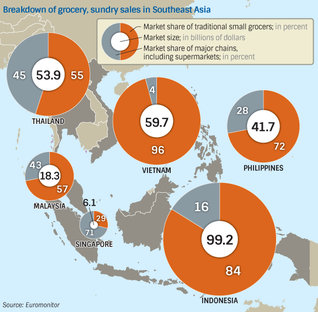
Source: Nikkei
In SEA there are significant signs that the CPG retail sector is going to leapfrog the supermarket/hypermarket phase that mature economies went through and go straight to e-commerce/convenience. This is why the big convenience store (CVS) brands in most SEA markets have been joined by Japanese and American chains with big expansion plans. In Indonesia when the Alfamart chain opens a new store it reaches out to the local traditional trade stores to help them with store management and purchasing power at no cost to the store owner. Increasingly local stores (independent and CVS) are becoming more sophisticated offering banking services such as remittance receipts as well as microfinance services.
In 2014 the research company Nielsen estimated that the SEA Middle Class (those with $16 to $100 disposable income per day) will have increased from 190 million to 400 million people by 2020. Across the region this burgeoning demographic is increasingly using local stores as a place to collect cash and a place to spend it.
So what? Why should Facebook care about local stores in South East Asia? These local stores are in many cases one of the main places that communities come together. Most convenience stores have seating areas and many have hot food. The traditional stores may also play the role of local bar/cafe. More convenience stores are also offering free wifi. So for communities that may struggle to get a stable mobile connection or where individuals have chosen not to pay for mobile credit these networks of local stores align very closely with Facebook’s mission of connecting the world. Also looking to their revenue, some of the biggest fan bases for pages run by Kraft, Nestle, Unilever are in this region.
According to data earlier this year reported by the social media agency We Are Social and the IAB, Facebook is still the most popular social network in the region, with the majority of users accessing on mobile. Those working in social media marketing in SEA will share that netizens are still surprisingly open to engaging with brands on social and for the most part are not as jaded or anti-ads as their over targeted American cousins. Brand managers though are constantly under pressure to ensure that any marketing activity can measurably drive to sales. There is still a confidence gap that social activities result is purchase.
So, we have an ecosystem: an increasingly sophisticated local retail trade; brands wanting to measurably monetize social marketing spend; a curious public looking to spend their new found affluence; and a social network that has the ability to prove presence in-store and provide one to one communications as well as app distribution through its Messenger platform. It should be possible for this ecosystem to work together to collectively fund the mass distribution of beacons and ensure as wide as possible Android operability. Acting now would avoid the inevitable fragmentation that is happening in more mature retail markets experimenting with location services.
The only ecosystem player who could initiate this and build a standard, is Facebook, but unfortunately they are spending their time building Place Tips in the USA on IOS. Bringing more location information to an audience that already has more location services than they can possibly use.





Stay updated on the go with our mobile app.
Get latest insights with smoother, more personalized experience through TIA mobile app.







📅 Upcoming Events
22 October 2026
Payoneer x CSPN Summit 2026