Shubhankar Bhattacharya · · 4 min read
Opinion: This trait can predict founders’ success when executing their visions
If you were to ask a hundred early-stage investors what the most important predictor of a startup’s success is, the vast majority of them are likely to pick either the team or the market size. An investor with a more nuanced view may come up with either timing or product-market fit.
However, there is one undeniable truth that every investor and entrepreneur will unambiguously acknowledge: Execution is everything.
By the same token, it is also acknowledged that, for all its importance, it is nearly impossible for an early-stage investor to accurately predict the likelihood of founders successfully executing on a grand vision.
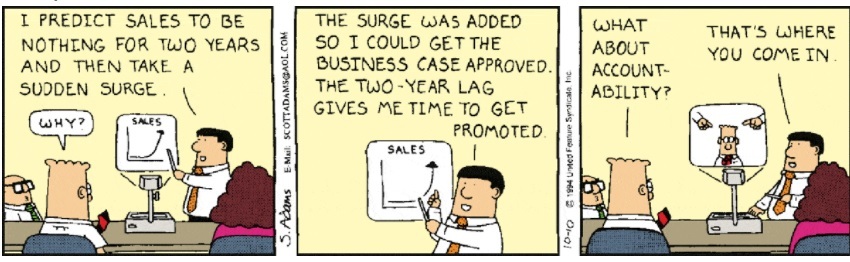
Photo credit: Dilbert.com.
But what if there was one personality trait that could be used as a handy proxy to serve exactly that purpose? What would that personality trait be? The answer is conscientiousness.
What does it mean to be conscientious?
Yes, I know what you are thinking. It’s rather convenient to use a long and unfamiliar word to make a point. So, let’s break conscientiousness down.
Here’s what conscientious (the adjective form of the word) means:
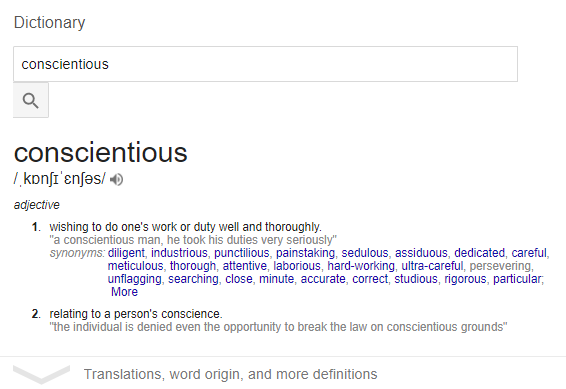
It would be fair to point out that defending conscientiousness as a virtue bears a circular logic. After all, conscientious people probably execute well simply because they are much more thorough about it. But to over simplify it to that extent would be to overlook a rather important nuance to this trait.
Back in the 1990s, Garry Kasparov, the then World Chess Champion, was someone many of us at school looked up to as a superlative demonstration of human intellect. Kasparov losing to IBM’s supercomputer Deep Blue in 1997 was a piece of news that was, therefore, met with the shock such an event deserved. We could use this as yet another example of the ongoing narrative on artificial intelligence that has gathered so much momentum of late.
However, the story on Kasparov and chess competitions doesn’t end there. In 2005, a freestyle chess tournament that included, amongst other classes of players, grandmasters and chess computers produced a revelation. As Kasparov himself narrated:
“The winners were a pair of amateur American chess players operating three ordinary PCs at the same time. Their skill of coaching their machines effectively counteracted the superior chess knowledge of their grandmaster opponents and the much greater computational power of others.”
How do you know if someone is conscientious?





Stay updated on the go with our mobile app.
Get latest insights with smoother, more personalized experience through TIA mobile app.