Raja Jamalamadaka · · 5 min read
Opinion: The downward spiral that led to Infosys CEO Vishal Sikka’s exit
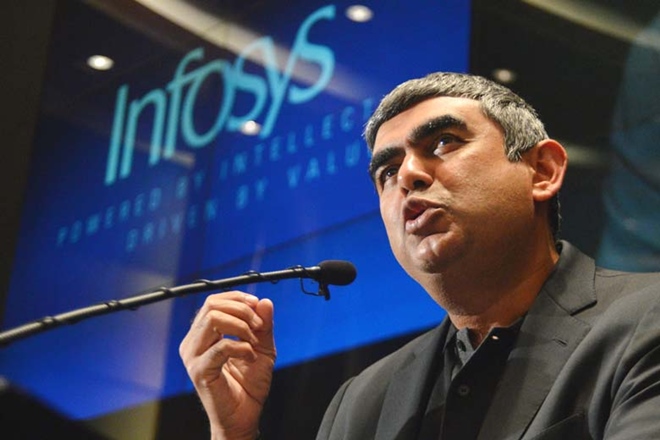
Photo credit: Financial Express.
If you were operating at or connected to the senior levels in the technology industry, the news of Infosys CEO Vishal Sikka’s exit from the company would neither be shocking nor unexpected. It was a question of when—not if—Sikka would be out of Infosys. So what went wrong?
The history
When Sikka took charge, Infosys was in the doldrums. Once an industry bellwether, Infosys stood still as industry peers like HCL and TCS grew quicker and delivered better returns. Its efforts at moving up the value chain through Infosys 3.0 came a cropper. Narayana Murthy’s (co-founder of Infosys) second stint as CEO under those tumultuous conditions was a largely forgettable one. The only positive event was Murthy’s efforts to bring in a new CEO.
The CEO search
The Infosys board envisaged what it needed in a new CEO: a successful technology executive with a global perspective and a proven track record. Sikka’s academic success and credentials at SAP looked impressive. Additionally, he seemed to have the depth of strategic skills and the right vision for an organization of Infosys’ size. He took charge as the first non-founder CEO in 2014. All good? Not quite. Two areas simmered in the background right from the beginning.
A values mismatch
The very first clue comes from Infosys’ tagline: “Powered by intellect, driven by values.” While Sikka’s Stanford PhD and SAP HANA success ensured his intellect stood out, his values unlikely ticked all boxes. He was a global executive that was schooled in liberal values. This made him diametrically opposite to the values of a traditional company like Infosys. Sikka’s formidable strategic skills and intelligence were an unlikely replacement for his mismatch of cultural values, especially for the top job at an organization that prided itself precisely on those very values.
Nature vs nurture
Sikka’s due diligence on the role of Infosys’ powerful and domineering founders presented an important potential fault line. There is a likelihood that Sikka mistook his experience in the West, where executive freedom is nearly guaranteed, as a benchmark for what to expect at Infosys. Little did he understand the true meaning of Murthy’s line: “Infosys is my middle child.” Sikka, like others, might have laughed it off as parting words from a genius and not as literal words from a very possessive personality.
In the battle of nature vs nurture, Infosys founders expected Sikka to get nurtured by existing company values whereas the latter expected his nature to turn the company around. That dichotomy, as time would tell, made all the difference.
However, a difference in such subtle yet vital areas rarely manifests themselves overnight; they build up over time before blowing up.
Enter Sikka
Sikka scored some early successes:
- He loosened the office dress code, promoted 500 employees, gave away iPhones, strengthened grassroot communications, and did everything to engage employees.
- He wooed the investor fraternity and the stock markets by presenting a grand and aggressive vision of a US$20 billion organization by 2020. For an organization known to underpromise and overdeliver, this was a cultural shock. This raised expectations drastically and, while that enthused the stock markets in the short run, the expectations as we now know made it difficult for Sikka to live up to them.
- Lastly, for a conservative organization known to harp on its brand but never pay top-of-the-line salaries, Sikka raised the salaries of his top reports to levels that were unheard of.
Seen from the perspective of Infosys’ founders, these initial “successes” were not successes at all; they were cultural failures, disturbing enough to lead to an uneasy relationship with Sikka but not alarming enough to cause a blast.
Meanwhile, Sikka brought an army of top employees from SAP to change the culture and help him transition Infosys from a lumbering elephant to a nimble cheetah. Unfortunately, he misjudged what it would take to bring about a cultural change. If the culture of a traditional 30-year-old organization with a hundred thousand employees could be changed with a handful of imported top managers, Peter Drucker’s (the founder of modern management) powerful line, “Culture eats strategy for breakfast every day” would not have stood the test of time.
The challenges
The exit





Stay updated on the go with our mobile app.
Get latest insights with smoother, more personalized experience through TIA mobile app.