In Google’s recent I/O 2016 developers event, it unveiled Allo, a new messaging app powered by Google’s cutting-edge AI technology. One of Allo’s highlighted features was Smart Reply.
Smart Reply originally appeared in 2015 in Inbox, an email app by Google. In Inbox, Smart Reply automatically suggests responses to emails by scanning and learning the contexts of email exchanges. Pretty neat, right? WIRED even called it “auto-magical”.
But back to Allo. In the messaging app, Smart Reply automatically creates suggested responses to not only text messages, but images as well. Using Google’s new computer vision technology (which first appeared in its Photos app), Allo is able to scan images, understand them, and suggest appropriate emotional responses.
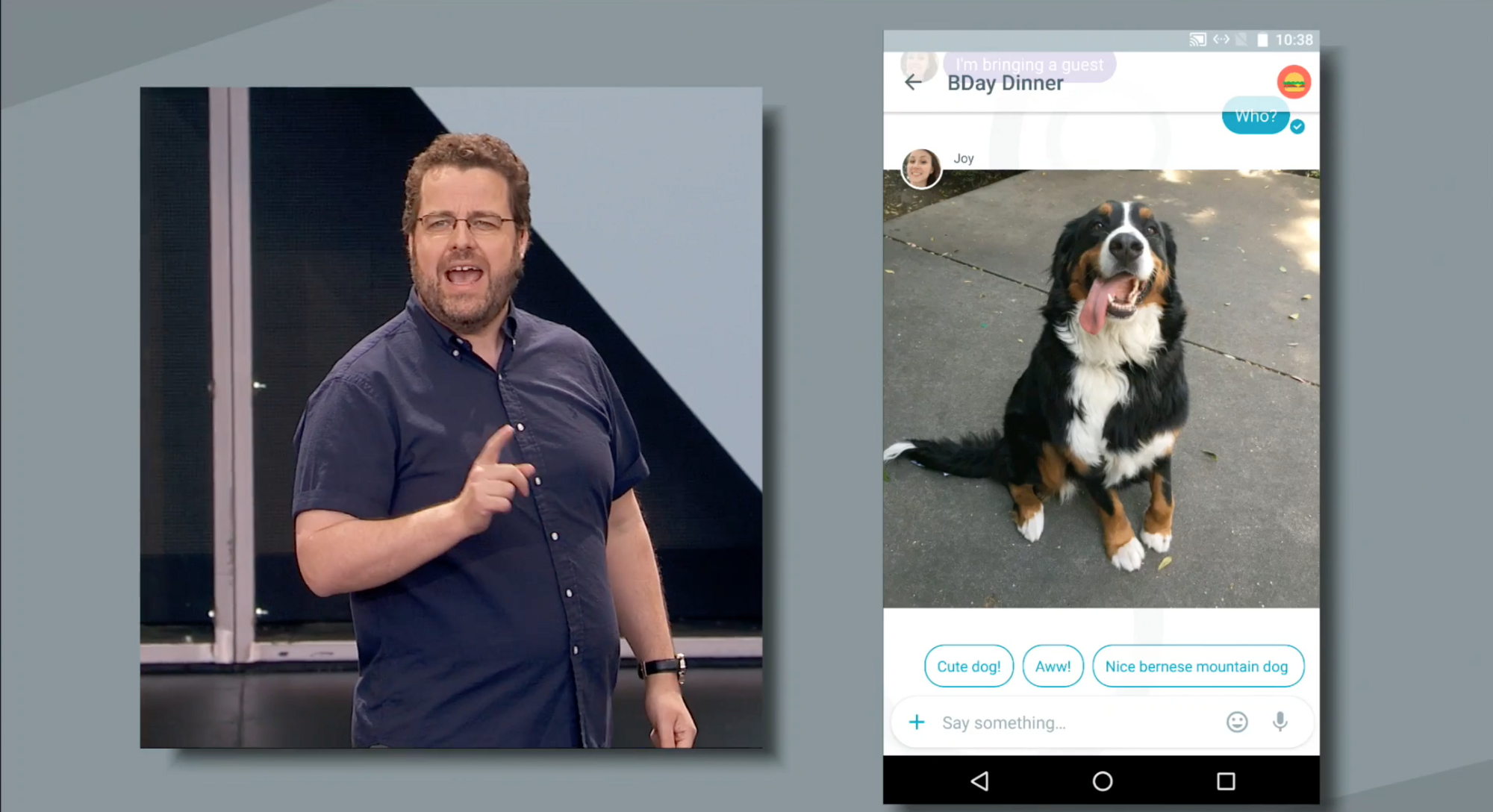
Erik Kay (Director of Engineering) demonstrating Allo’s suggested replies to an image of a dog.
To Google, this is going to be the future of chat. It’s the cutting, bleeding edge of applying the latest technologies to supercharge messaging.
But Allo is almost definitely going to fail. Besides of its very real privacy concerns and its need to fight with immensely successful competitors, Allo is also likely to fail in one aspect thanks to Smart Reply: social interactions.
The difference between emails and messaging
Smart Reply works great in Inbox. Three suggested responses to your email—who wouldn’t love that? And the key is this: to most of us, emails are a nuisance. It’s a means to an end. It’s the troublesome process of arranging a meeting at work. It’s the back-and-forth, the epitome of office red tape, the enemy-number-one of workplace productivity. Of course, there is much to be said about wonderfully crafted emails, but to most humans, emails are kinda meh.
But messaging? Messaging is about the messaging. It’s not a means, it’s the end. It’s a way for us to connect—via text, via audio, via photos and gifs and stickers and emojis and videos. It’s the “Morning ?”, and the “I miss you”, and the “OMG look at this cute puppy!”. And unless you’re constantly messaging your overly-clingy ex-Significant Other, messaging isn’t usually a nuisance.
Allo, are you really there?
That Google’s answer to messaging is to reduce (via Smart Replies) the amount of actual messaging is a little ironic.
The evolution of chat UX design has followed a trend towards highlighting the in-the-now presence of the person you’re chatting with. Sent messages come with a single tick, and read messages come with a double-tick. A person typing shows up as “…”. These interfaces let us know that the other party is here, has received your message and read it, and—oh—the person’s typing a response now.
Because messaging is personal. It’s best when it’s spontaneous, when it’s happening now. Smart Replies seem to take messaging in a totally opposite direction: it allows users to keep up a conversation without actually being there. The person you’re chatting with could be a total jerk and send you (automatically typed) meaningful one-liner replies, and you would be none the wiser.
Smart Replies have the potential to make that personal experience feel insulting. (And I’m not the only one who feels this way.) It’s like texting your Significant Other, only to realise that your partner’s assistant was the one replying all along. What could be worse than that? Oh, right—that a machine was the one replying all along.
Google doesn’t really understand people





Stay updated on the go with our mobile app.
Get latest insights with smoother, more personalized experience through TIA mobile app.