Nivas Ravichandran · · 4 min read
Opinion: Dear Slack, get over Microsoft. You have a bigger problem
Disclosure: The author has no affiliation with Microsoft, Slack, or Facebook.
On November 2, 2016, Microsoft officially launched Microsoft Teams, a chat-based workspace SaaS product that ties into its existing Office 365 subscriptions. During the launch, Microsoft CEO Satya Nadella explained, “Microsoft teams will bring together chat, meeting, notes, Office, Planner, PowerBI, and a host of extensions and applications to help teams get work done.”
Minutes before the launch, however, Slack published an open letter to Microsoft as a full back-page ad in The New York Times with the title “Dear Microsoft.” This was based on Apple’s full-page ad in the Wall Street Journal, welcoming its new competitor (IBM) to the personal computer market in 1981.
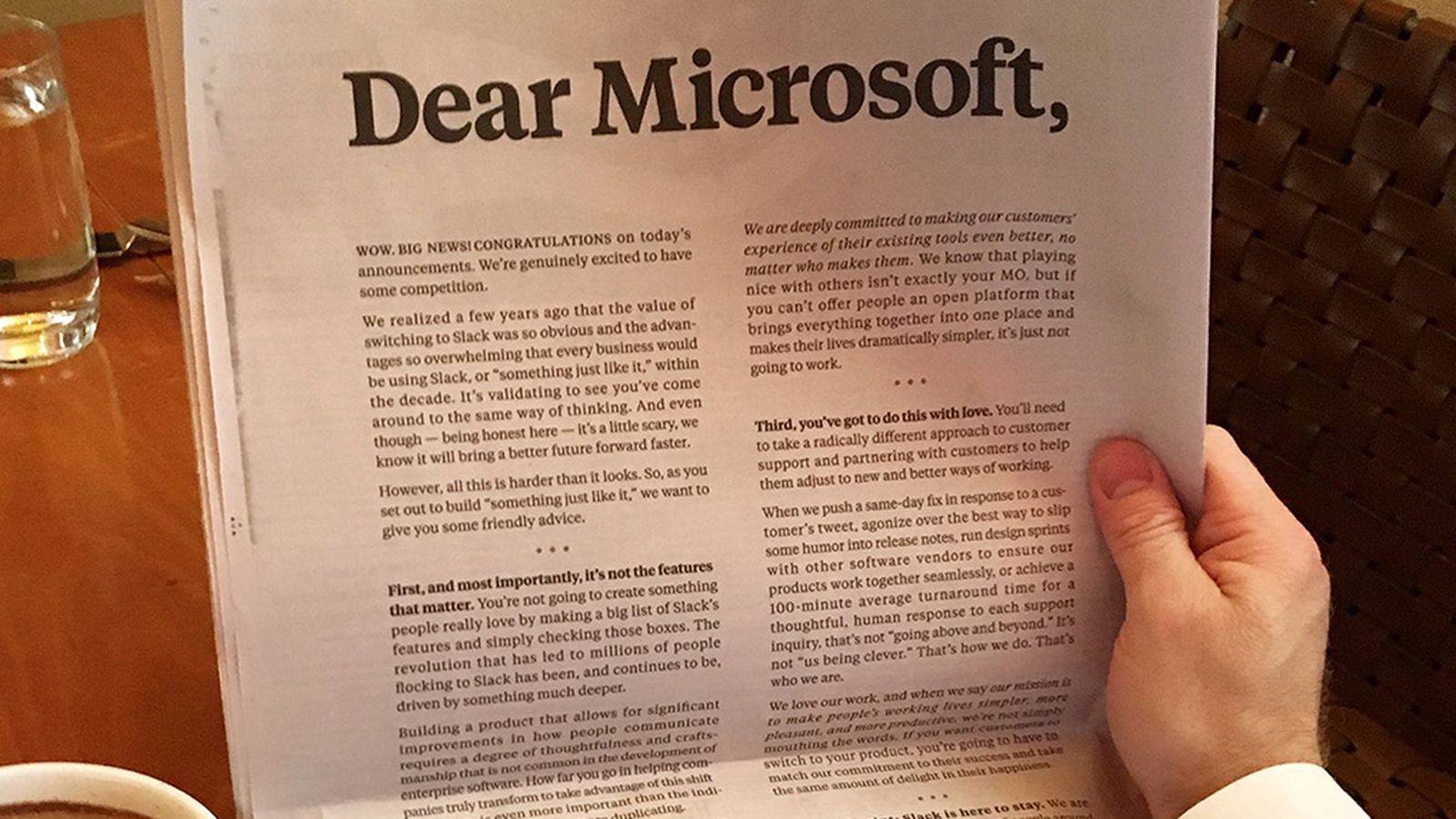
The open letter ad by Slack in The New York Times.
Though Slack’s open letter received a lot of attention in social media and PR circles, several technology media networks wrote about why this was a bad move. The Verge even published an article titled “Why Slack may live to regret its smarmy letter to Microsoft,” breaking down each point mentioned in the letter and how Microsoft could beat them.
But the problem for Slack is not Microsoft.
The office chat app has definitely had phenomenal growth—from 16,000 daily active users (DAU) in February 2014 to 4 million DAUs in October 2016. But between the first half and the second half of 2016, it’s DAU growth fell from 50 percent to 33 percent, and paid seat growth fell from 63 percent to 33 percent.
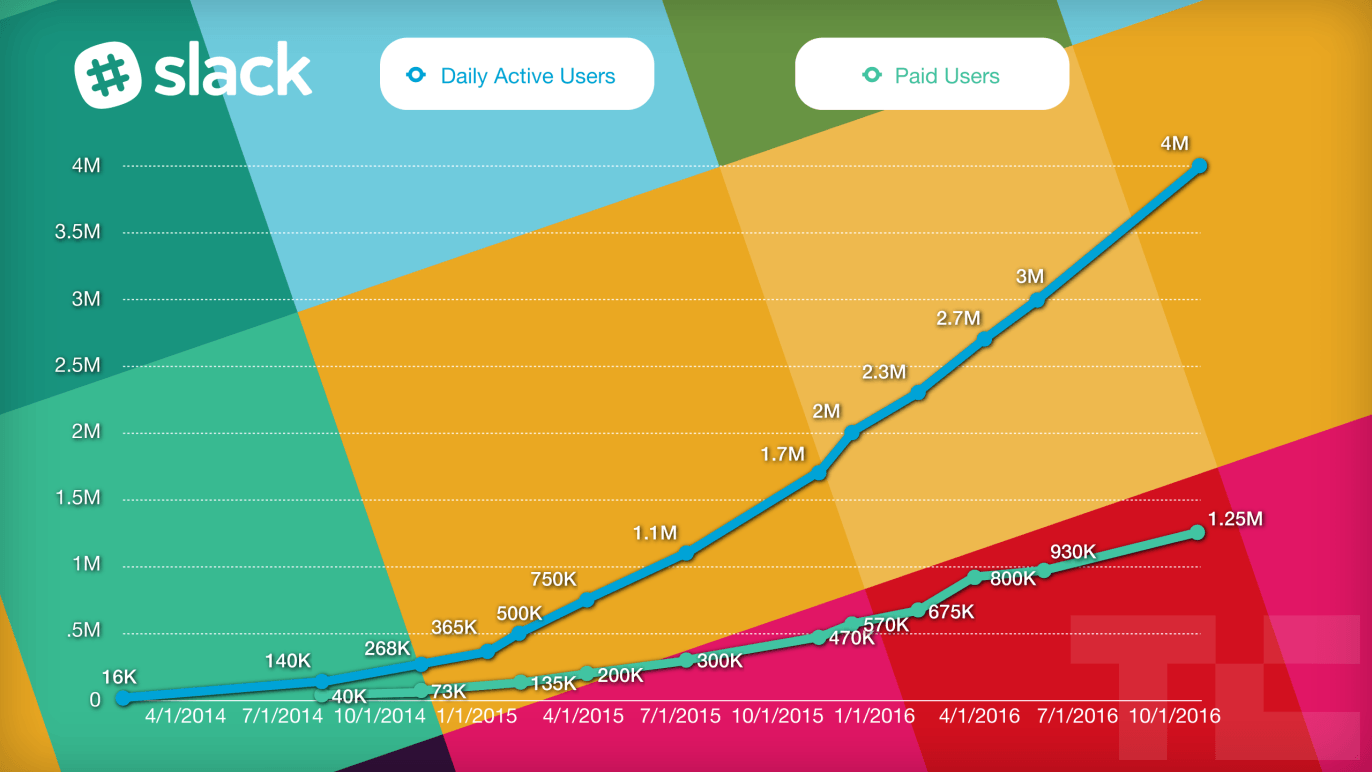
Photo credit: TechChrunch.
There have been questions about Slack’s ability to scale from a workplace chat app for small companies to a platform that large enterprises could use. In April 2016, Uber dropped Slack because the service was not able to handle its 12,000 employees trying to communicate simultaneously. Slack needs to identify a way to scale as a collaboration application for large enterprises and identify ways to retain or increase growth. But the company has a bigger problem on its path.
In October 2016, after two years of private beta testing, Facebook unveiled its Workplace software to the world. It’s essentially a platform that works like Facebook but for a network of co-workers. Instead of a monetization strategy through ads, it charges its enterprise customers a per-user subscription fee each month. The enterprise social networking and communications software was reported to have been used by 14,000 organizations in just six months after its launch.
One of the biggest challenges for Slack is exactly the biggest advantage for Workplace: the learning curve. The learning curve for Slack is big for new users, especially non-techies/busy people. With Facebook’s over 1.94 billion monthly active users (as of March 2017) and because the Workplace app is similar to it—news feed, groups, events, and messenger—the app is able to acquire users at a near-zero learning curve. No onboarding process means more people will be willing to adopt it.
Workplace even released a customer story about how Starbucks has over 80 percent of their store managers using the platform on a weekly basis. That’s more than 20,000 of Starbucks’ store managers on the app. This is a great example of faster adoption and the ability to handle communication at scale.
Though both platforms have a free version, Workplace has an advantage in the pricing of their premium version. Slack costs about US$6.67 per user for the standard paid version and US$12.50 for the Plus version. Workplace costs US$3 per month per user and down to US$1 a month per user for groups of over 10,000.





Stay updated on the go with our mobile app.
Get latest insights with smoother, more personalized experience through TIA mobile app.