- Insights This article was written by a TIA community member. Insights pieces undergo the same rigorous editorial process that newsroom-produced articles have.
 Stéphane Nasser · · 10 min read
Roadmap to a SaaS IPO: How to unicorn your way to $100m revenue
Update (April 2019): By popular demand, I added a link to the spreadsheet fully editable by all. Feel free to play around and geek out. I have another copy somewhere safe. 😛 Some graphics below have also been updated.
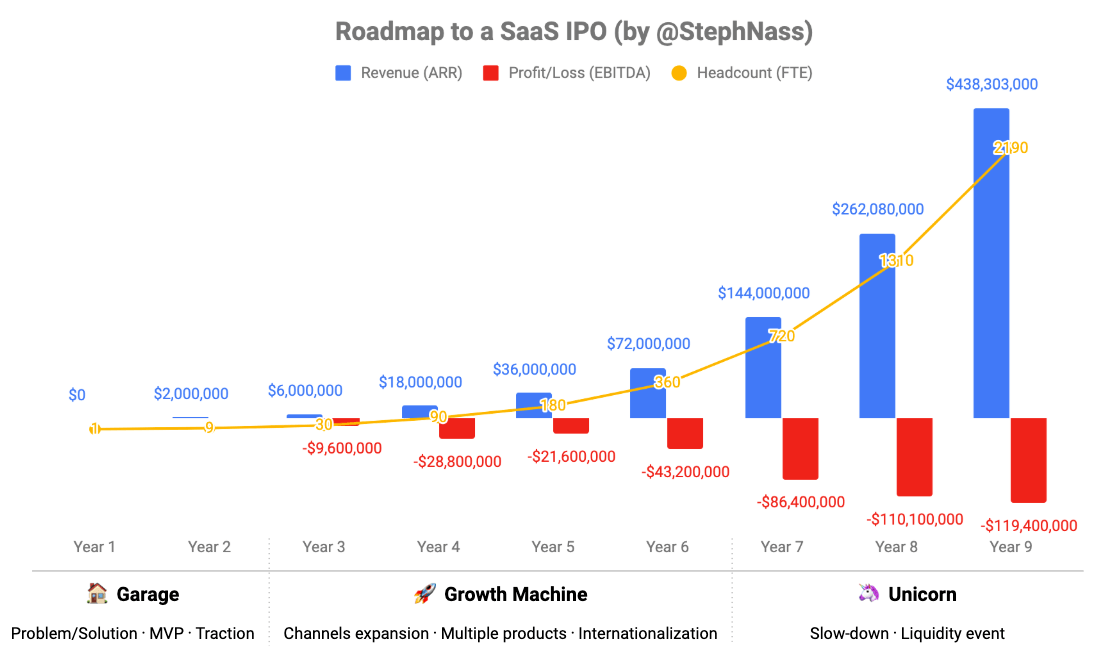
Nine years from garage to IPO
The world’s best entrepreneurs and investors have released highly valuable articles about SaaS startups. These readings contain a ton of numbers and metrics that are helpful to understand what a successful startup looks like at each step of the growth journey.
So, what happens if we put those numbers together in a spreadsheet? Can we paint the big picture of a SaaS startup from inception to IPO?
Here’s the result:
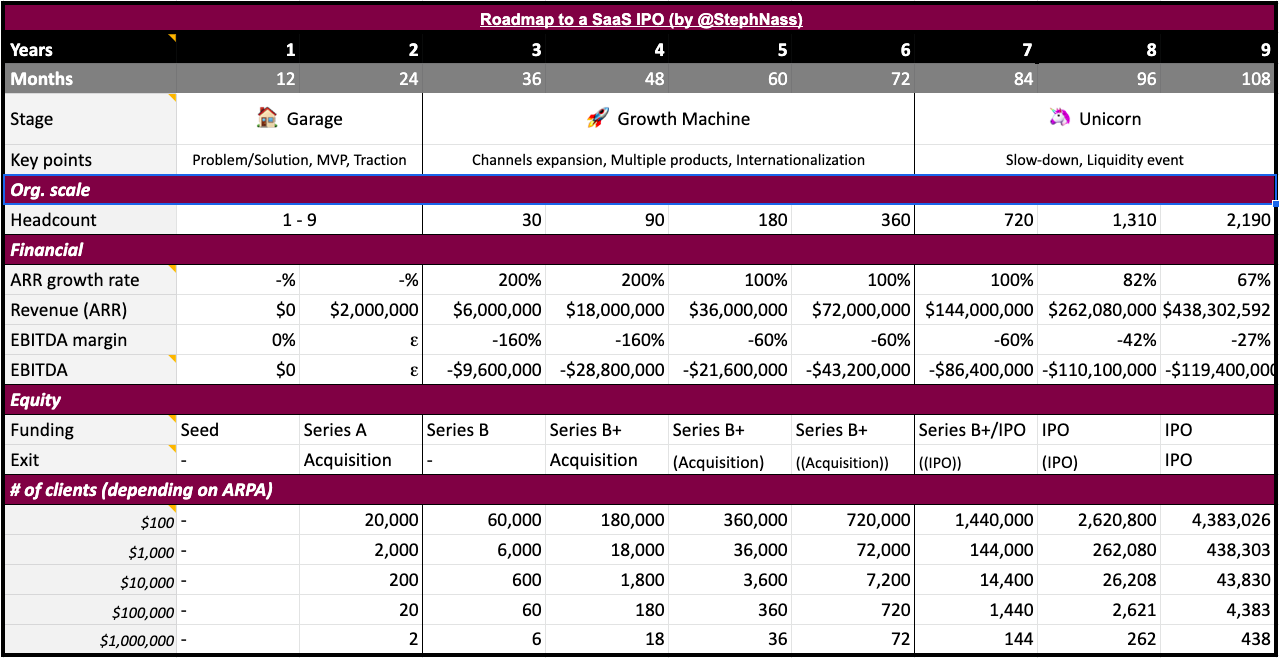
This article will walk you through the different steps that lead us to the chart above. Bear in mind that the numbers presented here are orders of magnitude rather than hard rules. They mostly apply to Silicon Valley-based and VC-backed SaaS startups. So, take them with a grain of salt. 🙂
1. Timeframe: six years to unicorn, nine years to IPO
Starting a startup is a long-term game.
Steve Blank, Morgan Brown, Brian Balfour, and Reid Hoffman have all described their own vision of the startup life cycle. Looking at it, we notice that a successful startup goes through three phases:
- Garage : Going from problem to product-market fit
- Growth machine : Expanding channels, product lines, and geographies
- Unicorn : Stabilizing and becoming liquid (IPO or acquisition) above a US$1 billion market value

In 2016, the TTU (time-to-unicorn) was stable at six years in the US. A unicorn, as originally defined by Aileen Lee of Cowboy Ventures, is a tech company (public or private) that reaches US$1 billion in valuation. More recent definitions exclude public companies from the scope for obscure reasons. Regardless, joining the blessing of unicorns remains a big deal, if not the mark of success for most founders.
2. Growth: triple twice, double thrice, then 82 percent growth persistence
3. Profit at scale = 40 percent – growth rate
4. Funding: seed, series A, series B
5. Exit: sell at US$1 million or US$10 million ARR or IPO at US$100 million ARR
6. Sales: US$100 million ARR = ARPA x number of customers
7. Headcount: US$200,000 ARR per employee





Stay updated on the go with our mobile app.
Get latest insights with smoother, more personalized experience through TIA mobile app.













📅 Upcoming Events
22 October 2026
Payoneer x CSPN Summit 2026