- Insights This article was written by a TIA community member. Insights pieces undergo the same rigorous editorial process that newsroom-produced articles have.
 Seyi Fabode · · 8 min read
I read 40 books last year. Here’s what I learned
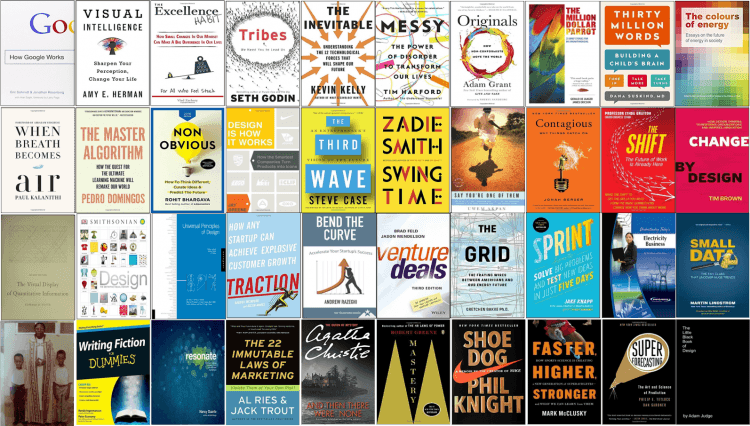
Photo credit: Seyi Fabode.
In 2016, I discovered a library near our new home. It’s amazing! I can enjoy reading books without having to buy them. Finding the library is also like traveling a lot around the world. On top of this, I also spent a lot of time assisting startups and VestedWorld’s world-changing portfolio.
It was a year filled with learning. I got to do three things that I love: improving company operations, reading, and writing (Linkedin has selected me as a Top Voice for Technology and I was able to publish a book, which I hope you buy on Amazon.).
Why did I read 40 books? I turned 40 this year and reading these books was my version of the so-called midlife crisis.
1. Forget data. Everything is tied to understanding consumers and their emotions–everything.
Marketing: While we all yearn for virality for our products or ideas, it most likely won’t happen. What we can all do is take a more structured approach to spreading our ideas.
This is what Jonah Berger offers in Contagious. He offers an approach to virality by triggering emotions of anger or goodwill. I applied this in a few of my blog posts this year (including How Elon Musk might be screwing this up which generated tens of thousands of views and vitriolic responses from Musketeers).
You can also trigger emotions by finding a bogeyman that rallies your audience, team, or customers. A bogeyman stirs up emotions that provoke action. For Phil Knight, it was Grelle, a classmate runner who always bested him and Adidas when he ran Nike. For Elon Musk, it is the incumbent utilities. For Edward Tufte, it was bad design. The bogeyman triggers emotions and drives you.
Also, read 22 Immutable Laws of Marketing by Al Ries and Jack Trout, and Traction by Weinberg and Mares as additional marketing knowledge to your arsenal.
2. You don’t know your customers until you know their stories.
Marketing: I read fiction books almost as much as I read non-fiction. The best fiction books do a great job in character mining. It’s how they get us to feel what the character feels and live the journey of the protagonists. My character mining fixes this year came from reading Say You’re One of Them by Uwem Akpan and Swing Time by Zadie Smith.
When you truly understand people, particularly your customers, you can empathize at a level where you can tell their stories and truly meet their needs. To learn how to tell stories, I also read Writing Fiction for Dummies by Randy Ingermanson and Peter Economy. I found the next layer of understanding, which was communicating with people, in the most unlikely of places: in the pages of 30 Million Words by Dana Suskind, which is all about building a child’s brain through conversation. It provides a structure for how we can ensure, even as adults, that we listen more than we speak by asking the right questions. We all need that.
I also reread And Then There Were None by Agatha Christie, one of the best well-written novels ever (and millions of people agree). Without giving away the plot, for fear of the ire of the few who haven’t read this, the business lesson here is that a well-laid-out plan based on a strategy that understands the very nature of people is plain murderous. I threw in Tribes by Seth Godin. What’s a year of reading about marketing without a Seth Godin book? I chose to go with an oldie but a goodie.
3. Design is still how it works. Whether you intentionally designed it or not, you’ve designed it.
Design: Edward Tufte is a legend in the world of visual information display, and the folk at Duarte, who created Slidedocs, are his esteemed students. Resonate by Nancy Duarte is, unsurprisingly, a well-laid-out book that provides a new way to think about slides and presentations. I’m not a designer (far from it) but between this book and Edward’s Visual Display of Quantitative Information, I created Utility Digest, a breath of fresh air in a staid industry. Looking at things differently and conveying the information in a different and simpler way make it more accessible to a wider audience–something that my industry, the utility industry, sorely needs.
I also read a few books on design including Design Is How It Works by Jay Greene, Design: The Definitive Visual History (which you actually browse), Change by Design by Tim Brown, and the Little Black Book of Design by Adam Judge as there is a convergence between design thinking and the utility industry that I need to get familiar with.
4. If you still choose to pay attention to data, focus on small data.
Trends: What Rohit Bhargava did in Non-Obvious 2016 I like to call future-casting; it’s like weather forecasting but for future business trends. In the 2016 edition of his recurring series of books, Rohit correctly predicts a few trends that came to define 2016. My favorites were small data and engineered addiction. The book speaks to always having an eye for where your industry is going so that you can discover the inherent business opportunities.
5. Death by a thousand cuts is a lot less painful, but not less deadly.
6. What technology wants is inevitable, and then it proceeds to standardize our experiences–for good and bad.
7. Mastery is not a destination. It’s a journey.
8. Doing the work will always be how you find out if it works.
9. Sometimes the mess wins. Embrace it.
10. Define the figure-ground relationship for you.





Stay updated on the go with our mobile app.
Get latest insights with smoother, more personalized experience through TIA mobile app.










📅 Upcoming Events
22 October 2026
Payoneer x CSPN Summit 2026